
Spot Gold Surges in Biggest Daily Rally Since 2008
Spot Gold is sharply higher on Tuesday, reversing yesterday’s steep sell-off and trimming its weekly loss. According to Reuters, bullion is in a position to post its biggest daily rise since November 2008 as buyers returned following Friday’s plunge.
At 15:15 GMT, XAUUSD is trading $4936.82, up $275.76 or +5.92%.
Essentially, investors who took profits on the rally to last week’s historic high are now returning at more attractive prices. They realize that the key bullish fundamentals remain intact — central bank buying, geopolitical risks and U.S. debt issues — and prices are now cheaper than they were a week ago.

Fed Policy Concerns Create Headwinds
The next leg up won’t be easy, however, with Fed policy concerns creating headwinds. As recently as last week, bullish traders were confident the Fed would cut rates at least twice in 2026. But after President Trump nominated a potentially hawkish Kevin Warsh for the Chairman of the Federal Reserve when the position opens up in May, the buying stalled and longs used it as an excuse to book profits.
Prior to the naming of Warsh, traders were on edge after a Producer Price Index (PPI) report came in hotter than expected. Since this will directly impact the next Consumer Price Index (CPI) report, traders felt this, along with the Warsh news, could mean the Fed won’t be cutting interest rates as aggressively. This blew up one of the bullish narratives — lower rates — that had been supporting gold throughout 2025.
Without a Support Base, Rally Attempts Will Likely Fail
Although gold traders may have found a value zone, without a support base, any price spikes are likely to fail. This suggests that investors didn’t learn anything from last week’s sell-off from overpriced levels. If this market is going to reach a new high later this year, it needs to have a good foundation, in my opinion. This means a sideways trade during February would be healthy. It also likely means we’re going to see traders selling rallies, which is something we haven’t seen in months.
Despite the major sell-off, the trend is up according to the swing chart. This assessment will remain valid as long as the December bottom at $4274.02 isn’t violated.
Gold Price Forecast
Every new Gold analysis as it publishes, today's technical signal and key levels, live price — on one page.
See all Gold forecastsThe break under the 50-day moving average at $4499.83 and the quick recovery show me that investors respect this indicator as both support and a trend indicator. Past performance shows it closely guided the market higher throughout 2025 until prices became overextended.
Key Retracement Zones Define the Next Move
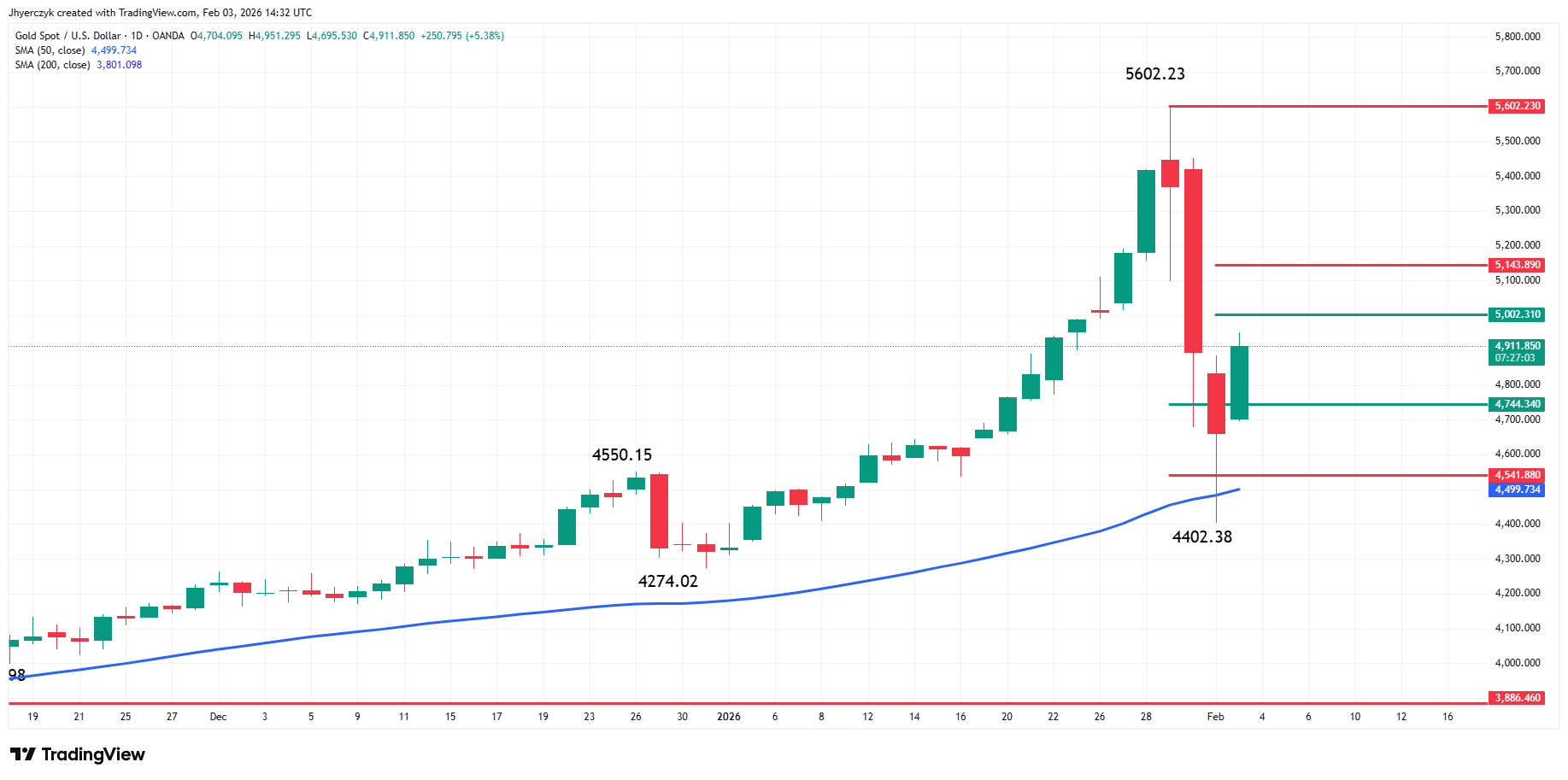
The intermediate term range is $3886.46 to $5602.23. Over the past three sessions, the market has shown respect for its retracement zone at $4744.34 to $4541.88 so we’re going to call it the value zone.
The short-term range is $5602.23 to $4402.38. Its retracement zone at $5002.31 to $5143.89 is the next upside target.
Looking ahead, I’m watching the price action and order flow on a test of $5002.31 to $5143.89. It will tell us if the buying is getting stronger and traders are gearing up for an upside breakout, or whether new sellers or shorts are coming in to stop the rally in an attempt to drive prices lower.
I wouldn’t be surprised if sellers show up at the retracement zone because a support base hasn’t been formed yet.
More Information in our Economic Calendar.