
Why NFP Is So Important
Firstly, the employment news is very timely. It’s released just a week after the month under review ends. Secondly, the report is rich in detail on the employment situation, which helps understand the present economic situation and forecast the future changes in macroeconomic variables. Thirdly, the report includes data on wages, which are the main source of income for most Americans and thus the main determinant of household spending. Because household spending accounts for more than 2/3 of the U.S. Gross Domestic Product (GDP), the investment community and the Federal Reserve (Fed) pay close attention to the employment report.
However, there is another, less obvious, reason the report has such a hold on financial markets and policymakers. The job numbers often contain surprises. Forecasting unemployment figures is notoriously difficult, as few indicators for the reference month are available at the time of release. Thus, it is not uncommon for the NFP expectations to be wide of the mark (poorly balanced), which, in turn, produces bullish or bearish surprises and triggers sharp moves in the markets.

Previous Report
The last report (published on 5 June) came out stronger than expected. It showed a solid rise in NFPs (+172k vs +85k expected), a stable unemployment rate (4.3%, in line with expectations) and a meaningful rise in average hourly earnings (+0.3%, as predicted). The NFP surprise immediately triggered a classical, ‘risk-off’ type of price action, with markets behaving exactly as one would expect in a tightening labour market.
- Yields on U.S. 10-year government bonds rose from 4.477% to 4.532% (+0.055 percentage points).
- U.S. Dollar Index (DXY) rose 0.64% and closed above the 100.00 mark.
- U.S. benchmark equity indices, S&P 500 and Nasdaq, plunged by 2.64% and 4.79%, respectively, as the volatility index (VIX) surged.
- Gold (XAUUSD) lost 3.10% and dropped below the critical 200-day moving average (for the first time in almost three years).
- Bitcoin (BTCUSD) continued to slide, shedding another 4.35% and dropping to an 18-month low.
What was the rationale behind precisely this type of move in the market? Here’s a quick schematic answer.
Strong jobs market➡️ Strong economy ➡️ Higher inflation risk ➡️ Hawkish Fed (tighter monetary policy/higher interest rate) ➡️ Yields and USD surge ➡️ Stocks, gold & crypto liquidation.
Chain Reaction Explained
The basic mechanism driving this entire price action is the Fed’s dual mandate (maximising employment while maintaining stable prices) and investors’ expectations of the future path of interest rates. ‘Good’ data, which point to a strong economy, make a Fed rate cut less likely, and by extension, make it more likely that the price of debt will rise further. In an environment where inflation is already above the Fed’s target, a tightening labour market effectively locks the Fed into a straitjacket of tight monetary policy.
Bitcoin Price Forecast
Every new Bitcoin analysis as it publishes, today's technical signal and key levels, live price — on one page.
See all Bitcoin forecastsA hot jobs report immediately signals to bond investors that the Fed will likely keep interest rates higher for longer or even raise them to cool the economy. As expectations for future interest rates rise, investors demand higher yields on long-term government bonds, causing bond prices to fall and yields to spike. Higher U.S. treasury yields attract foreign capital seeking safer, higher-paying returns. To buy these Treasuries, international investors must buy U.S. dollars, driving up the value of the DXY. Since stocks are sitting near all-time highs, their valuations are vulnerable. When risk-free assets like government bonds and savings accounts begin offering higher, guaranteed yields, the opportunity cost of holding risky stocks or non-yielding metals like gold and silver goes up. Therefore, investors choose to lock in profits in stocks, reduce their allocation to metals, and move money into safer yield-bearing assets.
Tech/growth stocks (heavily represented in the Nasdaq) are hit hardest because their high valuations rely on future earnings, which are heavily discounted when interest rates rise. As VIX surges, investors abandon speculative, ‘long-duration’ assets. Bitcoin thrives in environments of loose monetary policy and high liquidity. When the Fed is expected to tighten liquidity, capital immediately flees highly volatile crypto assets.
Upcoming Report
Because this Friday, 3 July 2026, is an observed federal holiday for Independence Day, the U.S. labour market report is released a day early, on Thursday. The market expects to see 110k new jobs, a 4.3% unemployment rate, and 3.5% year-on-year wage growth. Elev8 broker analysts expect NFP at 107k, which is below the market consensus. Thus, we expect to see a ‘bearish surprise’ for the U.S. Dollar. While any surprise is possible, the NFP print will not be a single indicator to watch. Unemployment rate and earnings are equally important.
If, indeed, the NFP report comes out weaker-than-expected, which is not unlikely given that NFP has already surprised to the upside for three consecutive months, we could see a market reaction diametrically opposed to last month’s. In other words, yields will drop, DXY will rise, stocks, gold and crypto will go higher. There are no guarantees here, but this is our baseline scenario.
Traders should not just blindly follow this forecast and open a long XAUUSD trade. After all, when it comes to trading (especially short-term trading), one should always study the underlying technical setup, carefully consider entry and exit points, and set stop-loss and take-profit orders.
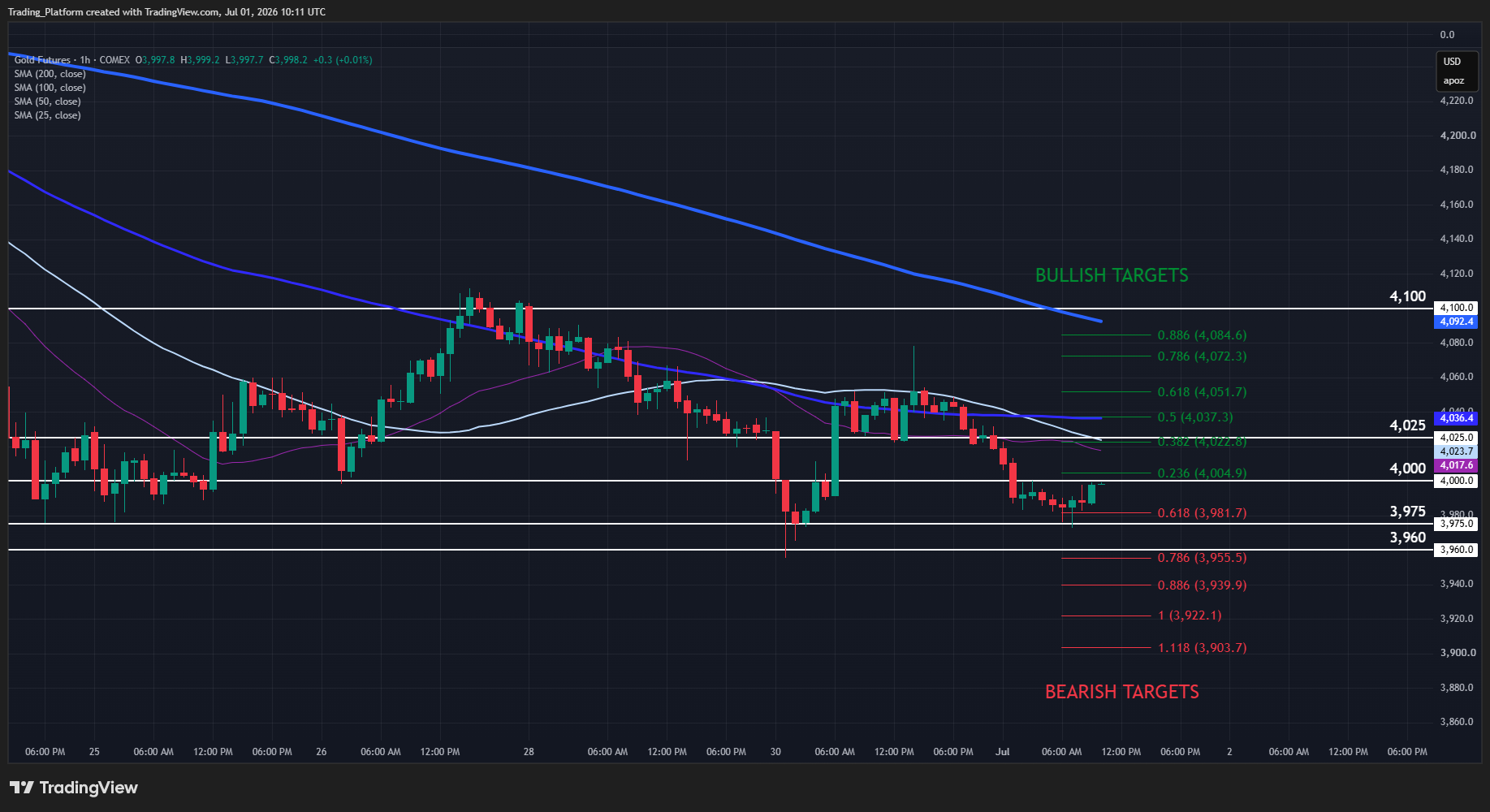
The macro trend in gold is decidedly bearish. Therefore, long positions should be avoided until a structural shift occurs. At the same time, the downside momentum has been weakening lately, so betting on a continuing decline is equally risky. Should the NFP report come out weaker than expected, a confident break above the 4,000-4,025 area would open the way towards the 4,072-4,085 zone. This is precisely where the 0.786 and 0.886 Fibonacci extension levels are located. Conversely, a stronger-than-expected NFP report will extend the underlying bearish trend. In this case, a confident drop below the 3,975-3,960 area would open the way towards 3,922 and 3,904, which are where the 1.0 and 1.118 Fibonacci extension levels lie.
Please note that this is not a trading recommendation. You should always perform your own due diligence. Given the fast-moving nature of markets, some targets or scenarios mentioned may have already triggered or shifted since publication.
XAU/USD 1-hour chart
Disclaimer: This article does not contain or constitute investment advice or recommendations and does not consider your investment objectives, financial situation, or needs. Any actions taken based on this content are at your sole discretion and risk—Elev8 does not accept any liability for any resulting losses or consequences.