
USD/JPY fell for the second week as key economic indicators and hawkish BoJ chatter fueled market bets on Fed rate cuts and a BoJ rate hike.
Bank of Japan Governor Kazuo Ueda signaled a rate hike, citing wage growth and easing US tariff risks. The BoJ Governor also fueled uncertainty about the number of rate hikes to reach monetary policy normalization, sending Japanese Government Bonds (JGBs) to their highest level since Q3 2007.
Rising bets on a BoJ rate hike coincided with softer US inflation figures, supporting a more dovish Fed rate path. The US Core PCE Price Index rose by 2.8% year-on-year in September, down from 2.9% in August. The prospect of BoJ rate hikes and Fed rate cuts set the stage for a USD/JPY drop below 150. A yen carry trade unwind would likely trigger a sharper fall toward 140.
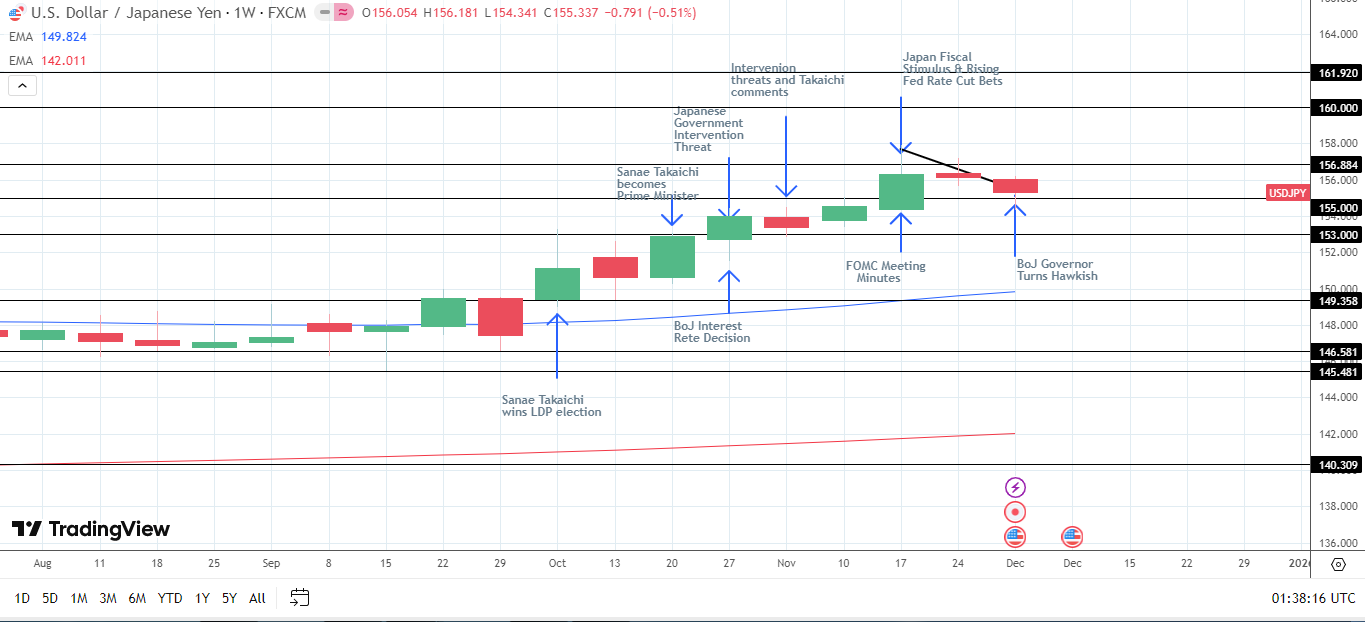
Below, we examine the upcoming economic calendar, the medium-term catalysts (4-8 weeks), and the technical levels traders should watch.

Critical Japanese Economic Indicators to Watch
In the week ahead, Japanese economic indicators and BoJ commentary will fuel speculation about a December rate hike. Key data includes finalized Q3 GDP, wage growth, and producer prices.
Finalized GDP Data and Wage Growth in Focus
On Monday, December 8, finalized GDP figures will face scrutiny after preliminary data showed a 0.4% quarter-on-quarter contraction in the third quarter. Softer private consumption and a drop in external demand affected the economy. Revisions to third-quarter components will be key as traders consider the December 19 BoJ interest rate decision.
USD/JPY Price Forecast
Every new USD/JPY analysis as it publishes, today's technical signal and key levels, live price — on one page.
See all USD/JPY forecastsUpward revisions to private consumption and external demand would boost yen demand, sending USD/JPY lower.
However, wage data will also require attention, given the BoJ’s focus on wage growth. Economists forecast average cash earnings to rise 2.2% year-on-year in October, up from 1.9% in September.
Stronger wage growth would suggest a pickup in consumer spending, fueling demand-driven inflation. Moreover, a rebound in spending would lift economic momentum, given that private consumption accounts for roughly 55% of Japan’s GDP.
Bank of Japan Governor Ueda Takes Center Stage
On Tuesday, Bank of Japan Governor Kazuo Ueda will be in the spotlight after last week’s hawkish spin. Further hints of a rate hike would strengthen the yen, pushing USD/JPY lower.
Since last week’s hawkish comments, Japanese economic data sent mixed signals. Services sector inflation edged higher in November, with consumer confidence improving, supporting a more hawkish BoJ policy stance. However, household spending unexpectedly plunged 3.5% month-on-month in October, weighing on the yen.
Despite the household spending slump, Governor Ueda will likely maintain his hawkish position. Wage negotiations for the 2026 cycle have reportedly been positive, and the weaker yen continues to raise concerns about import prices and household purchasing power.
Will Producer Prices Support a December Hike?
On Wednesday, December 10, producer prices will provide insights into the demand backdrop and inflation outlook. Economists forecast producer prices to rise 0.3% month-on-month in November, down from 0.4% in October, and an increase of 2.7% year-on-year (October: 2.7%).
A larger-than-expected rise in producer prices would indicate a pickup in consumer prices. Typically, producers adjust prices based on demand, passing cost savings or price hikes on to consumers.
These forecasts align with the bearish short- to medium-term outlook for USD/JPY.
Follow our real-time updates to stay ahead of USD/JPY market developments.
US Economic Calendar: The Fed Takes Center Stage
As speculation intensifies about a BoJ rate hike, the Fed will deliver its final interest rate decision of the year, setting the stage for a volatile week. Ahead of Wednesday’s decision, labor market data will draw interest, while inflation figures will influence bets on a Q1 2026 rate cut.
Key data releases for the week ahead include:
- ADP Employment Change Weekly (December 9).
- JOLTs Job Openings (December 9): Expected to fall from 7.227 million in September to 7.2 million in October.
- FOMC Interest Rate Decision, Economic Projections, and Press Conference (December 10): Economists expect a 25-basis-point cut.
- Initial Jobless Claims (December 11): Expected to increase from 191k week ending November 29 to 205k week ending December 6.
- Producer Prices (December 11): Economists expect producer prices to rise 0.4% month-on-month in November, up from 0.3% in October.
Weaker labor market data and softer producer prices would weaken demand for the US dollar, sending USD/JPY lower. However, the Fed’s interest rate decision, economic projections, and Fed Chair Powell’s press conference will be the key drivers for the US dollar and the USD/JPY pair.
Markets expect a 25-basis-point Fed rate cut on Wednesday, December 10, with the CME FedWatch Tool giving an 86.2% chance of a cut.
Barring a surprise hold, the market focus will be on the revised economic projections and the press conference. Upward revisions to GDP growth, a sticky inflation outlook, a modest drop in unemployment during 2026, and two further rate cuts would align with consensus.
Downward revisions to inflation and a sharper drop in unemployment, coupled with three to four cuts, would weigh on the US dollar and send USD/JPY lower.
Fed Chair Powell Departure and FOMC Committee Changes
Fed Chair Powell’s press conference is typically a market mover. However, markets are likely to discount his policy outlook, given his imminent departure. Notably, the composition of the FOMC Committee will also change for 2026, which may dampen the effect of the projections on the US dollar and USD/JPY trends.
In summary, the imminent replacement of Powell as Fed Chair and the change to the FOMC Committee will likely water down the effects of the projections and press conference on markets. Nevertheless, a two-to-three rate projection, predictions of softer inflation, and a weaker labor market outlook would weigh on the US dollar and USD/JPY.
Market View: Medium-Term Yen Strength
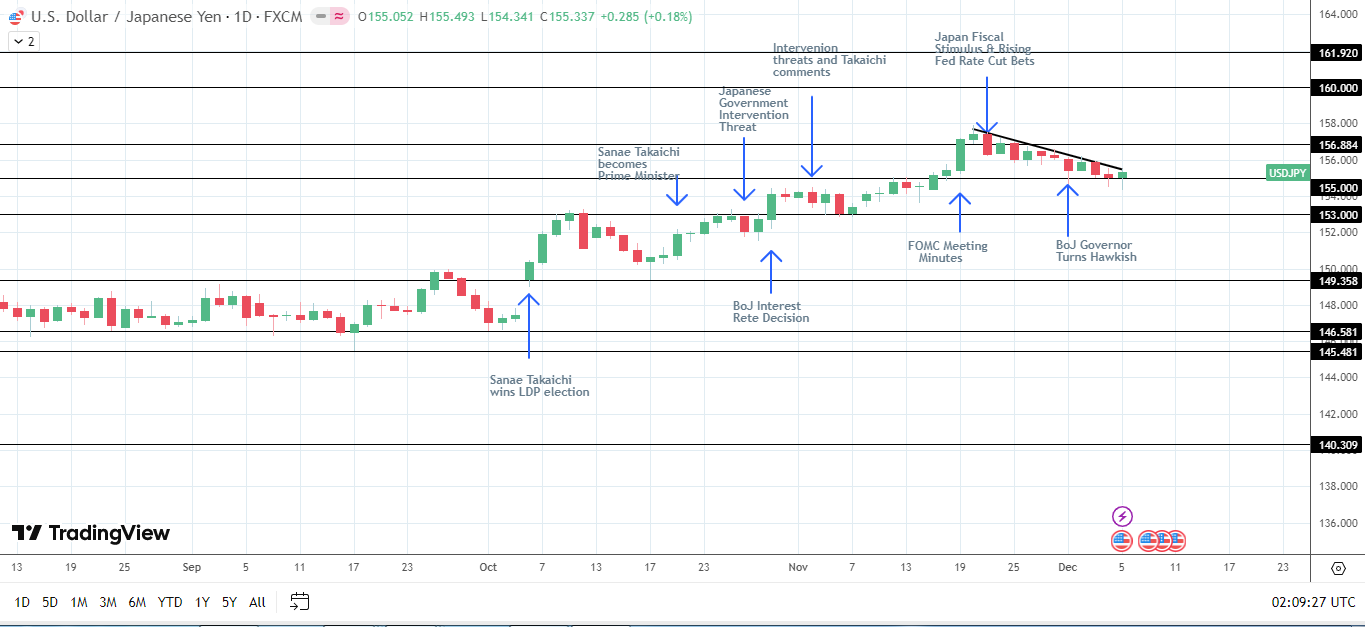
In my opinion, USD/JPY would likely drop to 150 on bets on a BoJ rate hike and a Fed rate cut. A dovish Fed policy outlook and hawkish BoJ would support the bearish medium-term outlook. A break below 150 would pave the way for a longer-term (8-16 weeks) fall to 140.
Counter-Trend Risks: What Could Push USD/JPY Toward 160?
Despite the bearish outlook, upside risks linger. These include:
- Strong US jobs data.
- The Fed stands pat on interest rates.
- FOMC Economic Projections: sticky or higher inflation, combined with expectations of a resilient labor market and stronger GDP growth.
- Weaker Japanese economic data.
- Dovish BoJ rhetoric.
However, yen intervention threats should cap upside around 160. Given the upside risks, a rise above the 157.893 November 20 high would invalidate the medium-term bearish structure. For context, yen intervention threats and the risk of the Japanese government intervening capped USD/JPY at 157.893 in November.
Financial Analysis
Technical Outlook: Bearish Momentum Building
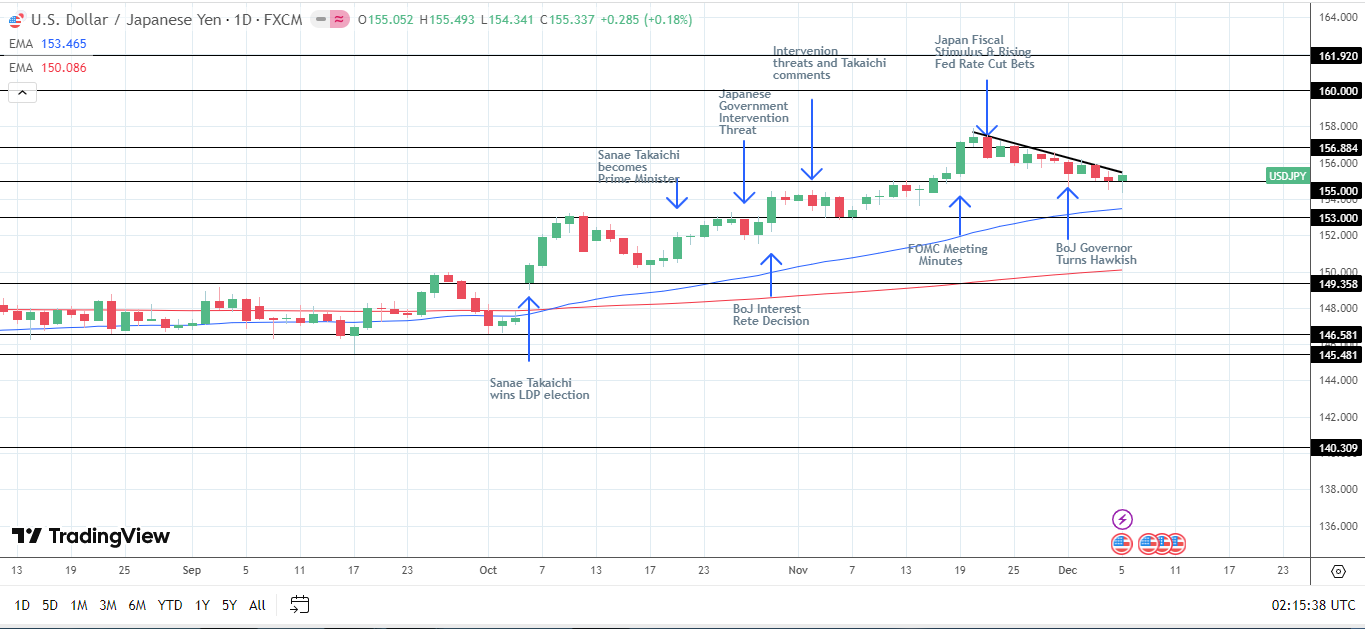
On the daily chart, USD/JPY remained above the 50- and 200-day Exponential Moving Averages (EMAs), signaling a bullish bias. However, fundamentals are beginning to diverge sharply from the technical trend.
A drop below last week’s low of 154.507 would bring the 50-day EMA and the 153 support level into play. If breached, 150 and the 200-day EMA would be the next support levels. Crucially, a break below the 50-day EMA would indicate a near-term bearish trend reversal, supporting the bearish short- to medium-term outlook.
Key Takeaways
The USD/JPY pair has risen 5.10% in the fourth quarter, taking H1 2025 gains to 7.89%. Key Japanese data, hawkish BoJ rhetoric, and a narrowing rate differential would support a bearish short- to medium-term outlook. Key levels will include 154, 150, and 140 on the downside, and 160 on the upside.
Consult our economic calendar for historical and upcoming data.