Oil Takes the Stock Market Back
Crude near $90 is running the show Wednesday afternoon and the rotation trade that was holding the Dow together is getting hit from both sides. President Trump said the United States will hit Iran hard after the missile attack on American forces, and WTI jumped 6.9% to $89.88 while Brent gained 6.6% to $89.61. The market went from pricing diplomacy Tuesday to pricing a wider conflict less than 24 hours later, and the indexes are paying for it.
The Dow Jones Industrial Average is down 761 points, or 1.4%. The S&P 500 is off 0.7% and the Nasdaq Composite is losing 0.9%.
This is not just the chip trade dragging the market lower. Higher oil is hitting the broader market through the inflation and rate channel, and the Fed announces its decision before the close with Chair Kevin Warsh facing the press right after.

Daily S&P 500 Index (SPX) Technical Analysis
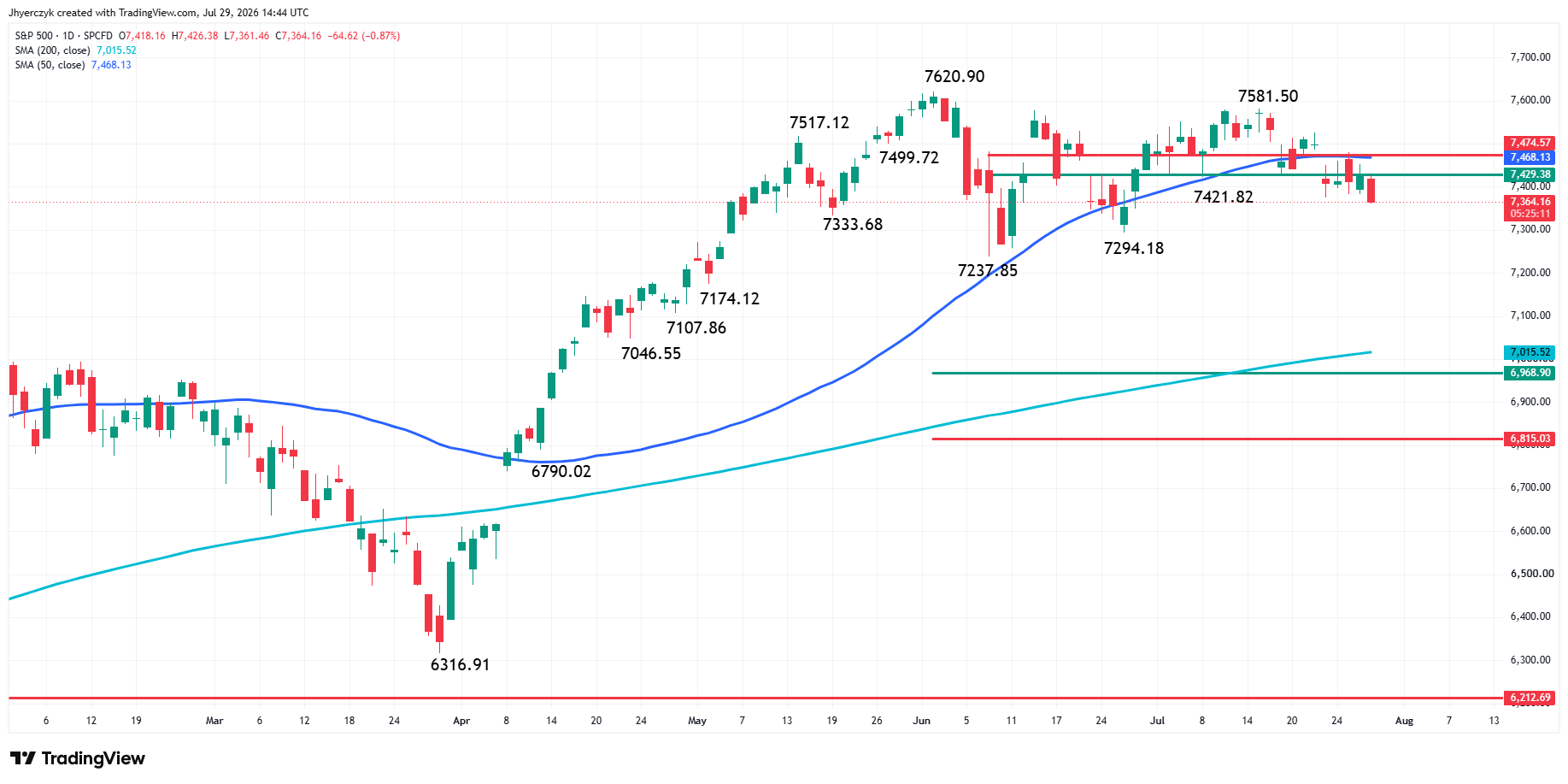
The S&P 500 Index is lower after the first hour of trading on Wednesday. Strong resistance has formed at the short-term retracement zone at 7429.38 to 7474.57. Inside this range is the 50-day moving average at 7468.35. This is both resistance and the trend indicator.
The current chart formation suggests the index may be getting ready to roll over to the downside. Now that it has finally begun to pull away from resistance, it may start to gravitate toward the nearest swing bottom at 7294.18. If this fails, the selling could extend into 7237.85. This is a potential trigger point for an acceleration to the downside.
My work indicates that any hard selling pressure could lead to a test of the 200-day moving average at 7015.51 and the long-term retracement zone at 6968.90 to 6815.00.
Dow Jones Price Forecast
Every new Dow Jones analysis as it publishes, today's technical signal and key levels, live price — on one page.
See all Dow Jones forecastsDaily Nasdaq Composite (IXIC) Technical Analysis
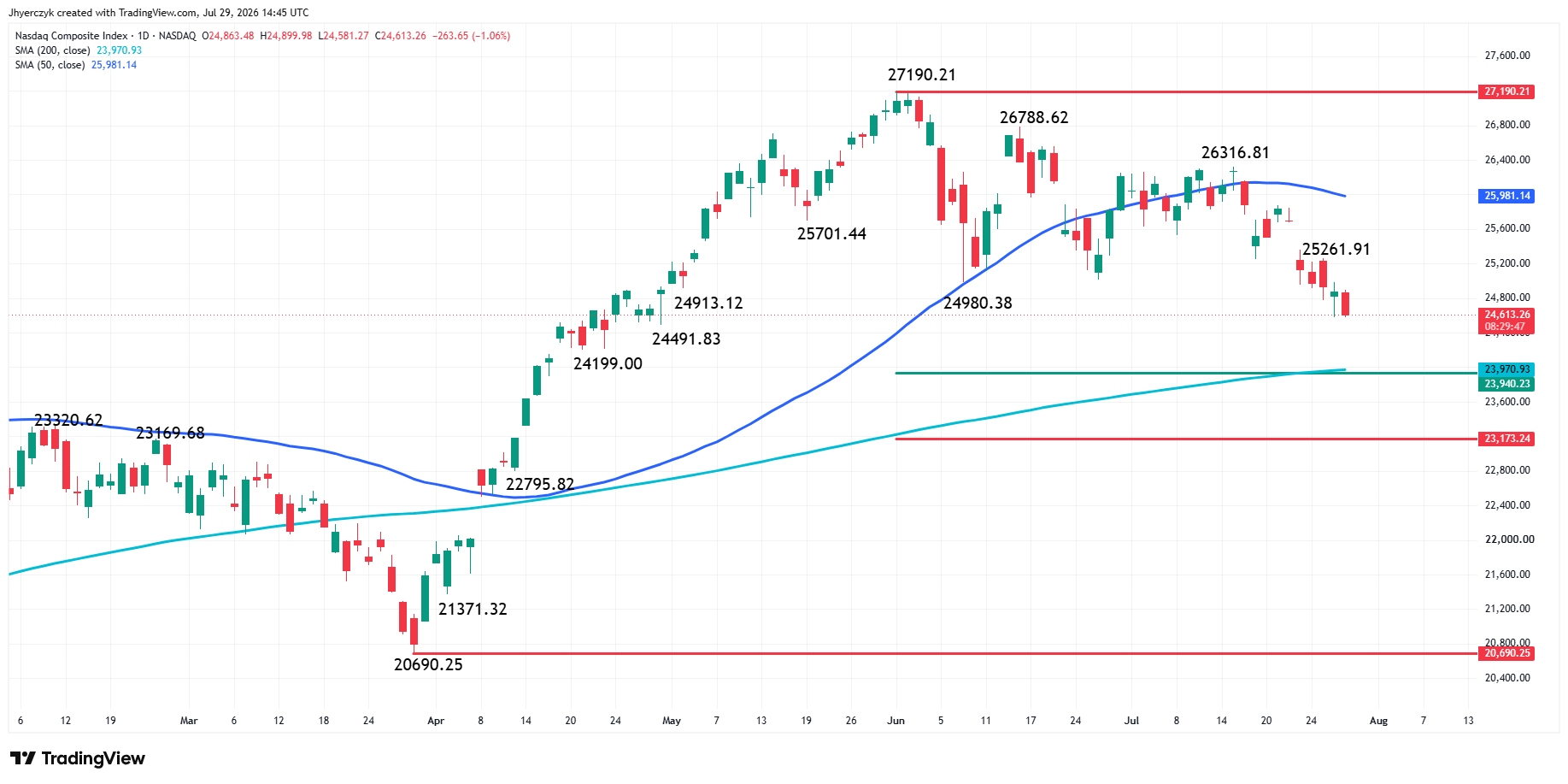
The Nasdaq Composite is sharply lower with the index threatening to take out yesterday’s low at 24581.01. This would be five straight days of lower lows, a strong sign that sellers are in control.
The downside momentum appears to be building with some bearish traders eyeing a further plunge into the 200-day moving average at 23971.10, followed by the retracement zone at 23940.23 to 23173.24.
Daily Dow Jones Industrial Average (DJI) Technical Analysis
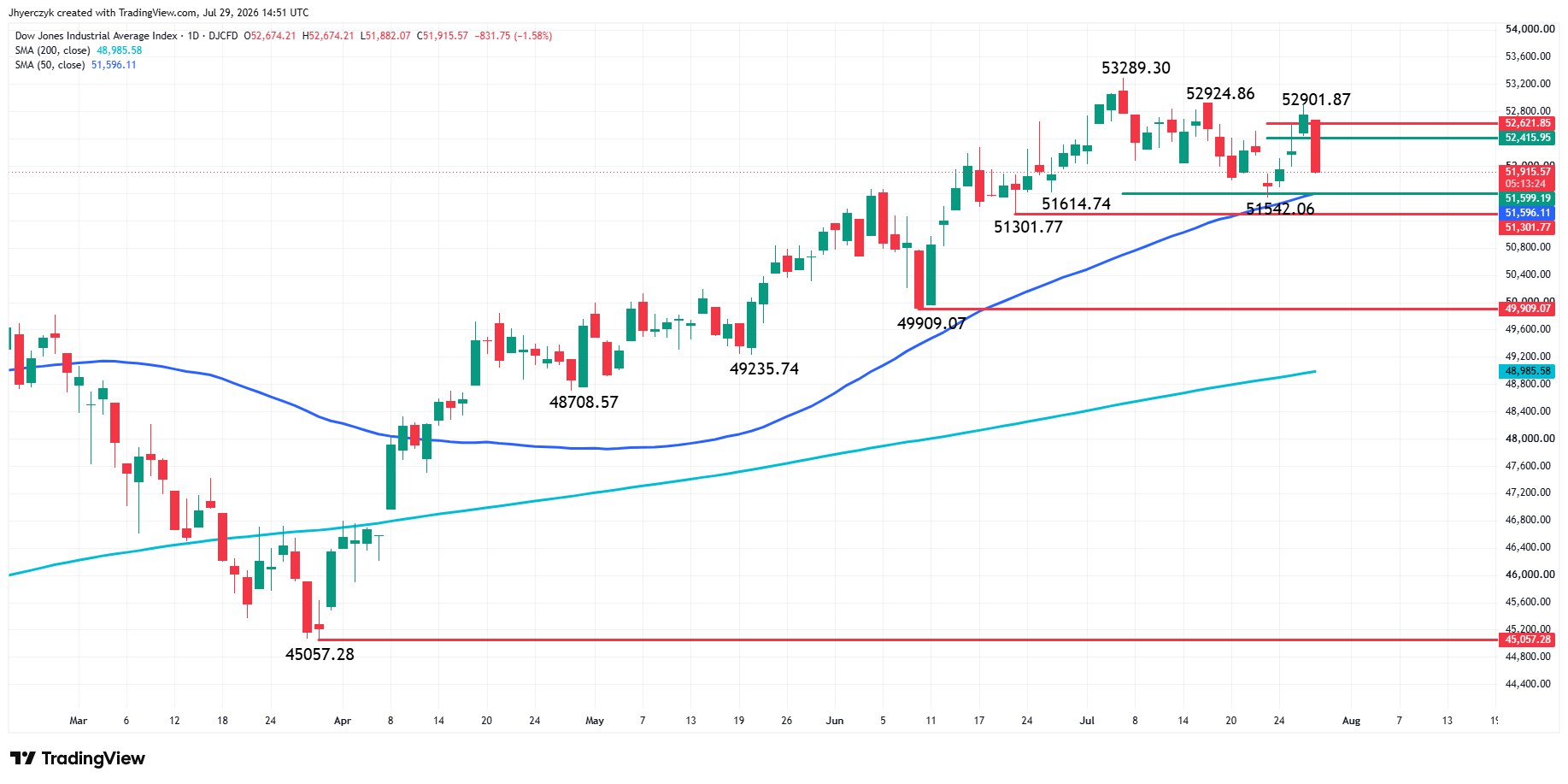
The Dow is sharply lower after taking out all of this week’s gains. The downside momentum suggests the market is headed into a short-term retracement zone at 51599.19 to 51301.77 and the 50-day moving average at 51596.96.
A close under the 50-day MA will be a sign of weakness, while taking out the swing bottom at 51301.77 could trigger an acceleration to the downside.
Tuesday’s strong performance had the Dow in a position to challenge the record high at 53289.30 over the near-term. But today’s price action is a strong indication of just how fast sellers can take it away.
Warsh Walks Into the Worst Setup for Stocks
Fed funds futures still show close to a 70% chance of a hold in the 3.5% to 3.75% range. The hold is not the problem. Warsh is about to face questions on inflation with crude up nearly 7% on the day and the President escalating the military response. That is not the press conference the market wanted.
The Dow’s rotation trade was built on falling oil. Financials, industrials and consumer names caught the bid Tuesday because lower energy costs gave the rate picture room to improve. Crude back near $90 with Trump threatening a harder response to Iran takes that room away. A hawkish tone from Warsh on top of the oil move hits the growth trade and the value rotation at the same time, and right now the market has nowhere to hide from both.
Chip Stocks Keep Breaking
The iShares Semiconductor ETF is down more than 2% Wednesday and has lost about 9% for the week. Micron is off more than 2%, AMD is down over 3%, KLA is losing more than 6% and Skyworks dropped 9% after its margin outlook missed.
The chip group is dealing with the AI spending question and the oil-driven rate risk at the same time. Teradyne surged 9% after beating estimates with a stronger third-quarter forecast. Seagate rose 6% on a better outlook and Western Digital gained 4% in sympathy. Strong numbers, but they are not changing the direction of the group. The buyers are rewarding individual names and staying away from the sector.
Vertiv fell 13% after revenue growth came in below expectations. The company beat on earnings and revenue, but the market wanted stronger growth from an AI infrastructure name. A simple beat is not enough for companies tied to the spending trade right now.
Stocks in the News
Ford rose 6% after raising its 2026 earnings outlook. GE HealthCare jumped 12% on an earnings beat with reaffirmed full-year guidance. Generac climbed 5.5% on stronger quarterly results with higher energy risk giving the backup power trade a bid. Manhattan Associates gained 11% after raising full-year profit and revenue forecasts. Deutsche Bank added more than 2% on record second-quarter profit. Biogen rose 0.7% after beating on earnings and revenue while raising adjusted EPS guidance.
What to Watch
Warsh’s press conference is the next event and he is walking into it with crude near $90 and the President talking about hitting Iran harder. The rotation that was keeping the Dow alive depended on the oil and rate picture staying calm, and both of those assumptions broke Wednesday morning. If Warsh reinforces the inflation risk with energy already running, the sectors that caught Tuesday’s bid give it back.
Microsoft, Meta and Qualcomm report after the close. Teradyne and Seagate proved strong results can still move individual chip names higher, but Vertiv showed the market is not giving AI companies the benefit of the doubt on growth. The Nasdaq needs at least one of those three reports to shift the conversation before the semiconductor selling pulls the index into a fifth straight day of lower lows with the 200-day directly below.
More Information in our Economic Calendar.