


Natural Gas Holds Near $3 on Light Holiday Volume
October natural gas futures are nearly flat Monday on extremely light Labor Day volume. At 14:48 GMT, October futures are trading at $2.973, down $0.002 or 0.07%.
Friday’s weather forecasts turned hotter for mid-September and brought buyers back after Thursday’s reversal from $3.026. Production near 114 Bcf per day and storage still above the five-year average are sitting on every rally attempt. The market has not been able to hold above $3.00 and it has not been able to break below the 50-day moving average. Monday’s holiday session is not going to resolve that.
Daily October Natural Gas Futures Technical Analysis
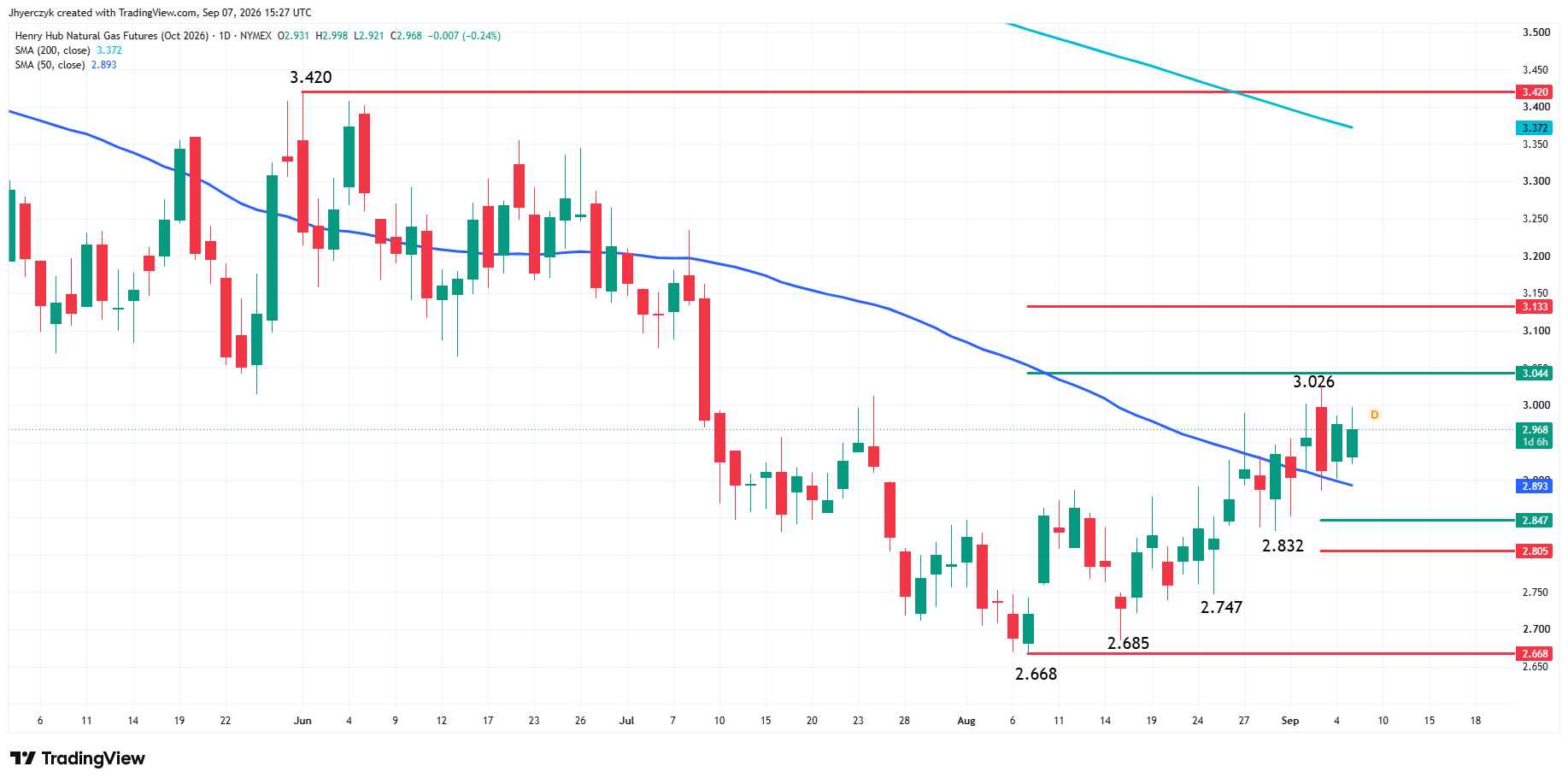
October natural gas futures are trading slightly lower early Monday. Holiday volume is extremely light, but the market remains above the 50-day moving average at $2.892. With the main trend up, buyers are positioned on the strong side of the indicator.
A trade below the 50-day moving average will signal weakness, but the main trend will remain intact unless selling pressure takes out the nearest swing bottom at $2.832. Buyers may show some interest on a pullback into the 50% level at $2.847.
On the upside, a trade through $3.026 will signal a resumption of the uptrend, but the market could encounter strong resistance at the long-term retracement zone at $3.044 to $3.133. Overcoming the upper, or 61.8%, level at $3.133 could trigger an acceleration to the upside, with the next major target the 200-day moving average at $3.372.
Hotter Forecasts Keep Power Burns Running Into Mid-September
Vaisala turned warmer for September 9-13 across the western half of the United States and trended slightly hotter across the central and southern parts of the country for September 14-18. Air conditioners are still running in September when the market normally expects cooling demand to start fading.
Natural Gas Price Forecast
Every new Natural Gas analysis as it publishes, today's technical signal and key levels, live price — on one page.
See all Natural Gas forecastsEdison Electric reported lower-48 electricity output rose 12.56% year over year in the week ended August 29 to 96,357 gigawatt hours. The 52-week total was up 2.63% to 4,375,966 gigawatt hours. Lower-48 gas demand was 80.6 Bcf per day Friday, up 7.3% from a year ago.
The weather gave buyers a reason to defend the market Friday. Thursday’s reversal from $3.026 said the heat alone is not getting the job done above $3.00.
LNG Feedgas Near 19 Bcf With Europe Still Behind
Estimated net flows to U.S. LNG export terminals were 19.1 Bcf per day Friday, down 1.8% from the prior week but still near the strongest levels of the year. Gulf Coast plants are pulling gas from the same system Texas power generators are burning through during the late-season heat.
European storage is still running well below the five-year seasonal average heading into fall. The Strait of Hormuz remains disrupted and Qatar-linked LNG flows are still exposed. U.S. cargoes are not losing buyers.
The 30 Bcf Build Was Friendly but Storage Is Not Tight
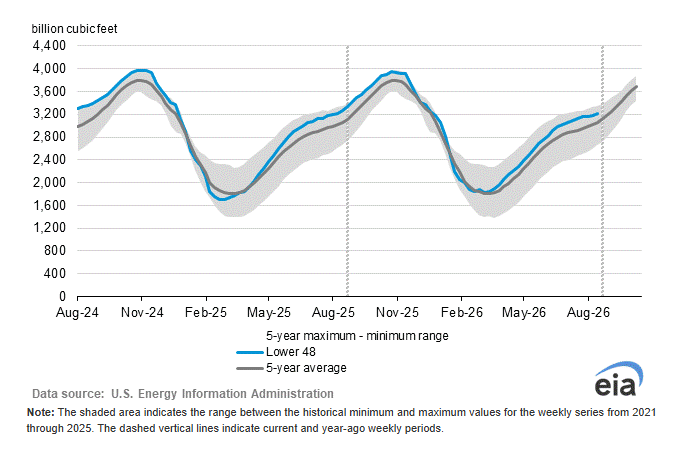
Thursday’s EIA report showed a 30 Bcf injection for the week ended August 28, below the 33 Bcf estimate and below the five-year average of 37 Bcf. The number was supportive. Storage is still 5.2% above the five-year seasonal average and 1.8% below last year.
The EIA projects inventories will reach 3,985 Bcf by the end of October, the highest in 10 years. The refill season is producing smaller builds than normal. It is still producing builds.
Production at 114 Bcf and Rigs Barely Moved
Lower-48 dry gas production reached 114.3 Bcf per day Friday, up 5.1% from a year ago. The EIA raised its 2027 production forecast Monday to 116.0 Bcf per day from 115.3 in July.
Baker Hughes reported active gas rigs fell by two in the week ended September 4 to 130. That is just below the three-year high of 134 reached in February. A two-rig drop with production at 114 Bcf per day is not a supply-tightening story.
El Niño Is the Winter Risk Bulls Cannot Ignore
Forecasters expect a very strong El Niño to continue through fall and winter 2026-27. There is a greater than 90% chance it remains very strong through the period, with a 69% chance it becomes the strongest El Niño since 1950.
The Plains, Great Lakes and parts of the Northeast could run warmer than normal if the pattern follows historical precedent. Those regions carry a large share of U.S. winter heating demand. High production, record expected October storage and a warm-winter risk from El Niño are sitting on the same side of the trade.
What to Watch
The near-term trade holds if the hotter mid-September forecasts stay in place and LNG feedgas near 19 Bcf per day keeps pulling from the Gulf Coast. Another below-average storage build next Thursday would keep buyers interested above the 50-day. El Niño, production above 114 Bcf per day and record October storage expectations are the medium-term ceiling. The heat is buying time for bulls. It is not changing the supply math yet.
The near-term read stays bullish while October futures hold above the 50-day moving average at $2.892. A trade through $3.026 resumes the uptrend but the retracement zone at $3.044 to $3.133 is where profit-taking showed up last week. A break below $2.832 changes the main trend to down and invalidates the rally. Monday’s holiday volume is not going to settle the direction. The next weather runs and next Thursday’s storage report are what matter from here.
More Information in our Economic Calendar.