Natural Gas Extends Losses to Fresh Multi-Month Lows as Supply Overwhelms Demand
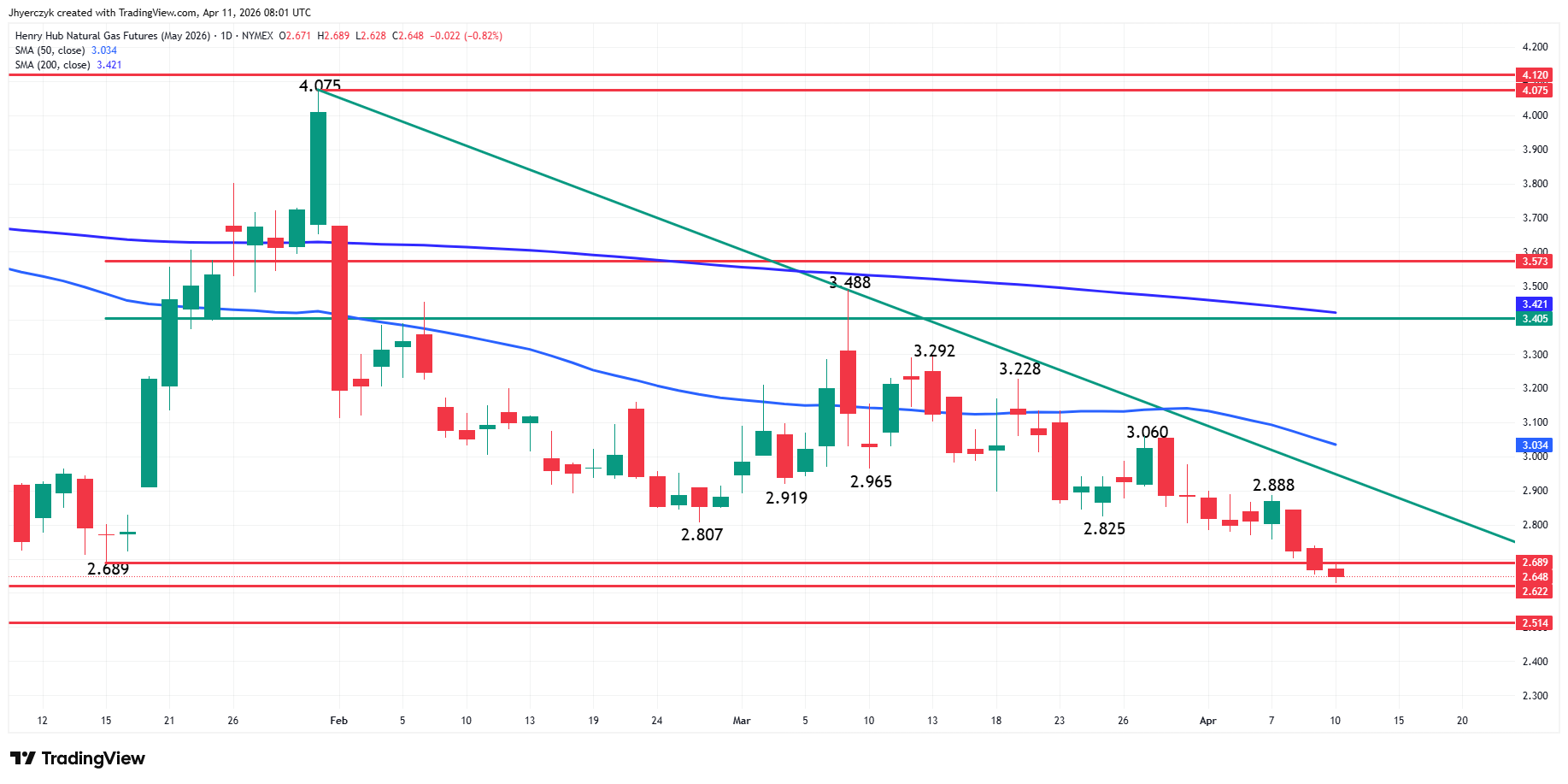
May Nymex Natural Gas futures settled down 0.82% on Friday, extending the week’s losses to fresh multi-month lows. The market has one problem and it isn’t geopolitical. It’s supply running well ahead of demand and no catalyst on the horizon strong enough to change that.
The market edged lower for a third straight session to end the week. The selling continued to drive prices toward multi-month lows at $2.622 and $2.514.
Three different trend indicators all agree that the direction is down. According to the main swing chart, the trend is down. A trade through $2.888 will reverse it. Trend line analysis points toward $2.950 as a potential breakout and change in trend price. The most important trend indicator is the 50-day moving average at $3.034.
Overcoming the 50-day MA will change the short-term trend to up on paper, but I suspect that if this happens, it’s likely to be driven by short-covering. This means new sellers are likely to re-emerge if the 200-day MA is challenged at $3.421.
What this all means technically is be leery of any short-covering breakout rallies and continue to watch for rallies to sell. Although I think there is still more downside potential, it’s difficult to sell weakness at current price levels, especially since the market is ripe for a closing price reversal bottom.

Weather Is Finishing Off What’s Left of Heating Demand
Forecasts show mild conditions across most of the U.S. through mid-April. Highs in the 60s to 80s and even 90s in parts of the South are cutting into heating demand at exactly the time of year when consumption is already declining seasonally. Total consumption is running light and the weather maps aren’t giving bulls anything to work with for at least the next week.
Production Won’t Let Up
U.S. dry gas output is running at 111.3 bcf per day, up 3.9% year over year and near record levels. The EIA raised its production outlook on top of that. Lower-48 consumption is down 9.7% from last year at 68.3 bcf per day. LNG export flows are steady near 19.8 bcf per day but not nearly strong enough to absorb the surplus. The math is simple. Supply is growing and demand is shrinking and that gap is what’s driving prices lower.
Natural Gas Price Forecast
Every new Natural Gas analysis as it publishes, today's technical signal and key levels, live price — on one page.
See all Natural Gas forecastsRig Count Looks Like a Pullback but Isn’t
Baker Hughes showed active natural gas rigs dropped 3 to 127. I wouldn’t read anything into that. Seventeen months ago there were 94 rigs running. The count climbed all the way to a 2.5-year high of 134 before this week’s small dip. Three rigs coming off that peak isn’t a signal. It’s a rounding error. The production trend is still up and one week of data isn’t changing that.
Storage Tells the Whole Story
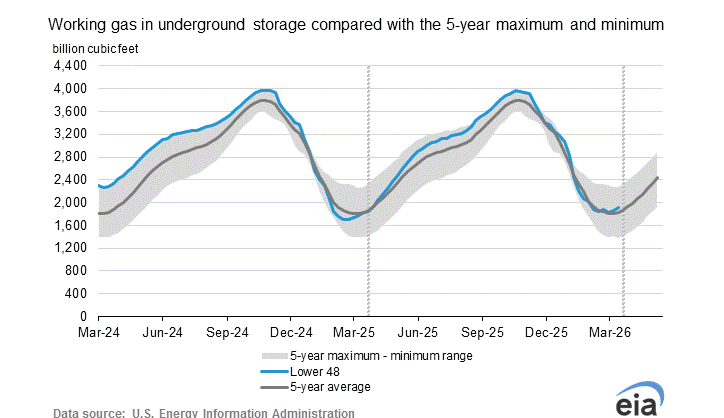
The EIA posted a 50 bcf injection this week. The five-year average for the same week is 13 bcf. That’s not a small miss. That’s almost four times the seasonal norm going into storage in a single week. Inventories are now sitting 4.4% above last year and 4.8% above the five-year average. Every week that demand stays this weak, that surplus gets bigger.
Global Risks Are Real but Not Moving This Market
I’m watching the Qatar Ras Laffan situation and the Strait of Hormuz disruptions. Those are real supply risks for global LNG markets and they matter for the longer-term picture. Right now they aren’t strong enough to move U.S. prices. The domestic oversupply is too big and too persistent. Until something changes that equation, the bears have the upper hand and rallies are for selling.
More Information in our Economic Calendar.