
Natural Gas Breaks to a New Low Ahead of Storage Data
Natural gas is lower Thursday and the contract has already printed a new multi-month low this week. Production near 111 Bcf per day, storage running 6.4% above the five-year average and cooler forecasts across the Midwest and Northeast are all working against buyers at the same time. LNG feedgas near 18 Bcf per day is keeping the floor intact but it is not enough to change the direction. Cheniere raised its full-year outlook Thursday on strong export demand. The domestic market does not care yet because the gas is not leaving fast enough.
The EIA storage report at 14:30 GMT is the next event. The market expects a 31 Bcf injection and is already trading as if the number will confirm what sellers have been saying all week.
September natural gas futures are trading $2.642, down $0.046 or 1.71% at 14:08 GMT.

Daily September Natural Gas Futures Technical Analysis
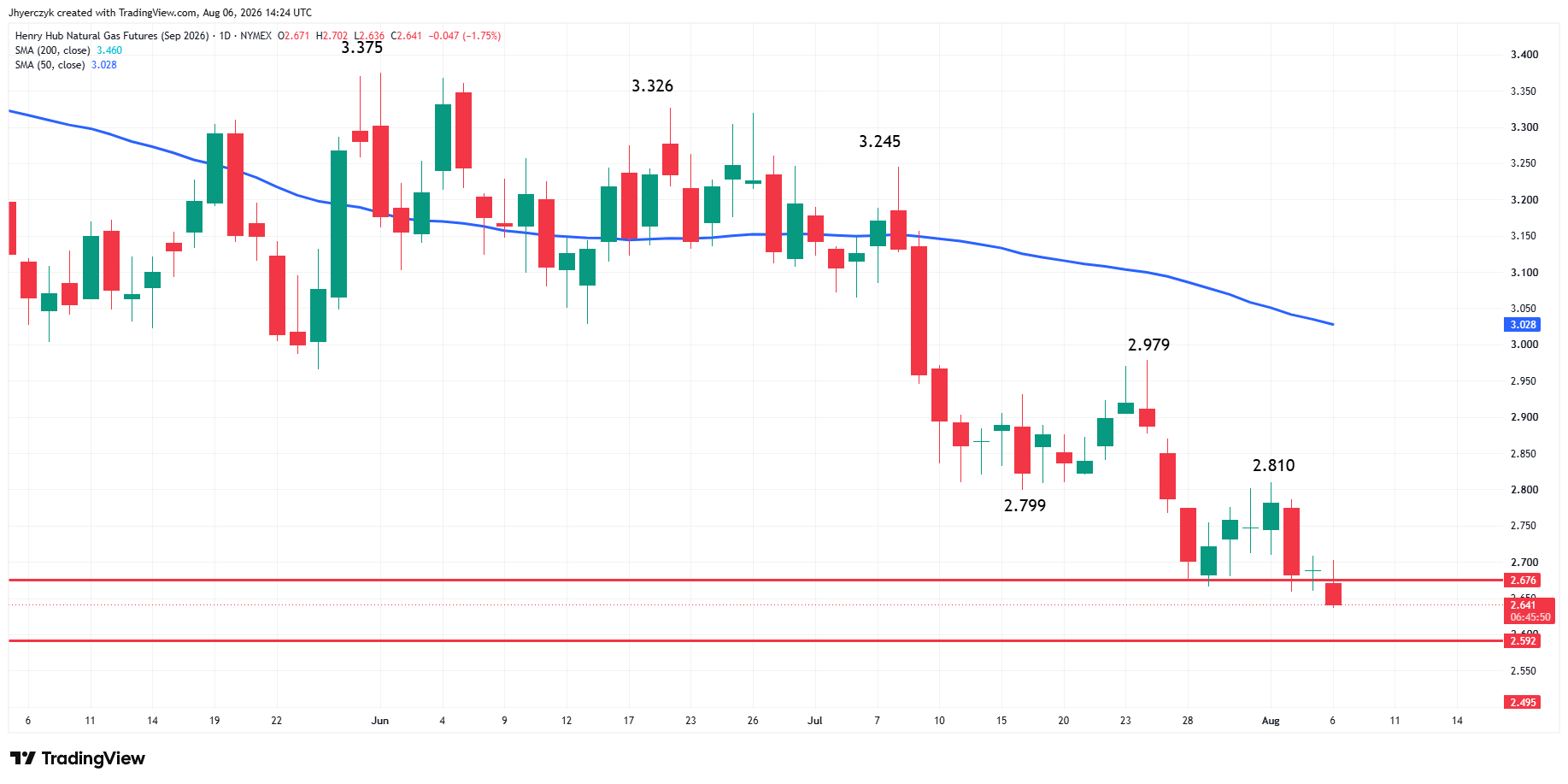
September natural gas futures are under pressure on Thursday as traders await the EIA weekly storage report. The session began with the market in a downtrend according to both the swing chart and the 50-day moving average.
The downtrend was reaffirmed earlier today when sellers took out Tuesday’s low at $2.659. If the selling pressure persists then we could see a test of long-term support at $2.592.
Recovering a former long-term bottom at $2.676 will suggest the market may be nearing a value area. But the buying is likely to be short-covering and perhaps a little bottom-picking.
The trend will change to up if the swing top at $2.810 is taken out. But it’s going to take strong buying to take out a second swing top at $2.979 in order to even reach the 50-day moving average at $3.028.
Natural Gas Price Forecast
Every new Natural Gas analysis as it publishes, today's technical signal and key levels, live price — on one page.
See all Natural Gas forecastsEIA Storage Has to Surprise to Matter
A 31 Bcf injection is already in the price. Inventories are running 6.4% above the five-year average and the trend has been loose all summer. Last week’s report came in at 28 Bcf, below estimates, and shorts covered for a session. The rally did not survive the week. That is the pattern right now. One tight number forces a squeeze that fades as soon as the next forecast refreshes.
Buyers cannot fix a surplus with a single print. They need repeated tight builds paired with hotter weather and rising feedgas, and they need them strung together over weeks. A build above 31 Bcf just confirms what sellers have been trading all along.
Heat Keeps Missing Where It Matters Most
The West and South are running hot but that is not the trade. Population density across the Midwest and Northeast is what drives power burn hard enough to change storage math. Recent forecasts shifted cooler across both regions and cash prices confirmed it. Physical weakness showed up across Texas, the Gulf Coast and parts of the Midwest earlier this week.
Daily demand is not tight enough to challenge the futures selloff. A hot revision centered on the East could still force a sharp round of short covering. Nothing in the current forecast supports it.
LNG Demand Cannot Overcome the Supply Side
Feedgas near 18 Bcf per day is the strongest thing buyers have. European storage at 58% full heading into winter is well below normal for early August. Global buyers want U.S. cargoes and Cheniere’s raised outlook confirms the demand is real.
The problem is that July exports actually slipped to 10.48 million metric tons from 10.6 million in June while overseas prices were screaming for more supply. Summer maintenance at Freeport LNG and other facilities limited how much gas could leave the country. Feedgas has improved but it is running below the spring peak and is not pulling enough out of the domestic system to offset what is coming in.
The Hugh Brinson pipeline reaches full capacity at 1.5 Bcf per day by September 1. That is more Permian gas heading straight to Henry Hub just as summer demand fades. LNG demand has to fight existing production, rising pipeline capacity and storage that is already above average. The export story turns bullish when plants come back from maintenance and start pulling harder. The market is not pricing that until it shows up in the daily nominations.
What to Watch
Thursday’s EIA number is the immediate catalyst but a build near the 31 Bcf estimate does not help buyers when storage is already running 6.4% above the five-year average. Sellers have production near 111 Bcf, new Permian pipeline capacity arriving next month and weather that keeps missing the population centers that drive summer demand.
Buyers have to prove something has changed in the balance before the market treats any bounce as more than short covering. The downtrend was reaffirmed on a new multi-month low and the 50-day moving average is a long way overhead. Getting there requires taking out multiple swing tops, and that kind of sustained buying is not going to happen while the East stays cool and storage keeps building above average.
More Information in our Economic Calendar.