


Heat Is the Bid Before Storage
Natural gas futures found buyers Wednesday after the weather maps turned hotter heading into today’s EIA storage report. The Commodity Weather Group shifted hotter for July 27 through July 31 with above-normal temperatures across the central United States and NatGasWeather is calling for widespread highs in the upper 80s to 100s with some 110-degree readings through July 27. ERCOT is already breaking load records and cash prices strengthened across the West on Wednesday, which tells you the heat is reaching the physical market and not just sitting on a model.
Storage is still above the five-year average, production has not slowed down and the supply side has not gone anywhere. The heat has to keep delivering into August or the bears have everything they need to press this back down.
At 10:55 GMT, August Natural Gas futures are trading $2.957, up $0.032 or +1.09%.

Daily August Natural Gas Technical Analysis
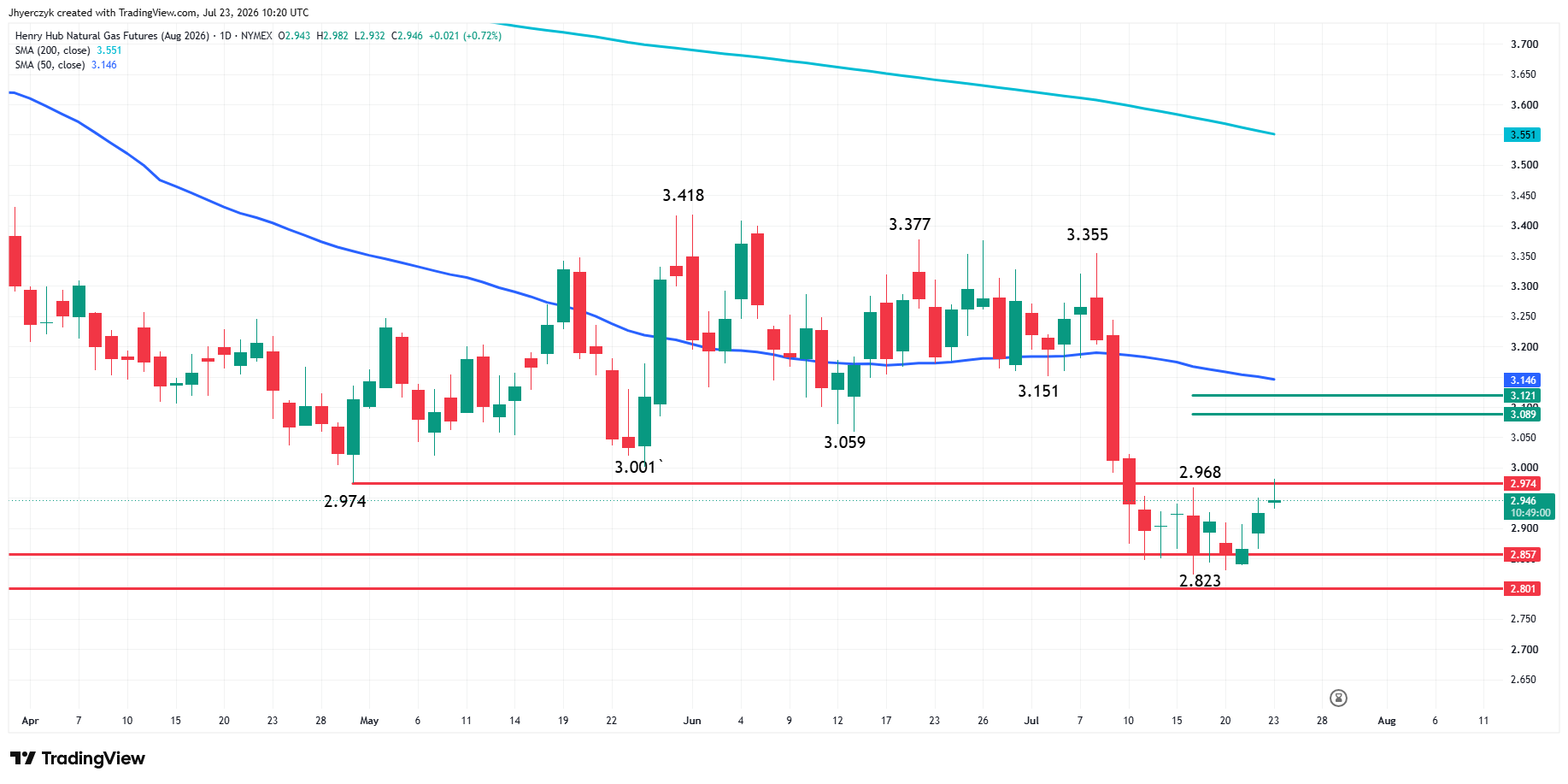
August natural gas futures are edging higher early Thursday, shortly before the NYMEX opening and the weekly EIA storage report at 14:30 GMT.
Since longs were forced out by aggressive sellers about two weeks ago, prices have been consolidating between the April bottom at $2.974 and a long-term low at $2.823. The new weather forecast has agitated the market enough to challenge the top end of the range, but it appears that traders are awaiting the EIA report before they make their move later today.
My chartwork indicates that the market is set up for a possible surge through $2.974 with resistance targets a pair of 50% levels at $3.089 and $3.121. Capping this set-up is the 50-day moving average at $3.146.
On the downside, the support base is $2.857 to $2.801.
It’s too early to throw in the towel on a summer rally, but I think we have enough evidence to say it’s not likely to be a trending rally, but more likely to be a spiking rally if there even is one.
Natural Gas Price Forecast
Every new Natural Gas analysis as it publishes, today's technical signal and key levels, live price — on one page.
See all Natural Gas forecastsStorage Report Lands Into a Hotter Forecast
The EIA is expected to report a 29 Bcf build for the week ended July 17 against a five-year average of 30 Bcf. Last week’s report added 41 Bcf compared to a 39 Bcf estimate. Inventories were down 0.9% from a year ago but still running 6.4% above the five-year seasonal average as of July 10.
A number near consensus keeps the focus on the heat. A larger build gives sellers something to lean on because the surplus has not gone away. A smaller build puts more pressure on the shorts after Wednesday’s recovery and gives the weather bulls a reason to press.
Heat Needs to Spread Before Bulls Get Control
Lower-48 dry gas demand hit 80.6 Bcf per day Wednesday, up 6.3% from a year earlier, and electricity output rose 2.0% year over year in the week ended July 18. The central U.S. heat is doing the work right now but the Midwest, Great Lakes and Northeast have cooler interruptions that keep the national picture from lining up cleanly.
One hot run does not change the season. The central heat needs to hold into August and spread east for futures to build real follow-through. Without that, the market is trading the same pattern it has been stuck in all summer where a hot forecast lifts the bid and then the surplus and production bring sellers right back.
Production and LNG Keep Sellers Confident
Lower-48 dry gas output hit 110.9 Bcf per day Wednesday, up 2.5% from a year ago, and the EIA raised its 2026 production forecast to 111.2 Bcf per day earlier this month. The rig count held unchanged at 126 last week, below February’s 134-rig high, so a fresh production surge is not showing up. But current output is more than enough to keep the supply argument alive.
LNG net flows to U.S. terminals reached 17.9 Bcf per day Wednesday, up 7.9% from the prior week. That is pulling gas out of the domestic market. Tropical Storm Bertha is the short-term risk because any disruption to Gulf Coast export facilities leaves more gas at home and can turn a weather rally into another storage build fast.
QatarEnergy extending force majeure on LNG deliveries matters for the global market over time but it is not what moves Henry Hub on EIA day. The immediate trade is U.S. heat, power burn, domestic production and whether export facilities stay online through Bertha.
What to Watch
The storage number starts the reaction but the forecast decides whether it lasts. A build near 29 Bcf keeps the focus on the late-July heat and gives the weather bulls room to work. A larger print gives sellers a reason to lean on the surplus that has capped every rally this summer.
The heat has to spread and hold. ERCOT records and stronger Western cash prices show the physical market is responding but the national picture needs the Midwest and East to join before this turns into more than a one-week bid. Bertha is the wildcard for LNG exports and any disruption to Gulf Coast terminals tilts the domestic balance back toward the bears fast.
The market is consolidating between the April bottom and the long-term low and today’s report is the catalyst that could push it out of the range in either direction. A surge through the top end opens the path toward resistance and the 50-day average. If sellers hold the upper end, the support base below is where the market settles back into. The setup favors a spike over a trend and the next five days decide which side gets control.
More Information in our Economic Calendar.


