


Fed Hike Sends Platinum Lower as Dollar Clears 100
The price of platinum fell below $1,780 per troy ounce, a drop of about 6%, before the Federal Reserve’s September 16 meeting. During the meeting, the 12-person Federal Open Market Committee (FOMC) voted unanimously, 12 – 0, to raise the federal funds rate, and this led to a 25-basis-point hike with a new range of 3.75% – 4.0%. It is worth noting that this is the first time the committee has hiked the federal funds rate since July 2023, and there are projections that about 16 – 18 Fed officials are still expecting another possible hike before 2026 runs out.
The dollar index reacted immediately to the rate hike, pushing past the $100 mark on the news. Now, when the Fed increases rates, and the dollar strengthens, yielding dollar instruments like the U.S. Treasury Bills give larger returns on investment. And as a result, more investors are compelled to pull their funds out of non-yielding assets like platinum and put them in yielding ones.
The chairman of the Fed, Kevin Warsh has said that inflation is still too high, and he pointed to the U.S.-Iran war as a significant catalyst. The Fed’s hawkish posture places the Platinum Group Metals (PGM) complex under pressure as it increases the opportunity cost of holding them while the dollar strengthens. Metals in the PGM complex include platinum, palladium, rhodium, ruthenium, iridium, and osmium. And platinum price is more likely to fall against the U.S. dollar when the Fed is hawkish.

WPIC Surplus Revision Masks a Dangerously Thin Inventory Buffer
A look at platinum’s fundamental picture reveals an interesting demand & supply narrative. On September 9, 2026, the World Platinum Investment Council (WPIC) did a big u-turn on its 2026 platinum supply forecast, changing its previous expectation of a 297,000-ounce deficit to a 265,000-ounce surplus. That reversal measures up to a total of 562,000 ounces. When you analyze this move at the surface level, it looks very bearish, as it represents a sudden shift from deficit to oversupply, which usually leaves sellers chasing buyers and crashing the price of a commodity in the process.
However, things are not that straightforward. The WPIC’s change of heart was as a result of diminishing platinum investments, not higher mining output. Let me explain: according to a WPIC report, there was a drop of 534,000 ounces in platinum Exchange-Traded Fund (ETF) holdings, as investors were massively selling their shares in the platinum ETF. There was a further reduction in exchange stocks by 65,000 ounces, which led to an overall decline of 599,000 ounces in measured platinum investment demand. These massive investment outflows, which force funds to sell physical platinum blocks held in their vaults and directly translate to a commodity supply shock, were what pushed the WPIC to change their stance on expected 2026 supply.
A 265,000-Ounce Surplus Barely Dents a Three-Year Deficit
Now, if we pay attention to the bigger picture, we will see that this forecasted supply shock won’t make much of an impact afterall, as there is a large deficit in the market to absorb it. WPIC CEO Trevor Raymond said by the end of 2026, global platinum inventories will only be able to cover about 3.4 months of demand, even after the ETF supply outflows hit the market. This projection points to a serious global deficit of platinum right now that has been going on for three consecutive years. The measure shortfall in 2025 alone was 1.4 million ounces and a 265,000-ounce surplus will only fill about 8% of the stockpile depleted between 2022 and 2025.
Long story short, not much of a supply shock can be expected when the WPIC’s projected surplus hits the market. Which means that the current market deficit will still very much be in play, and will support the bull case for platinum.
South Africa’s Structural Decline Is Not Reversible on Any Short Timeline
Another key factor that determines what happens to platinum’s price is whether the global mining output of the metal is able to meet demand or not. South Africa is home to about 91% of the world’s Platinum Group Metals (PGM) reserves, however, the country’s output has continuously declined over time. According to the U.S. Geological Survey, South Africa’s PGM output declined by an estimated 9% between 2024 and 2025. This decline is mostly as a result of old infrastructure, rising operational costs, and unreliable electricity supply.
To make matters worse, the country’s utility authority, Eskom, has increased mining tariffs by around 60% in the last 5 years, with an April 2026 tariff bump of 8.76%, according to NERSA filings. The problem these electricity costs bring is that once they are deducted from the current prices of platinum, the margins left are significantly smaller.
Mining CEOs Warn the Output Slide Has Years Left to Run
According to a June 2026 projection by Sibanye-Stillwater’s executive team, the world’s mining output of platinum is expected to drop by as much as 15% by 2034. In addition to this, the CEO of Northam Platinum, Paul Dunne, sent a troubling outlook to the market and said the industry is already in a terminal decline, with a predicted 10% drop in national platinum output over five years. Also, even if any significant funds are committed to building mines in the Bushveld Complex, a geological formation in South Africa that holds over 70% of the world’s platinum resources, it would still take about 10 to 15 years for those mines to be completed and commercially producing platinum.
Bullish Flag Holds Above Key Support, but the Descending Channel Tests Conviction
The daily XPT/USD price chart reveals a bullish flag that has been forming from as far back as January this year. Price recently tested the upper trendline of the flag near $1,920 and rejected it on Thursday, September 10, sending it back down to $1,737 five days later. Platinum is trading near $1,786 per troy ounce as at the time of writing, well above the 1,442 – 1,559 support zone. Price had tested that zone in June and bounced off it, reaching the $1,800 levels by August.
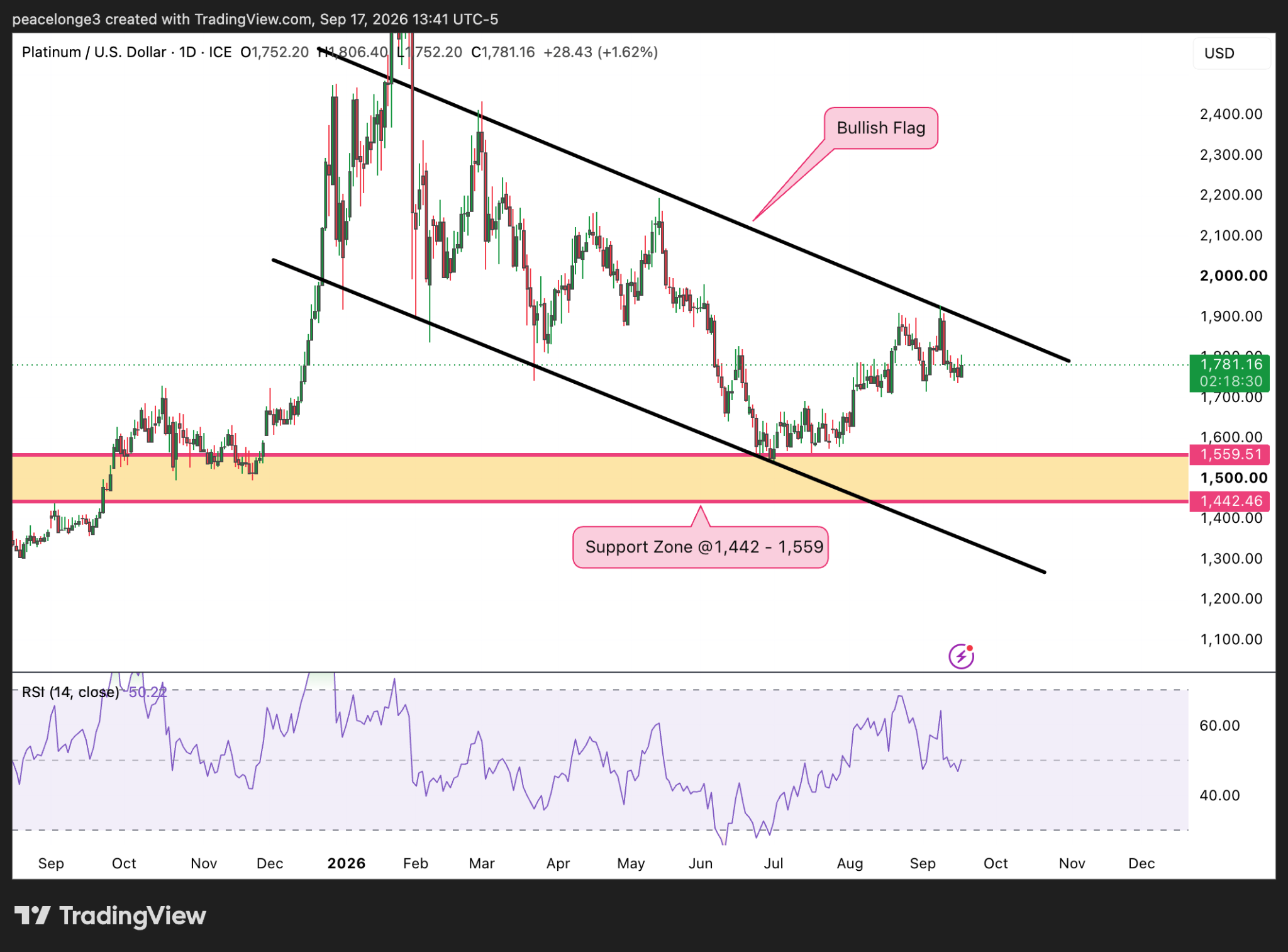
If we’re able to get a break and close outside the upper trendline of the flag on the daily timeframe, we can expect a sustained bullish move to the $2,000 psychological level, and then further up to the activity zone near $2,118. If, however, price keeps falling, we can expect a retest of the 1,442 – 1,559 support zone. A break and close below that zone on the daily timeframe exposes a path to the flag’s lower trendline near $1,340. The RSI currently reads 50.80, which is just at the average level and leaves enough room for momentum to build in either direction.
Where the Bull and Bear Cases Break Down
In summary, the major risk for the bull case lies in the Fed’s hawkish posture. If rates are held higher for longer and the dollar strengthens, yielding-assets will be favored over non-yielding metals like platinum, which can weaken the investment demand for platinum and send its price lower. For the bearish thesis, the key risks lie in the projected low above-ground stocks and physical demand. If physical demand for platinum increases, the price can rise as a result. If above ground stocks struggle to be supplemented due to diminishing production in South Africa, scarcity increases and the price of platinum sky rockets.


