
Wednesday’s Rally Did Not Survive the First Session
Nymex Natural Gas is lower Thursday after Wednesday’s rally to the highest level in nearly four weeks stalled short of the key moving average overhead. Buyers took the trend change. They could not hold it through the overnight session. The market is back below Wednesday’s low and trading on the weak side of the resistance zone that was supposed to become support.
The EIA storage report lands at 14:30 GMT. Production is still running above 111 Bcf per day. The heat across the South and West is real but the calendar is working against it. Thursday’s pullback is the market asking whether Wednesday’s move was a trend change or a short-covering pop that ran out of momentum in the same place every summer rally has stalled.
At 12:38 GMT, September natural gas futures were trading at $2.756, down $0.058 or 2.06%.

Daily September Natural Gas Futures Technical Analysis
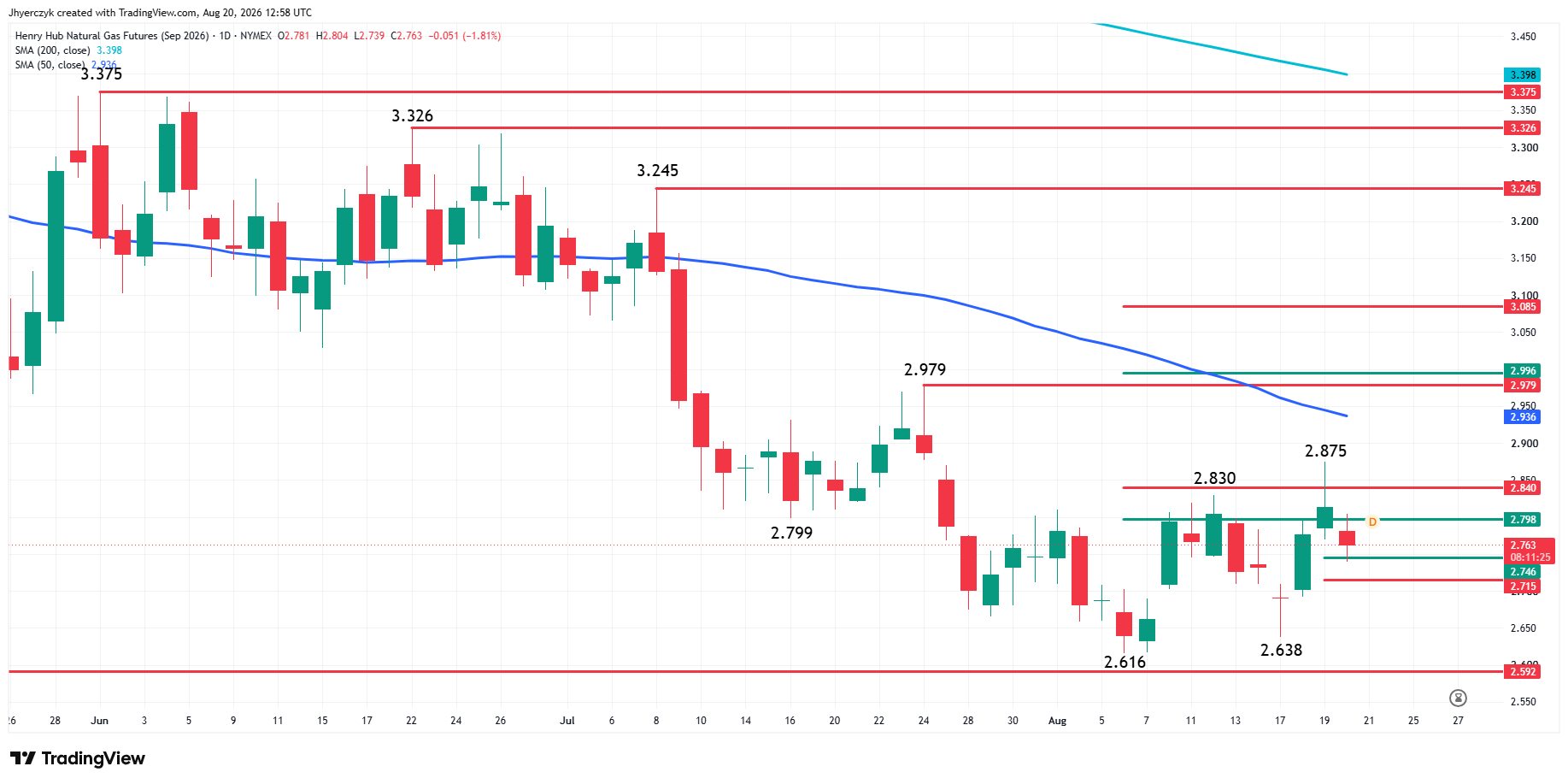
September natural gas futures are edging lower on Thursday after notching its highest price since July 24 the previous session. The market isn’t just lower today, but below Wednesday’s low, which goes to show you how difficult it is to sustain a rally during a summer of high production.
Nonetheless, the main trend did turn up yesterday when buyers took out $2.830, sending prices to $2.875. But that’s where short sellers were waiting and the rally stalled. The move took the market to just under the 50-day moving average at $2.936, which is both a key trend indicator and resistance.
Natural gas is also trading on the weak side of a retracement zone at $2.798 to $2.840, which could become new resistance.
Given the current range of $2.616 to $2.875, its retracement zone at $2.746 to $2.715 is also a potential downside target.
With two main bottoms at $2.616 and $2.638, and a main top at $2.875, we’re going to call the market neutral.
Natural Gas Price Forecast
Every new Natural Gas analysis as it publishes, today's technical signal and key levels, live price — on one page.
See all Natural Gas forecastsRecord Production and a Storage Surplus Are Still Running the Larger Trade
Lower-48 dry gas output has averaged more than 111 Bcf per day in August, above July’s record monthly pace. Producers have not adjusted to lower prices. Shale wells keep producing. Associated gas from Permian oil drilling keeps showing up. The supply side of this market has not flinched once during the entire summer and Wednesday’s one-session rally did not change that.
Storage is reinforcing the same argument. Inventories have stayed above the five-year seasonal average for weeks. The surplus grew through the hot months that were supposed to draw it down. Mild spring weather let companies inject more than usual and strong production has kept the builds going. There is a comfortable cushion heading into fall and traders are not bidding this market up with that much gas in the ground.
Wednesday’s rally ran into a wall at the same level where every summer bounce has stalled. Record output absorbs the demand increase before the move can change the larger balance. The production number and the storage number are both on the same side of this trade and neither one moved in the bulls’ favor overnight.
The Heat Is Still Here but the Calendar Is Turning
Temperatures across the South and West remain above normal and power demand has been elevated. That was the catalyst behind Wednesday’s move. The forecast has not reversed the way it did Monday. The heat is holding.
The problem is timing. The summer cooling season is winding down. Longer-range outlooks are starting to show milder conditions arriving in the Northeast and Midwest. The regions that drive the biggest swings in gas demand are the ones where the forecast is getting less supportive. The South can keep power demand firm for a few more days. It cannot carry the trade alone once the broader national outlook cools.
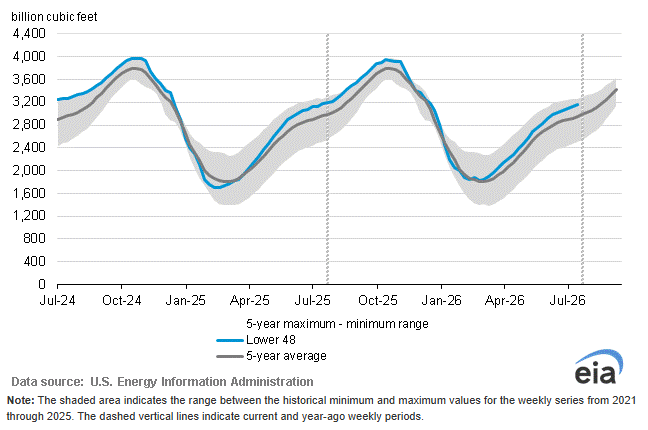
Thursday’s EIA storage report at 14:30 GMT covers a period when heat was already elevated. Expectations are pointing toward a smaller-than-average injection. A light build would confirm that the weather trade has been doing some work on the storage balance. The market is cautious ahead of the number. Traders are lightening positions rather than holding through a report that can move futures fast in either direction.
Oil staying firm on Middle East tensions helped Wednesday’s rally. That support has not been enough to prevent Thursday’s decline. The gas market is focused on its own domestic balance and that balance still favors supply.
What to Watch
The EIA report at 14:30 GMT is the session. A smaller-than-average injection confirms the heat reached the data. Another heavy build tells the market that record production is still absorbing summer demand the way it has all year. Wednesday’s trend change needs the storage number to back it up. Without it, the pullback extends and sellers have the stronger hand heading into the final stretch of August.
The main trend turned up Wednesday but the market is already back below Wednesday’s low. The retracement zone that was supposed to hold as support has flipped back to resistance. The market is neutral between the summer lows and Wednesday’s high. The heat is holding in the South and West but the calendar is turning. Until the storage data starts confirming what the weather models have been promising, the rallies keep running into the same ceiling.
More Information in our Economic Calendar.