
Storage Surplus Holds Off the Weather Bulls
Natural gas is lower Friday because the heat story still cannot overpower the supply picture. Texas is running hot, ERCOT is hitting load records and cash prices have firmed across the West. But the EIA printed a larger-than-expected storage build Thursday, LNG feedgas demand is running below its summer peak and production has not slowed down. The market had reasons to rally this week and could not hold any of them. Early August heat spreading east is the one catalyst that could shift the balance but the forecast has not delivered that yet and sellers are using every hot weather rally to reload.
At 17:42 GMT, August Natural Gas futures are trading $2.889, down $0.027 or -0.93%.

EIA Build Stopped the Rally Cold
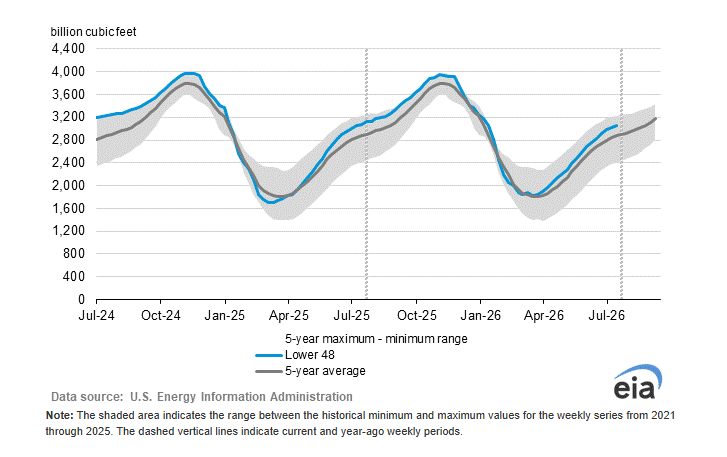
The EIA reported a 32 Bcf injection for the week ending July 17, slightly above the 29 Bcf estimate and near the five-year average. Working gas inventories stood near 3,056 Bcf, running about 6.4% above the five-year average and slightly below year-ago levels. The build was smaller than the 61 Bcf injection reported earlier this month, which shows summer power burn is doing some work, but the surplus is not shrinking fast enough to change the direction of this market.
Short-covering pushed futures to $2.991 ahead of the report Thursday and the number killed the move right at the top of the range. A near-consensus build does not give bulls enough ammunition to push through resistance when the five-year surplus is still this wide.
LNG Flows Are Below Peak and Bertha Is Watching
Seven-day LNG feedgas demand was estimated near 17.5 Bcf per day Friday. That is a large volume leaving the domestic market but it is below the peak summer pace closer to 19 Bcf per day. Freeport maintenance and uneven Gulf Coast operating rates are holding flows back. Corpus Christi is running stronger nominations and helping offset some of the weakness but one terminal improving does not change the picture when total export demand is running below its recent highs.
Natural Gas Price Forecast
Every new Natural Gas analysis as it publishes, today's technical signal and key levels, live price — on one page.
See all Natural Gas forecastsTropical Storm Bertha has not created a major outage yet but the threat is keeping traders from pressing long into a weather rally. Any disruption to Gulf Coast LNG facilities traps more gas in the domestic system and the timing could not be worse for bulls trying to build a case that demand is catching up to supply. Global LNG prices are elevated because the Middle East shipping crisis has tightened Asian supply, which supports U.S. exports over time. That is a background factor. It is not lifting August futures today.
Heat Needs the East to Join
High pressure is expected to keep much of the country hot through July 29 with widespread highs in the upper 80s to 100s and some 110-degree readings. Texas is doing the heavy lifting because ERCOT load has been hitting records and gas-fired power demand climbs fast when that heat holds. Lower-48 demand was running at 80.6 Bcf per day earlier this week, up 6.3% from a year ago.
The Midwest, Great Lakes and Northeast are getting periodic breaks with showers and temperatures in the 70s and 80s moving through regions that need to participate for national power burn to surge. That keeps demand in the moderate-high range instead of pushing it into the kind of broad sustained pattern that forces shorts to cover above $3. Early August heat expanding east is the scenario that changes this trade. The market has enough short positioning and enough LNG demand underneath to move fast if the forecast delivers. It has spent most of the summer selling hot weather headlines after the storage data reminds everyone how much supply is available.
Daily August Natural Gas Technical Analysis
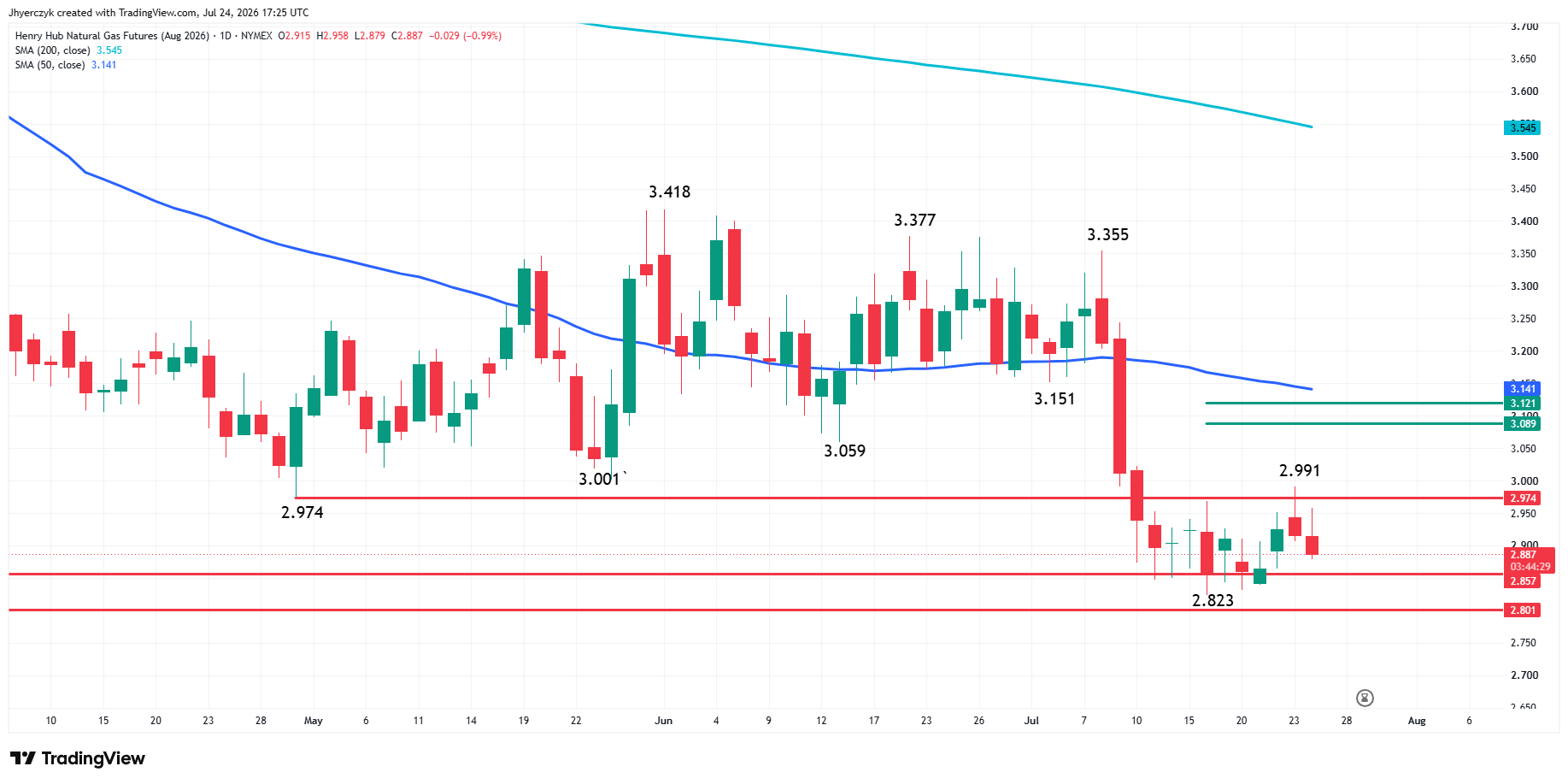
August natural gas futures continue to consolidate inside their two-week range between $2.823 and $2.991. The price action suggests that while the level of gas in storage is decisively bearish, there appears to be enough seasonal, speculative buying to prevent a washout to the downside.
Short-covering ahead of Thursday’s EIA report helped fuel a surge to $2.991, but the actual report likely stopped the rally cold at $2.991. This price is the new potential trigger point to the upside. However, buyers will still face major headwinds at a pair of 50% levels at $3.089 and $3.121 and the 50-day moving average at $3.140.
What to Watch
The next weather update matters more than Friday’s price action. Bulls need heat spreading beyond Texas and the central states with fewer cool breaks in the Midwest and Northeast. They also need Freeport maintenance to end and LNG feedgas demand moving back toward peak summer levels. Until both of those show up, the storage surplus gives sellers the upper hand on every rally attempt.
The market is stuck inside its two-week range and Thursday’s EIA report stopped the rally at the top end. A breakout above that level opens the path toward resistance and the 50-day average but buyers face heavy headwinds at every level above. The supply side has not given an inch with production above 110 Bcf per day and inventories well above the five-year average. The range holds until the weather or LNG demand changes the math and neither one has done it yet.
More Information in our Economic Calendar.