



Novartis Enters Q2 After Weathering One of the Biggest Patent Cliffs in Its History
Although first-quarter revenue fell 1% year over year to $13.1 billion, or 5% at constant currencies, the results largely matched management’s expectations as several blockbuster medicines lost patent protection in the United States.
Chief Executive Vas Narasimhan described the period as “the biggest loss of exclusivity in Novartis’ history, emphasizing that the weakness reflected temporary patent expirations rather than deteriorating demand across the company’s portfolio.
Core operating income declined 14% on a constant-currency basis, while core EPS fell 15% to $1.99. The decline reflected lower sales as well as continued investment in research and development. Despite this pressure, Novartis maintained healthy profitability with a 37.3% core operating margin, while free cash flow remained broadly stable at $3.3 billion. That suggests the company continues to generate substantial cash even during a challenging earnings period.
The brighter picture came from Novartis’ growth portfolio, where nearly every strategic medicine continued to post double-digit expansion.
Kisqali remained the standout performer, with sales jumping 55% as adoption broadened in breast cancer. Pluvicto climbed 70%, reflecting growing demand for radioligand therapies, while Kesimpta increased 26% as multiple sclerosis patients continued switching to newer treatments.
Other recently launched medicines also maintained exceptional momentum. Scemblix surged 79%, and Leqvio advanced 69%. Several pipeline candidates also achieved important regulatory milestones, including positive late-stage data for Remibrutinib and priority review for Ianalumab.
The acquisition of Avidity Biosciences also strengthened Novartis’ long-term growth pipeline by adding several late-stage neuromuscular disease candidates.
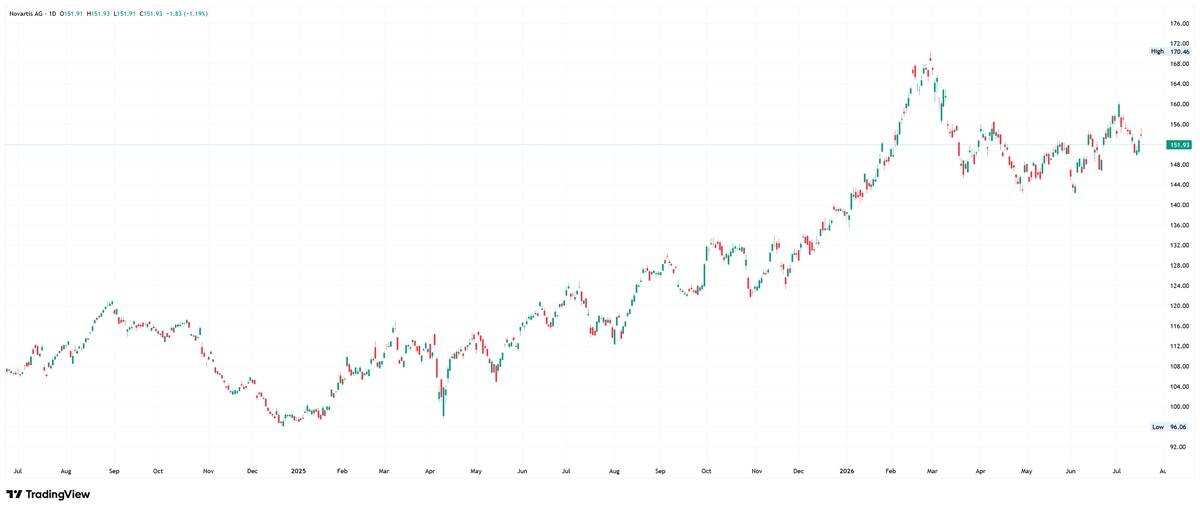
Overall, these performances suggest that the underlying business remains healthy despite temporary revenue headwinds from generic competition. Management therefore reaffirmed its full-year guidance, still expecting low-single-digit sales growth while forecasting a low-single-digit decline in core operating income during fiscal 2026.
What Investors Should Monitor in Novartis’ Second-quarter Earnings
The second-quarter report is unlikely to be judged solely on whether earnings beat analyst estimates. Instead, investors will be looking for confirmation that the company’s growth engines continue to compensate for patent losses.
The first area to monitor will be sales momentum across Novartis’ priority medicines. Markets will want to see whether Kisqali, Pluvicto, Kesimpta, Leqvio, and Scemblix can maintain the exceptional growth rates seen in the first quarter. Sustained expansion would reinforce management’s confidence that the worst impact from generic erosion may already be passing.
Novartis’ shift toward high-innovation pharmaceuticals has made regulatory milestones, late-stage trial results, and new product rollouts top priorities for investors. Progress on key therapies such as remibrutinib, Fabhalta, and ianalumab will likely influence the company’s long-term growth trajectory far more than minor quarterly earnings fluctuations.
Industry analysts also view several experimental medicines as critical to the next phase of growth. Pelacarsen in cardiovascular disease, remibrutinib in multiple sclerosis, and Del-desiran in genetic disorders are widely seen as important long-term opportunities. Collectively, these therapies are estimated to have peak annual sales potential exceeding $10 billion, which would help offset expected revenue losses when blockbuster medicines such as Cosentyx and Kisqali face patent expirations around the turn of the decade.
Investors will also focus on management’s commentary regarding the second half of 2026. The company previously guided for stronger growth later in the year as comparisons become easier after the initial wave of generic competition. Any indication that this recovery remains on track would likely reassure investors that 2026 represents a transition year rather than the beginning of a longer slowdown.
Finally, analysts will pay close attention to research and development spending. Novartis has deliberately continued investing aggressively despite lower earnings. If management maintains this strategy while preserving margins, it would reinforce confidence that today’s spending is intended to support tomorrow’s product launches rather than simply offset current weaknesses.
Why U.S. Drug Pricing Reforms Could Become an Even Bigger Risk Than Quarterly Earnings
Although second-quarter numbers will attract most of the immediate attention, a much larger issue has been dominating discussions across the global pharmaceutical industry in recent months: the impact of the Most Favored Nation (MFN) pricing policy.
President Donald Trump’s MFN pricing policy has fundamentally changed how pharmaceutical companies think about launching medicines around the world. Under the policy, prices paid in the United States — the world’s most profitable pharmaceutical market — can increasingly be linked to prices charged in other wealthy countries, including many European nations.
For decades, drugmakers accepted lower prices across Europe because premium pricing in the United States largely compensated for thinner overseas margins. That model is now under pressure. Novartis CEO Vas Narasimhan recently warned that the full impact of the policy could become visible over the next 18 months, describing it as a potentially “very difficult situation” for both patients and pharmaceutical companies.
If a medicine launches first in Europe at relatively low prices, those prices could eventually influence what companies are allowed to charge in the United States. Because the U.S. market generates significantly higher profits, pharmaceutical companies may increasingly delay European launches in order to protect American pricing.
This is the critical link between European access to medicines and U.S. pricing policy. Lower prices negotiated by European health systems can indirectly reduce the profitability of launching a medicine in the United States. As a result, companies may choose to prioritize the U.S. market first and delay launching new therapies in Europe.
Narasimhan has warned that unless European governments improve how they reward medical innovation, patients across Europe could face slower access to breakthrough treatments. Novartis currently expects only a modest direct financial impact, estimating that MFN presently affects roughly 5% to 10% of Medicaid-related sales.
However, industry leaders believe the longer-term strategic implications are considerably larger. Novartis is far from alone: executives at Roche and AstraZeneca have also warned that Europe’s fragmented reimbursement systems, slower regulatory processes, and lower medicine prices risk making the region increasingly unattractive for launching innovative therapies.
Recent industry data already suggest that this shift may be beginning. According to GlobalData, new medicine launches in Europe have fallen by roughly one-third since the MFN policy was introduced, as companies increasingly seek to protect pricing in the United States.
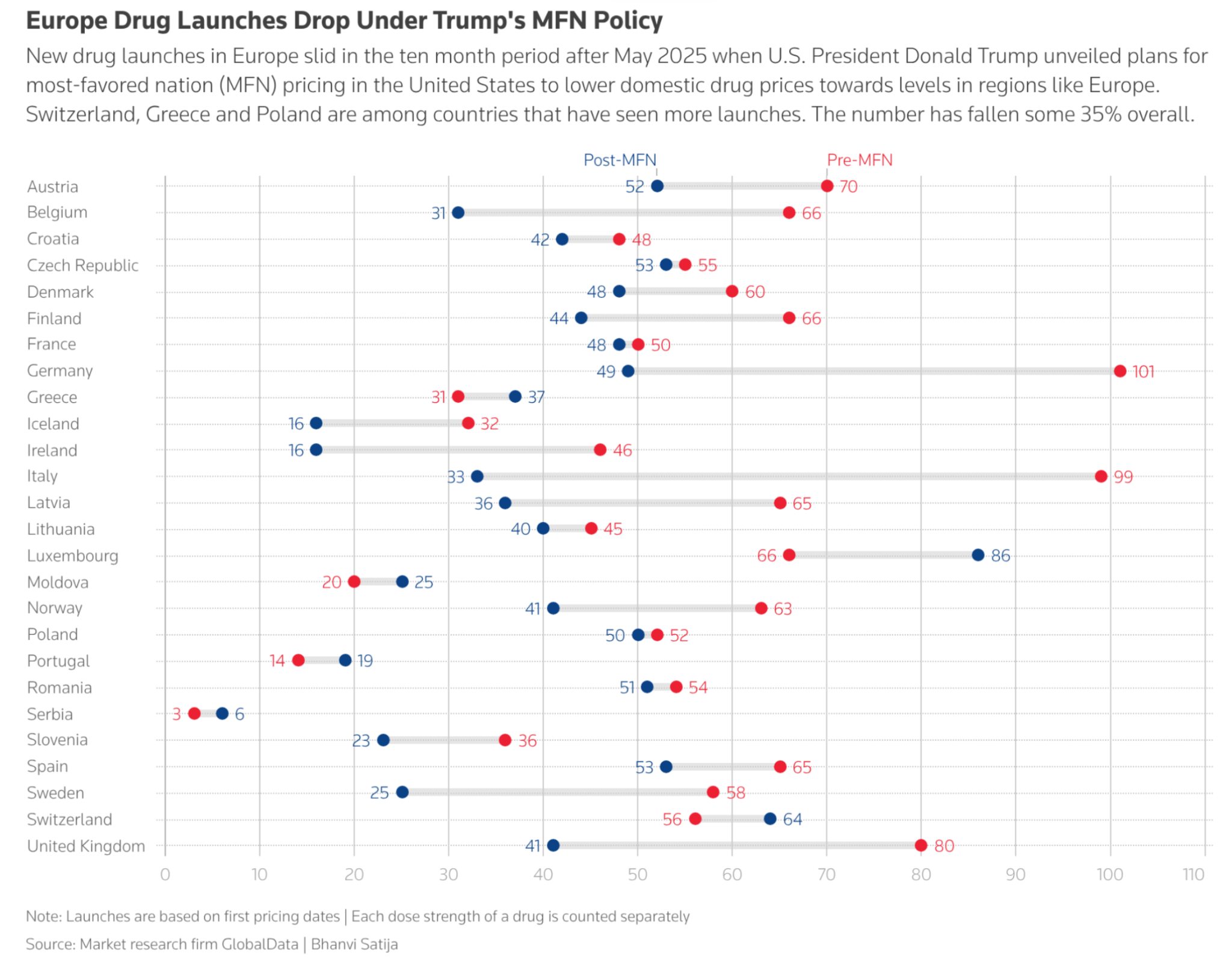
Adding to the uncertainty, the 15% tariff on pharmaceutical exports to the United States is ending more than three decades of tariff-free trade for medicines. Combined with evolving U.S. pricing rules, these developments suggest that the economics of global drug development are changing rapidly.
For investors, this means Novartis is no longer simply a company driven by drug approvals, patent expirations, and quarterly earnings. Healthcare policy, international trade negotiations, and government pricing decisions are becoming increasingly important drivers of long-term valuation.
Bottom Line
As Novartis prepares to release its second-quarter results, investors will be looking well beyond headline earnings. The main focus will be whether strong demand for its newest medicines can continue to absorb the impact of generic competition, while management’s strategy for navigating major global policy shifts will also be under scrutiny.
However, with the stock up nearly 14% year to date following a 24% rally in 2025, much of this optimism may already be reflected in the share price. Trading at roughly 16 times forward earnings, Novartis commands a premium valuation relative to many industry peers, leaving less room for error.
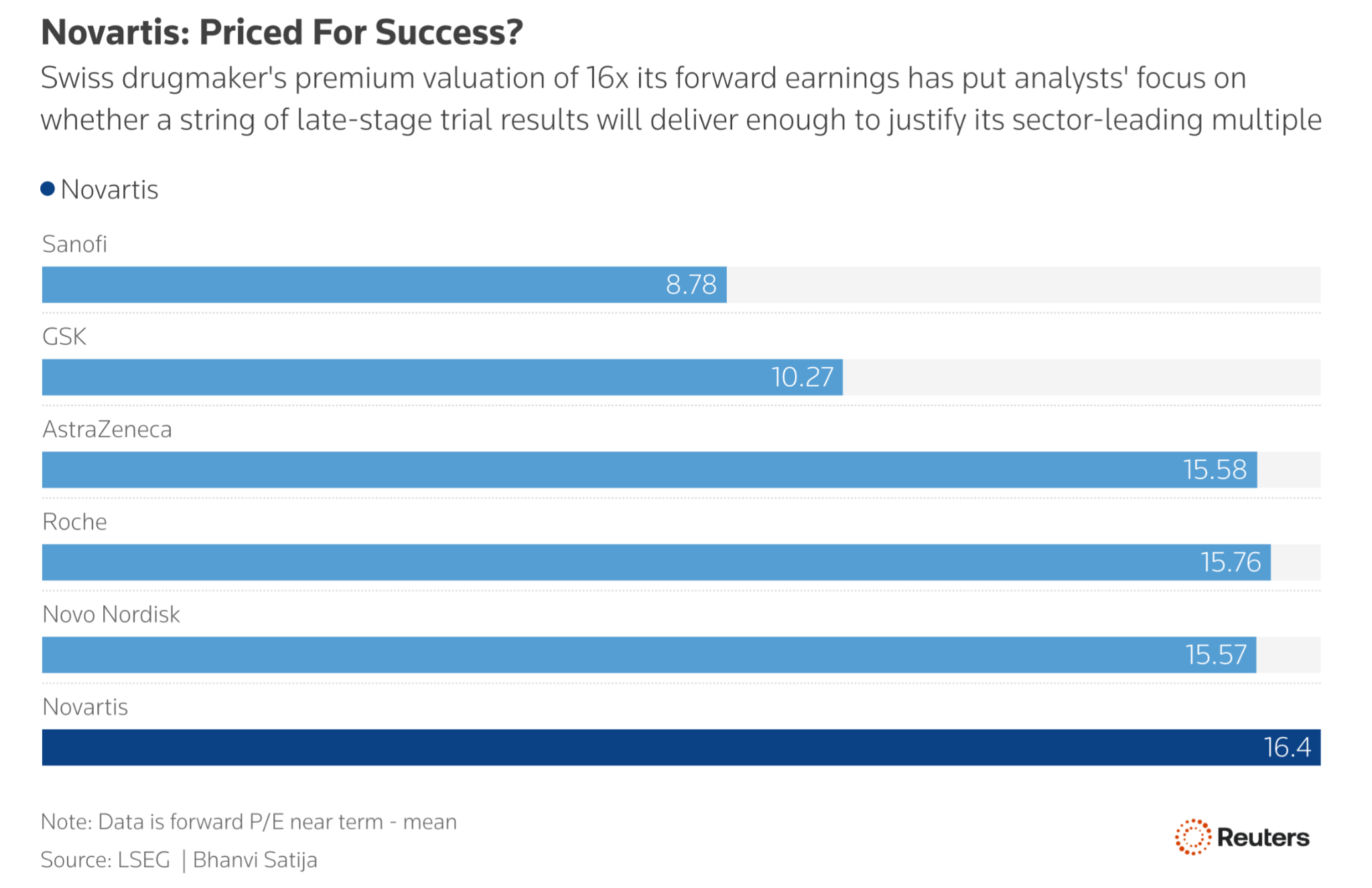
Analyst sentiment reflects this high-stakes environment. Jefferies has emphasized that sustaining the current valuation multiple will depend heavily on strong second-half momentum and successful upcoming pipeline readouts. Goldman Sachs has similarly argued that the company needs positive results from at least two of its three major late-stage trials; otherwise, Novartis’ sector-leading valuation could face meaningful downward pressure.
In that context, the July 21 earnings release will matter for more than just quarterly performance. It will offer investors a clearer view of whether Novartis can successfully navigate both its near-term patent cliff and the longer-term transformation of the global pharmaceutical pricing landscape.
Sources: CNBC, Novartis, Reuters, European Commission, White House