
The New Zealand Dollar is trading lower on Monday as the recent surge in commodity prices shows signs of weakening on indications of progress in talks between Russia and Ukraine to end their three-week war.
A stronger U.S. Dollar is also weighing on its New Zealand counterpart amid expectations of the Fed’s first rate hike since the pandemic began in March 2020. A rate hike from the U.S. central bank is considered a certainty this week and financial market traders have already priced in six or seven for this year.
At 09:22 GMT, the NZD/USD is trading .6796, down 0.0016 or -0.24%.
The Reserve Bank of New Zealand (RBNZ) last month raised its key rate by 25 basis points to 1% and forecast a higher peak in the tightening cycle.
A recent statement by the RBNZ said more work needs to be done to control inflation and that it’s too early to assess the impact, if any, of the Russian invasion on policy – a reminder that the central bank is one of the most hawkish among developed countries.
Financial futures investors are confident of a 0.5% increase in April, and expect rates to hit 2.75% by year-end.

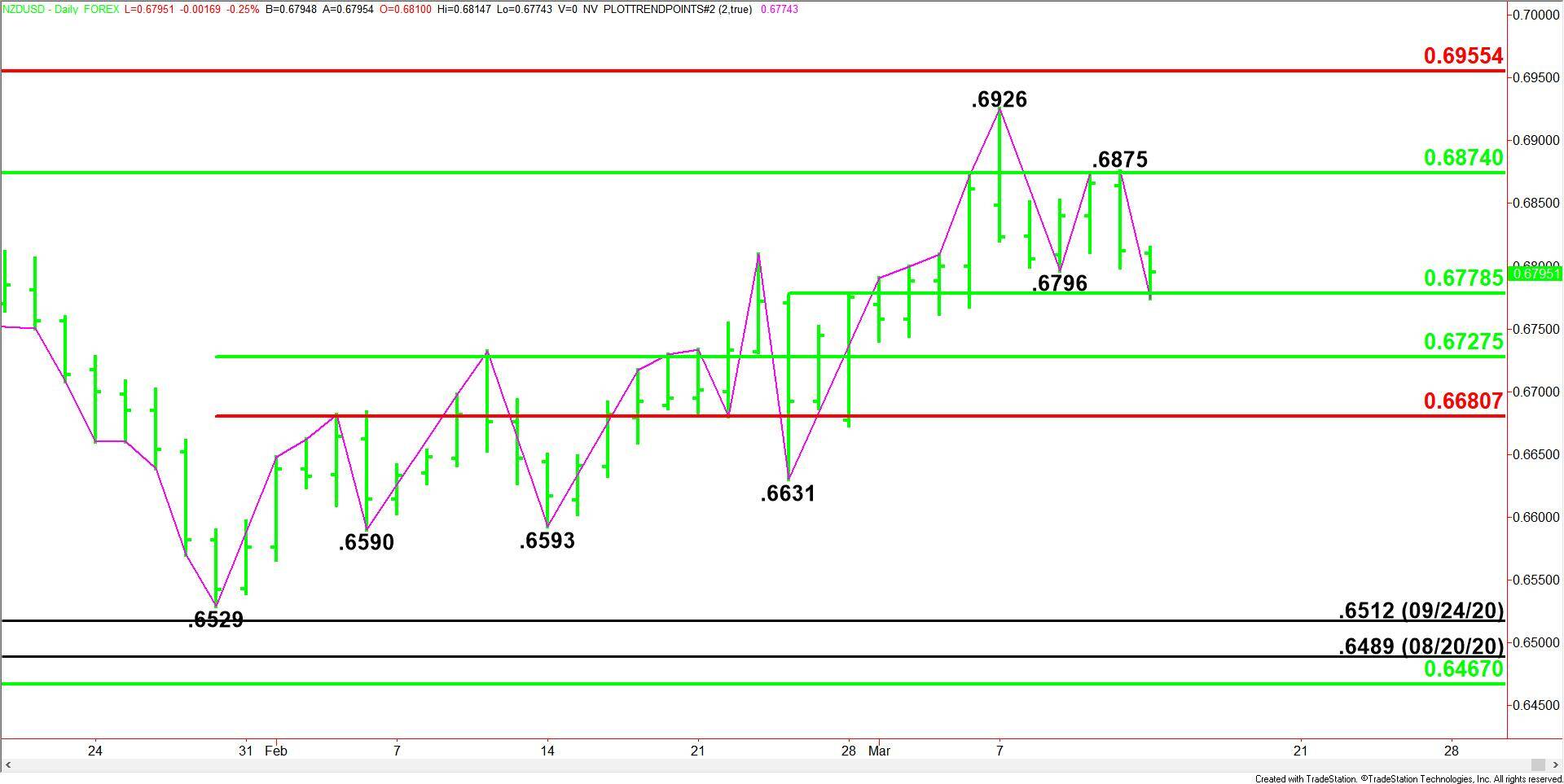
Daily Swing Chart Technical Analysis
The main trend is down according to the daily swing chart. The trend turned down earlier today when sellers took out the last main bottom at .6796. A move through .6875 will change the trend back to up.
On the upside, the major resistance is the longer-term retracement zone at .6874 to .6955.
On the downside, the first support is the minor 50% level at .6778. It was tested earlier today. The short-term retracement zone at .6727 to .6681 is propping up the market.
Daily Swing Chart Technical Forecast
The early price action suggests the direction of the NZD/USD on Monday is likely to be determined by trader reaction to .6778.
Bearish Scenario
A sustained move under .6778 will indicate the presence of sellers. If this move generates enough downside momentum then look for the selling to possibly extend into the short-term 50% level at .6727. Prices could collapse into the Fibonacci level at .6681 if the selling pressure increases.
Bullish Scenario
A sustained move over .6779 will trigger a short-covering rally with .6824 the next target. Since the main trend is down, sellers could come in on the first test of this level. Overcoming it, could trigger a surge into the resistance cluster at .6874 to .6875.