



Oil Swings $26 in a Week Then Settles Near $96 as Fear Trade Unwinds
May WTI crude had a week I won’t forget quickly. High of $117.63, low of $91.05, settled at $96.57. That’s a $26 range and a weekly loss of $14.97 or 13.42%. I’ve been covering oil for a long time and weeks like this don’t come around often.
Fear Drove the Rally, Ceasefire Killed It
The run to $117 had one driver. Fear. Traders were scrambling to get long ahead of what looked like a worst case scenario for Strait of Hormuz supply. Then the ceasefire hit and it was over. The risk premium that took weeks to build came out in days. Crude broke back below $100 and the selling fed on itself. Nobody wanted to be the last one holding a position built entirely on a war scenario that just got taken off the table.
The Physical Market Is Still Tight
I want to be clear about something. The selloff didn’t fix anything. The infrastructure damage across the Gulf is still there and tankers are still not moving freely through the Strait of Hormuz. The price came down because fear came out, not because supply came back. The physical oil market is tighter than the price action suggests right now. OPEC+ signals around potential production increases and slightly higher U.S. inventories added to the downward pressure but they didn’t change the underlying supply picture.
Weekly Forecast
The tone going into next week is slightly bearish. The geopolitical premium has been removed and that keeps pressure on prices as long as the ceasefire holds. But the supply disruptions haven’t been fixed and that puts a floor under the market. Expect two-way volatility. Any headline out of the Middle East can move this market sharply in either direction. Watch the $91.05 low. If that holds, the broader uptrend stays intact. If it breaks, the next support zone is $84 to $90.
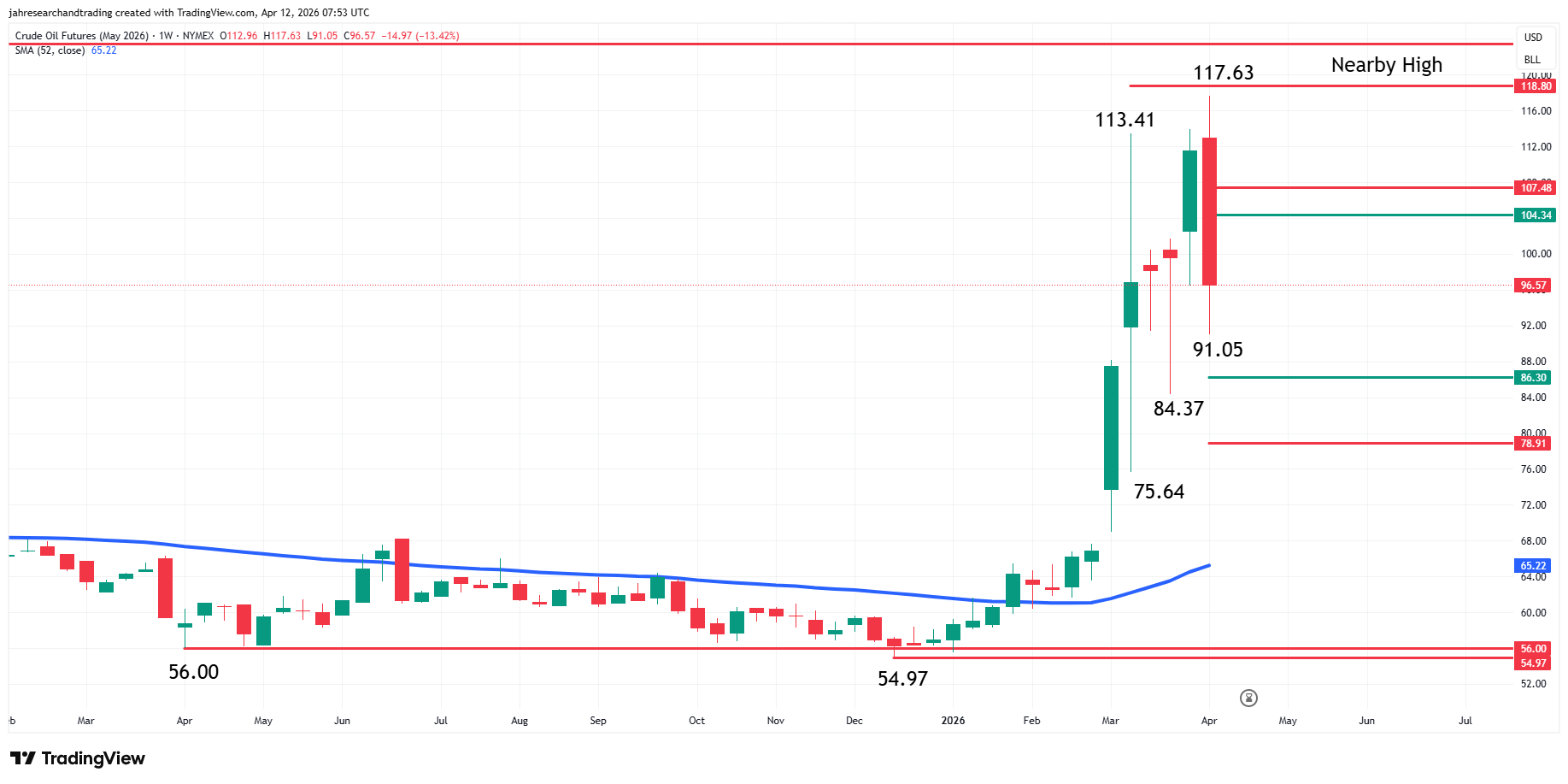
Technically, the main trend is up, but last week’s closing price reversal top suggests momentum may be getting ready to shift to the downside.
Brent Oil Price Forecast
Every new Brent Oil analysis as it publishes, today's technical signal and key levels, live price — on one page.
See all Brent Oil forecastsThe potentially bearish chart pattern will be confirmed by a trade through $91.05. If this occurs then look for the selling to possibly extend into the retracement zone at $86.30 to $78.91. Since the trend is up, watch for buyers to return on a test of this zone.
The new short-term range is $117.63 to $91.05. Its 50% to 61.8% retracement zone at $104.34 to $107.48 is the key area to watch. Overcoming will be a sign of strength. However, if sellers defend it then assume the bias is shifting to the downside.
More Information in our Economic Calendar.