Markets on Monday are balancing renewed energy concerns against hopes that corporate earnings can support equities. Oil has reversed earlier losses and shown significant strength, while the U.S. dollar remains firm and investors prepare for U.S. inflation data in the next few days.
The central question is whether businesses and households can absorb the rising cost of energy and higher financing costs, or whether there will be a major drop in growth in the United States. The market still sees equity resilience, though alongside currency and sovereign debt stress, depending on the country we are speaking of.

Crude Oil Rising Again
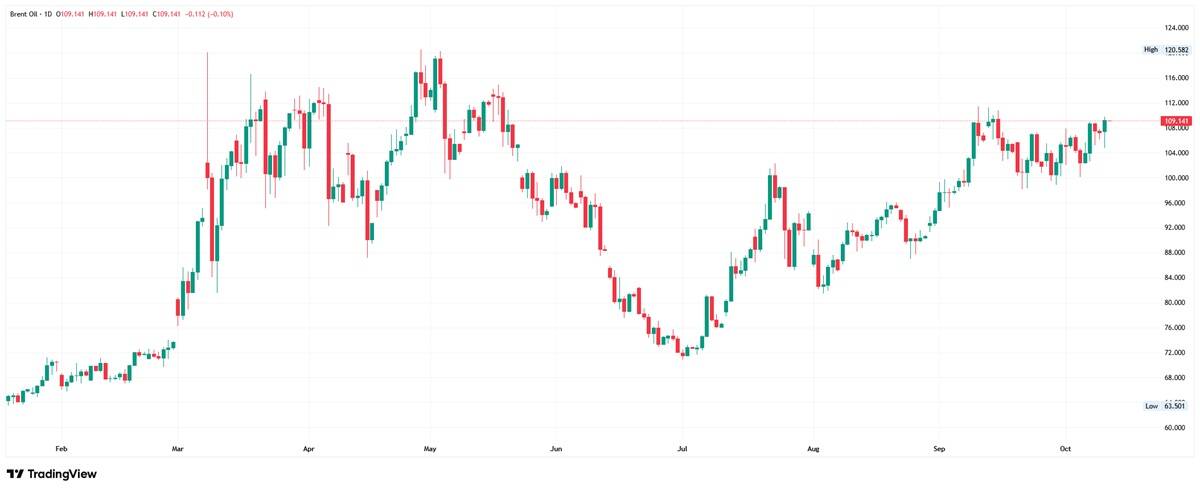
Brent futures have jumped to over $109 a barrel and WTI to over $94. Attacks on Saudi Arabia and regional shipping have renewed supply concerns. President Donald Trump claimed that there is a Russia-Ukraine energy ceasefire, but Ukraine subsequently accused Russia of violating it, while Moscow had not commented. A durable settlement therefore remains very shaky and unconfirmed in that area of the world.
Russian Diesel
There is a confirmed policy development behind the diesel discussion, though. On October 9, the United States Treasury Office of Foreign Assets Control issued Russia-related General License 135, which authorizes transactions involving diesel that originates in Russia. This is an announcement influencing trading on Monday, as it establishes a legal authorization, but it does not establish how much fuel will actually reach consumers, how quickly additional deliveries can take prices down, or whether it will simply be another round of minor movement.
Markets need evidence of supply being delivered before treating diplomatic announcements as lasting relief from inflation. More available diesel will ease transport and industrial costs, whereas persistent disruption of shipping could offset that benefit. For oil-importing economies, sustained energy costs can squeeze purchasing power and external balances, which will complicate the choices facing many central banks. Japan is one example; another could be Germany and Central Europe as a whole.
Continued US Dollar Demand
Currency trading has reflected continued U.S. dollar demand, as the U.S. Dollar Index is up slightly and the euro is giving up its earlier gains. The dollar’s resilience suggests investors are weighing overseas risk alongside relative interest rates rather than responding solely to the prospect of another interest-rate hike from the Federal Reserve.
AUD/USD Price Forecast
Every new AUD/USD analysis as it publishes, today's technical signal and key levels, live price — on one page.
See all AUD/USD forecastsEuropean fiscal concerns remain another source of uncertainty. Bloomberg has reported upward pressure on French yields again from political deadlock over fiscal policy. The British pound is somewhat unchanged, while the euro has weakened against it. Higher sovereign yields can hurt a currency when investors see deteriorating credit confidence rather than stronger growth.
Bank of India and Oil Pressures
India has seen itself be an example of policy addressing energy-related currency pressure. According to the Reserve Bank of India, its special dollar facility for Indian Oil, Hindustan Petroleum, and Bharat Petroleum takes effect today. Dollars will be sold through designated banks. Redirecting these purchases can help relieve spot-market demand, although it cannot itself reduce the underlying cost of imported energy.
The Federal Reserve’s next decision comes against a recently tightened policy backdrop. In the September 16 statement, it confirmed a quarter-percentage-point increase to the 3.75% to 4% target range, citing elevated inflation. This is established policy, nothing new, but the next meeting on October 27 and 28 could be a mover.
CPI and PPI
The latest completed CPI release showed August consumer prices rising 0.4% on the month and 3.4% year over year. Excluding food and energy, the increases were 0.3% and 2.4%. The next report’s composition will be as important as its headline, because persistent broad inflation would present a different policy challenge than energy shocks.
The Bureau of Labor Statistics releases September CPI on Wednesday and PPI on Thursday. Both of those will be big movers this week, with monthly headline CPI at 0.6% and core CPI at 0.2% expected. Equities showed limited conviction ahead of those tests, with futures markets up ever so slightly and the S&P 500 and Nasdaq 100 futures down just over 20 basis points.