
Together, they point towards something potentially much bigger: the world may be entering a structural repricing of the resources it cannot function without.
For anyone still treating the Commodity rally as another temporary cycle, the greater risk may increasingly be waiting too long.
“The biggest mistake traders and investors can make now is looking at Energy, Metals and Agriculture as separate stories,” says Lars Hansen, Head of Research at The Gold & Silver Club. “They are increasingly different expressions of the same underlying force: scarcity.”

The $100 Oil Signal Is Becoming Harder to Ignore
Consider what is happening in Oil.
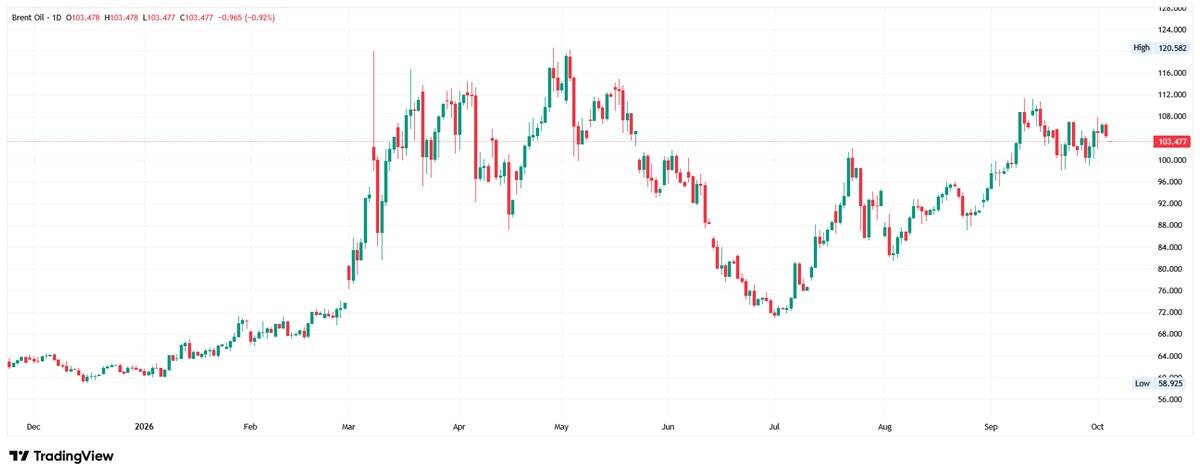
Middle Eastern crude exports have recovered sharply, yet Brent remains above $100 a barrel – approximately 40% above pre-war levels.
The reason is increasingly about more than production.
Global Oil logistics have been transformed. Rates for VLCC tankers carrying crude from the Middle East to Asia recently exceeded $1.3 million per day, compared with roughly $30,000 in January. Freight that previously represented around 3% of the delivered cost of Oil can now account for approximately 27%.
Meanwhile, analysts estimates the global Oil deficit at around 1.6 million barrels per day, even after improving dramatically from roughly 4 million barrels during peak disruption.
This is the new Commodity equation.
The world may have Oil. But accessing it, transporting it, refining it and delivering it where it is needed has become considerably more expensive.
“Scarcity is no longer simply about what exists underground,” Hansen says. “It is about what can actually reach the consumer, in the right form, at the right time.”
Brent Oil Price Forecast
Every new Brent Oil analysis as it publishes, today's technical signal and key levels, live price — on one page.
See all Brent Oil forecastsGovernments Are Now Fighting for Fuel
Perhaps nothing demonstrates the seriousness of the situation better than government intervention.
China – home to the world’s largest refining system – suspended October fuel-product exports as Beijing prioritised domestic energy security. Commercial Chinese diesel and gasoil inventories were estimated at roughly 20 million barrels below the level authorities wanted before normalizing exports, while gasoline inventories were approximately 9 million barrels short.
The G7 has meanwhile agreed to coordinate the release of 100 million barrels of crude and refined products from emergency reserves, with diesel supplies front-loaded.
That sounds enormous.
Against global Oil consumption of roughly 100 million barrels every day, however, it provides perspective on the scale of the market governments are attempting to stabilize.
Emergency reserves can suppress immediate pressure.
They cannot manufacture refining capacity.
Diesel Is the Scarcity Trade Reaching the Real Economy
U.S Diesel recently hit a record $6.528 a gallon.
The U.S ultra-low-sulphur diesel crack spread – effectively a measure of refining profitability and product tightness – reached a record closing high of approximately $118 a barrel in September.
U.S refineries responded by operating at an extraordinary 96.3% average utilization during the third quarter, compared with 91.9% in 2024.
Yet tightness persisted.
That matters because Diesel powers freight, agriculture, mining, construction and manufacturing.
“Diesel is where an Energy shortage begins spreading through the entire economy,” Hansen says. “Every truck, excavator, combine harvester and supply chain paying more for fuel becomes another transmission mechanism for scarcity.”
Copper and Gold Are Sending Their Own Message
The phenomenon extends far beyond Energy.
Copper recently broke above $14,500 per tonne, reaching an all-time high as available supply outside the United States tightened.
Gold presents another striking signal.
Despite U.S Treasury yields reaching multi-decade highs – normally a substantial headwind for a non-yielding asset – Gold has remained above $4,000.
China imported 1,077 tonnes of Gold during the first eight months of 2026, putting annualized imports on course for their highest level in 11 years.
Central-bank Gold demand is forecast at approximately 720 tonnes this year, still substantially above pre-2022 levels.
Agriculture Could Be the Next Major Repricing
Now attention may be shifting towards food.
The FAO Food Price Index rose 1.5% in September to its highest reading in nearly four years.
But beneath the headline, the moves were considerably more powerful.
Global cereal prices jumped 5.1% in a single month and stood 17.2% above last year. Wheat gained 6.3%. Maize rose 5.6%. Sugar surged 6.1%. Sorghum jumped 13.7%.
World cereal trade is now forecast to decline 3.5% from 2025/26’s record level.
Energy, freight, fertiliser, weather and geopolitical disruption are beginning to intersect.
“You cannot print another harvest,” Hansen says. “And you cannot replace a lost growing season with lower interest rates. Agriculture is where financial markets collide most directly with physical reality.”
From the Year of Hard Assets to the Hard Asset Decade
This is why The Gold & Silver Club believes its “Year of Hard Assets” thesis may ultimately prove to have identified something considerably larger.
What if 2026 is not the end of the Commodity move?
What if it is the beginning?
Gold has already demonstrated the power of structural demand. Copper has broken records. Energy markets are forcing governments to deploy strategic reserves. Agricultural prices are accelerating.
Even mainstream portfolio thinking is shifting. UBS recently argued that Commodities deserve renewed consideration amid inflation uncertainty, geopolitical fragmentation and concerns over traditional stock-bond diversification.
The investment case is no longer simply about inflation.
It is about ownership of what the world cannot quickly replace.
There will be corrections. There will be violent pullbacks. Individual Commodities will move at different speeds.
But that may be precisely where opportunity lies.
“Physical supply cannot expand at the speed financial capital can recognise scarcity,” Hansen says. “When the market finally understands that imbalance, repricing can be extraordinarily fast.”
The world spent decades investing for abundance.
The Gold & Silver Club believes the next decade could reward those positioned for scarcity.
And if that thesis is correct, the greatest risk may no longer be entering the Commodity trade too early.
It may be discovering the Hard Asset Decade after the biggest moves have already happened.
Money Loves Speed. Scarcity Rewards Positioning.
The opportunity is now. The only question is: will you seize it – or let the Scarcity Trade leave you behind?
Where are prices heading next? Watch The Commodity Report now, for my latest price forecasts and predictions: