XRP tests support at $1.5 as a cascade of market developments triggers a Bitcoin (BTC) plunge, impacting the broader crypto market.
Hotter-than-expected US producer prices and US President Trump’s nominee for Fed Chair, Powell’s successor, signaled a shift in the Fed’s rate path. Waning bets on an H1 2026 Fed rate cut sent cryptos crashing lower. Extended US BTC-spot and XRP-spot ETF outflows overshadowed crypto-related legislative developments on Capitol Hill.
Nevertheless, the medium-term outlook remains cautiously bullish, despite testing key support at $1.5.
Below, I will explore the key drivers behind recent price trends, the medium-term (4-8 weeks) outlook, and the technical levels traders should watch.
US XRP-Spot ETF Extends Outflow Streak
The US-XRP spot ETF market reported $52.26 million in net outflows in the reporting week ending January 30. This week’s outflows followed last week’s $40.64 million in net outflows, which had snapped a 10-week inflow streak.
XRP-spot ETF weekly outflows stemmed from the Grayscale XRP ETF (GXRP) seeing $98.39 million in net outflows on January 29. Notably, GXRP has been the reason for two out of three total net outflow days for the US XRP-spot ETF market. GXRP reported net outflows of $55.39 million on January 20, resulting in total net outflows of $53.32 million for the day.
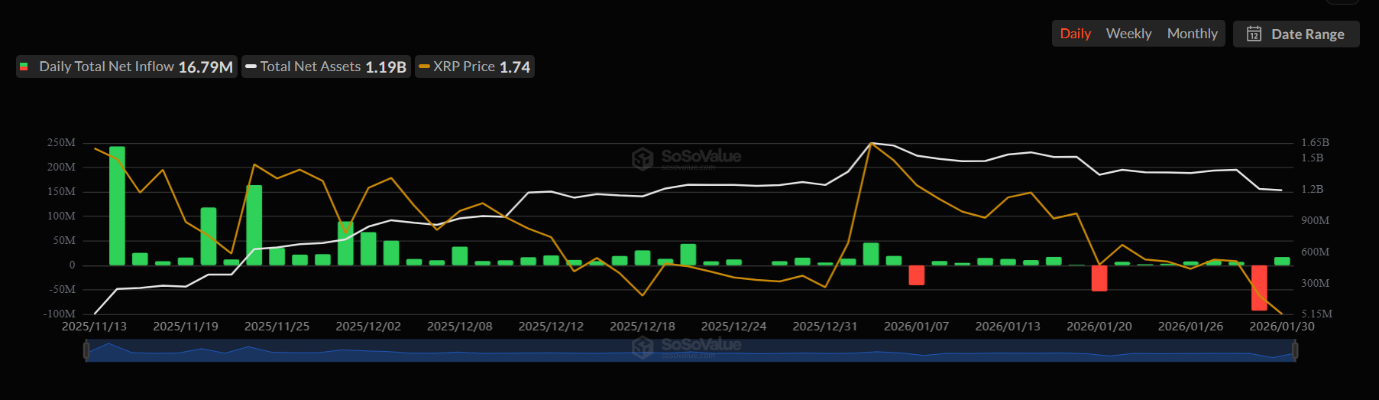
Despite the weekly outflows, the US XRP-spot ETF market has seen total net inflows of $1.18 billion since trading commenced in November 2025. In contrast, the US BTC-spot ETF has reported total net outflows of $4.3 billion since the US XRP-spot ETFs began trading. In January, the US BTC-spot ETF market saw net outflows of $1.61 billion, contrasting with net inflows of $15.59 million into US XRP-spot ETFs.
Nevertheless, given BTC’s status as the crypto market’s barometer, the spot ETF market’s extended outflow streak overshadowed monthly inflows into XRP-spot ETFs.
Despite BTC’s ongoing influences on sentiment, resilient demand for XRP-spot ETFs supports the medium- to long-term price outlook for XRP.
Bitcoin Price Forecast
Every new Bitcoin analysis as it publishes, today's technical signal and key levels, live price — on one page.
See all Bitcoin forecastsMarket Structure Bill Crucial for Bullish Medium- to Long-Term Projections
While BTC-spot ETF outflows may overshadow XRP-spot ETF inflows, crypto-related legislative developments could decouple XRP from BTC.
This week, the US Senate Agriculture Committee advanced its draft text of the Market Structure Bill. However, there was no bipartisan support for the text, as no Democratic Committee members voted to advance the markup.
Nevertheless, the advancement completed one important step toward much-needed crypto legislation. The onus now rests on the US Senate Banking Committee to release an updated draft text and schedule a markup vote. In January, the Banking Committee postponed its markup vote after Coinbase (COIN) withdrew its support for the Market Structure Bill.
Coinbase CEO Brian Armstrong cited the draft text’s stance on stablecoin yields as one of several reasons for withdrawing support for the Bill. Given US banks’ opposition to stablecoins offering yields and the crypto market’s push for rewards for stablecoin holders, the Banking Committee’s draft text may face more hurdles.
Finding common ground between the US banks’ push to retain depositors and crypto’s drive onto Main Street, targeting traditional depositors, will be crucial. XRP will likely return to a state of limbo as traders monitor developments on Capitol Hill. XRP holders faced a similar period of uncertainty during the lengthy SEC vs. Ripple case, which concluded in August 2025.
White House Crypto Meeting to Take Center Stage
The deep divide between US banks and crypto players has drawn the attention of the US administration.
On Monday, February 2, the US Administration is holding a White House meeting with crypto and banks. The US administration is offering a platform to address the issues surrounding stablecoin yields and advance the Banking Committee’s draft text. However, Monday’s meeting will not include major US bank CEOs or Coinbase CEO Armstrong, who withdrew his support for the Bill.
Crypto in America host and journalist Eleanor Terrett shared details of the meeting, stating:
“This is intentionally not a C-suite meeting, so Coinbase chief Brian Armstrong and major bank CEOs will not attend. Instead, the discussion will include senior policy executives, including Coinbase’s head of US Policy, Kara Calvert, along with crypto trade groups Blockchain Association, Digital Chamber, and Crypto Council. Banking representation will come from the American Bankers Association (ABA) and the Independent Community Bankers of America (ICBA).
Terrett added that the meeting is meant to be a working session to facilitate open dialogue on key issues relating to the Banking Committee’s draft text.
TradFi vs. DeFi: The Main Event
Monday’s session will give traders insights into whether TradFi and DeFi can find common ground. However, given the risks stablecoin yields pose to US bank profits, the session could be a testy one.
In July 2025, the American Bankers Association requested that the Office of the Comptroller of the Currency (OCC) delay banking license approvals for Ripple and Circle. The request underscored fears within the banking community that DeFi and stablecoins could materially erode US banks’ domination on Main Street.
Fast forward to January 2026, Bank of America CEO Brian Moynihan warned that more than $6 trillion in deposits could move from the US banking system to stablecoins if crypto legislation permitted stablecoin rewards/yields.
US banks fear that crypto legislation would put crypto firms on a level playing field. Higher stablecoin yields than negligible interest on deposits with US banks would materialize Moynihan’s worst fears, should stablecoin holders receive the same degree of protection.
An exodus of US bank deposits would mean less scope for lending or the need to tap wholesale funding, which is costlier than interest on deposits. Lower lending and/or narrower net interest margins (NIMs), the difference between interest paid and interest received on capital, would erode banks’ profits.
The crypto community and the US administration could suggest that US banks increase the interest offered on deposits to be more competitive with DeFi, or face the consequences. However, given the potential impact on NIMs, it seems implausible for banks to consider such an option without hiking interest rates on loans, which could adversely affect the broader economy.
These dynamics underpin the uncertainty over the Banking Committee advancing its draft text in the short term.
XRP Price Forecast: Short-, Medium-, and Long-Term Targets
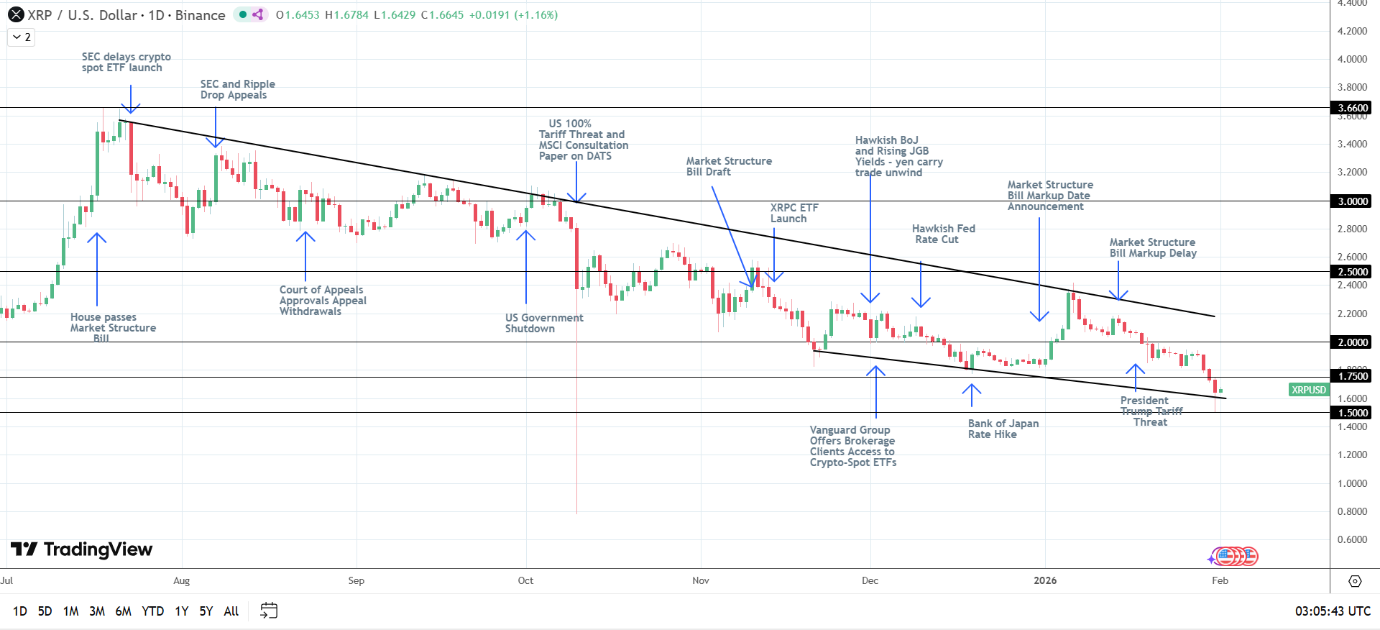
This week’s reversal left XRP below crucial support levels, indicating a bearish trend reversal and invalidating the positive short-term outlook (1-4 weeks). The bearish trend reversal indicates a negative short-term outlook, with a target price of $1.5.
However, bets on multiple Fed rate cuts, expectations that the Market Structure Bill will progress, and increased XRP utility continue to affirm the bullish medium- to long-term price projections:
- Medium-term (4-8 weeks): $2.5.
- Longer-term (8-12 weeks): $3.0.
Key Downside Risks to the Bullish Medium-Term Outlook
Several events could challenge the constructive bias. These include:
- A hawkish Bank of Japan, with a higher neutral interest rate (potentially 1.5%-2.5%). A hawkish BoJ rate path would narrow US-Japan rate differentials sharply, potentially triggering a yen carry trade unwind, as seen in mid-2024. A yen carry trade unwind would reaffirm the bearish trend reversal.
- Upbeat US economic data and falling bets on an H1 2026 Fed rate cut.
- Delays and/or partisan opposition to the Market Structure Bill.
- Extended periods of XRP-spot ETF net outflows.
These scenarios would weigh on demand for XRP, pushing XRP toward $1.5 and reaffirming the bearish trend reversal.
Technical Analysis: Levels to Watch
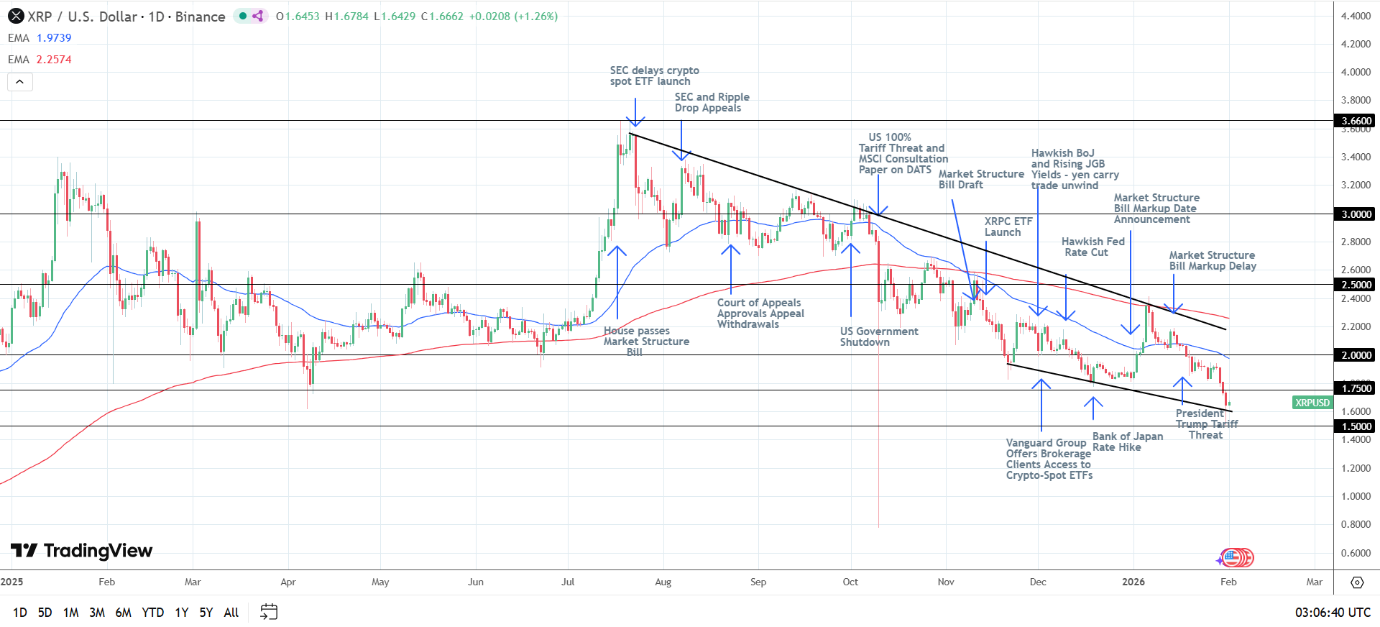
XRP fell 3.98% on Saturday, January 31, following the previous day’s 4.03% loss to close at $1.6454. The token faced less severe selling pressure than the broader crypto market cap, which plunged 6.36%, underscoring favorable fundamental developments for XRP.
Nevertheless, Saturday’s sell-off left XRP trading well below its 50-day and 200-day EMAs, indicating a bearish bias. However, several positive fundamentals continue to counter bearish technicals, supporting a bullish medium-term outlook.
Key technical levels to watch include:
- Support levels: $1.50 and then $1.0.
- 50-day EMA resistance: $1.9739.
- 200-day EMA resistance: $2.2574.
- Resistance levels: $1.75, $2.0, $2.5, and $3.0.
On the daily chart, a break above $1.75 would enable the bulls to target the 50-day EMA and $2.0. A sustained move through the 50-day EMA would signal a near-term bullish trend reversal, bringing $2.2 into play. A breakout above $2.2 would pave the way toward the 200-day EMA.
A sustained move through the EMAs would reaffirm the bullish medium-term price targets.
Fundamental Events Driving Near-Term Price Action
Near-term price drivers include:
- XRP-spot ETF flow trends.
- US economic data and the Fed’s rate path.
- Crypto-related legislative developments.
- The Bank of Japan’s neutral rate and rate path.
- Increased geopolitical risks.
Bearish Structure Exposes $1.5
Saturday’s drop to $1.5021 affirmed the bearish trend reversal and invalidated the bullish short-term outlook. A drop below $1.5 would expose the psychological $1 level. If breached, the October 10 flash crash low of $0.7773 (Binance) would be the next key support level. Crucially, a break below $1.5 would reinforce the bearish short-term outlook and validate the bearish structure.
Meanwhile, breaking above $2.0 would open the door to testing the upper trendline. A sustained move through the upper trendline would indicate a bullish trend reversal, invalidating the bearish structure. These scenarios would reaffirm the constructive medium-term bias.
- Short-term (1-4 weeks): $1.5.
- Medium-term (4-8 weeks): $2.5.
- Longer-term (8–12 weeks): target of $3.0.
XRP Outlook Hinged on Crypto Regulations and ETF Flows
Looking ahead, the progress of the Market Structure Bill will be crucial for XRP’s price trajectory. Updates from Monday’s White House session and the US Senate Banking Committee will influence sentiment. Advancing the draft text would lift hopes that the Senate will pass the Bill, driving XRP demand.
However, geopolitical risks, central bank chatter, and XRP-spot ETF flows will also dictate near-term price trends.
A more dovish Fed rate path and a lower BoJ neutral rate (potentially 1%-1.25%) would boost sentiment. Strong inflows into US XRP-spot ETFs and the progress of the Market Structure Bill would reaffirm the positive medium-term outlook.
In summary, these events support a medium-term (4–8 weeks) move to $2.5. The US Senate’s passing the Market Structure Bill would reaffirm the longer-term (8–12 weeks) price target of $3.0.
Beyond 12 weeks, these factors are likely to drive XRP to its all-time high of $3.66 (Binance). A break above $3.66 would support a 6- to 12-month price target of $5.