Chainlink’s LINK token has returned to a historically important accumulation area that preceded one of its strongest rallies, raising the possibility of a long-term price rebound in 2026–2027.

LINK Retests Its 2022–2024 Accumulation Range
As of Wednesday, Aug. 5, LINK was trading near $8.15 after falling below the upper boundary of the $7.01–$9.48 accumulation range. The same zone supported Chainlink throughout much of 2022 and 2023 before its price surged by roughly 550% from around $5 to above $30.
The historical comparison suggests long-term buyers may begin accumulating LINK again. However, the token could still decline toward the zone’s lower boundary near $7 before establishing a convincing bottom.
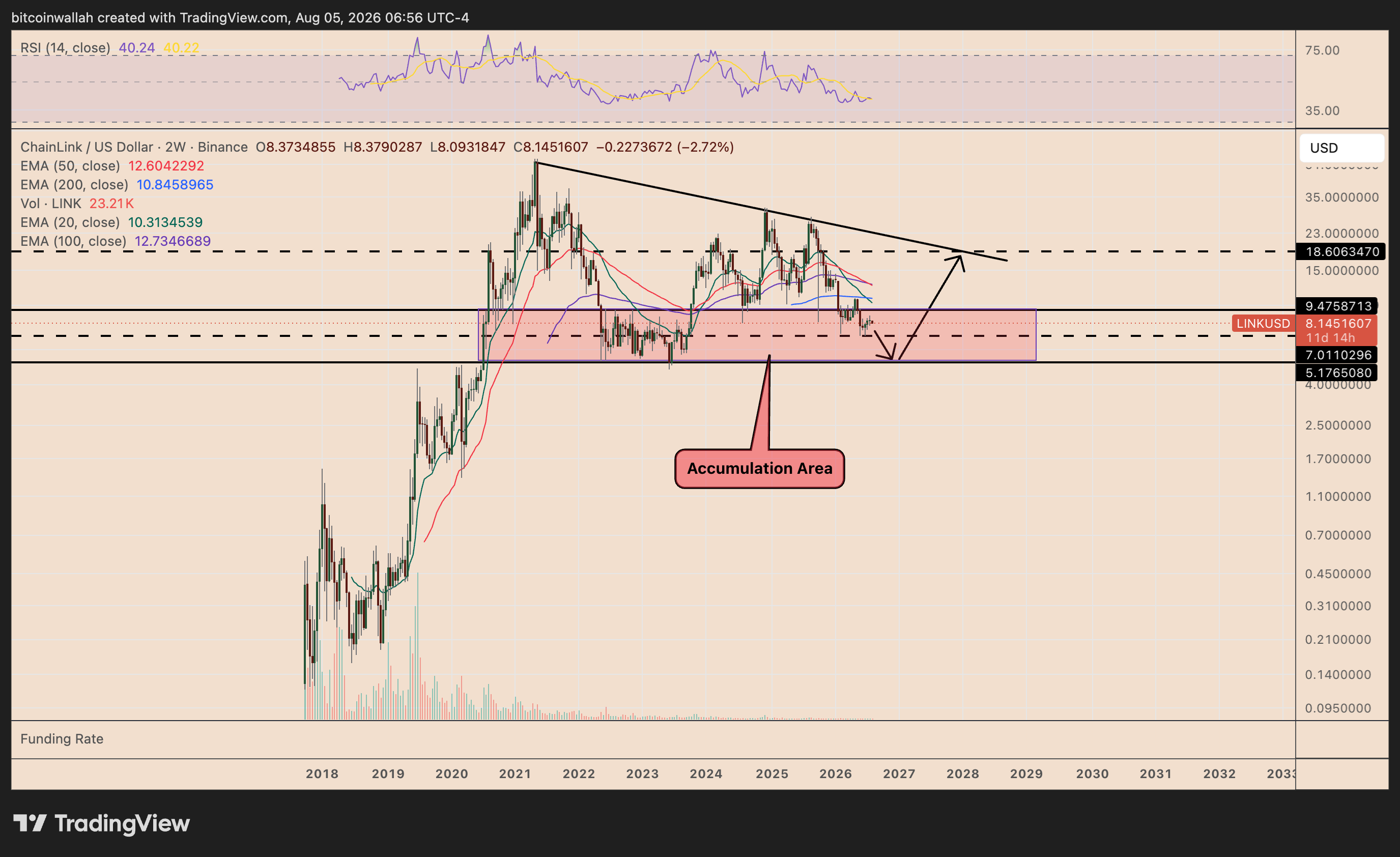
A decisive breakdown below $7 would weaken the bullish fractal and expose LINK to its next major support near $5.17. It was instrumental as a price floor during the 2022–204 period.
Chainlink remains below all major two-week EMAs, with resistance clustered between the 20-period EMA near $10.31 and the 100-period EMA near $12.73. Its RSI near 40 also shows that momentum remains weak, leaving room for another dip before conditions become oversold.
The main upside target is LINK’s multi-year descending trendline, which has capped major rallies since the 2021 peak. Depending on when price reaches it (perhaps in the 2027–2028 period), the resistance sits near $15–$18.60.
To approach that zone, LINK must first reclaim $9.48 and break above the $10.30–$12.75 EMA cluster. A successful breakout would clear the path toward the trendline, where another major rejection could occur.
LINK Supply Growth Remains a Bottleneck
Chainlink’s fixed supply is capped at 1 billion LINK. Around 748 million LINK are currently in the market, while the remaining tokens are being released gradually.
The current schedule adds roughly 70 million LINK to circulation each year. That equals about 7% of the total supply, but nearly 9% of the tokens are already circulating. In simple terms, the market must absorb a significant amount of new LINK every year just to keep the price stable.
Recent transfers have increased these concerns. Chainlink released 21 million LINK in June, with 18.375 million sent to Binance and the rest allocated for staking rewards. Another 19 million LINK was released in April.
Transfers to Binance do not prove that all the tokens were immediately sold. They may also be used for market-making, grants or operational expenses. Still, moving large amounts of LINK to an exchange makes the tokens easier to sell and adds to the market’s available supply.
Chainlink is trying to offset this pressure through its LINK Reserve, which uses network revenue to purchase and hold LINK. However, the reserve remains much smaller than the number of tokens released annually.
For now, LINK demand must grow fast enough to absorb the additional supply.