At the time of writing, Coffee Arabica, which is the most popular coffee species globally with at least 60% market share, is trading at $3.463 per pound. Since December 2024, the crop’s price chart has been printing a series of lower highs and lower lows that have now formed a clear bullish flag pattern. Coffee Arabica is testing the upper trendline of that flag, which it failed to break when it tested it last month, in July.
Bullish flags ideally break to the upside, but there are fundamentals that play heavily into where the price of Coffee Arabica will go. According to Safras & Mercado, Brazil, the world’s largest producer of the crop, is 7% behind on its coffee harvest completion rate for 2026/27 compared to the last year. The finer coffee arabica is not doing so well either, as its harvest is only 86% complete against the 95% of last year.
This current deficit in the 2026/27 harvest completion rate lowers the near-term market supply, which typically leads to higher coffee prices.
In addition, Intercontinental Exchange (ICE) reported a record low of 229,214 arabica bags, reinforcing the bullish thesis that’s driven by a possible short squeeze in the near future. The 2026/27 harvest deficit and low inventories serve as a floor beneath Coffee Arabica’s price as it trends within the flag.

Can the Flag Break Out Above 3.55?
The technical picture on Coffee Arabica is clear. Zooming out on the daily timeframe reveals a bullish flag pattern that is being tested at the upper limit around $3.463, at the time of writing. The flag ranges as far back as December 2024, with a support floor established in the 2.362 – 2.683 range. If price breaks above the upper trendline at 3.550 and closes beyond that level on the daily timeframe, the upward path to the $4.000 psychological level opens.
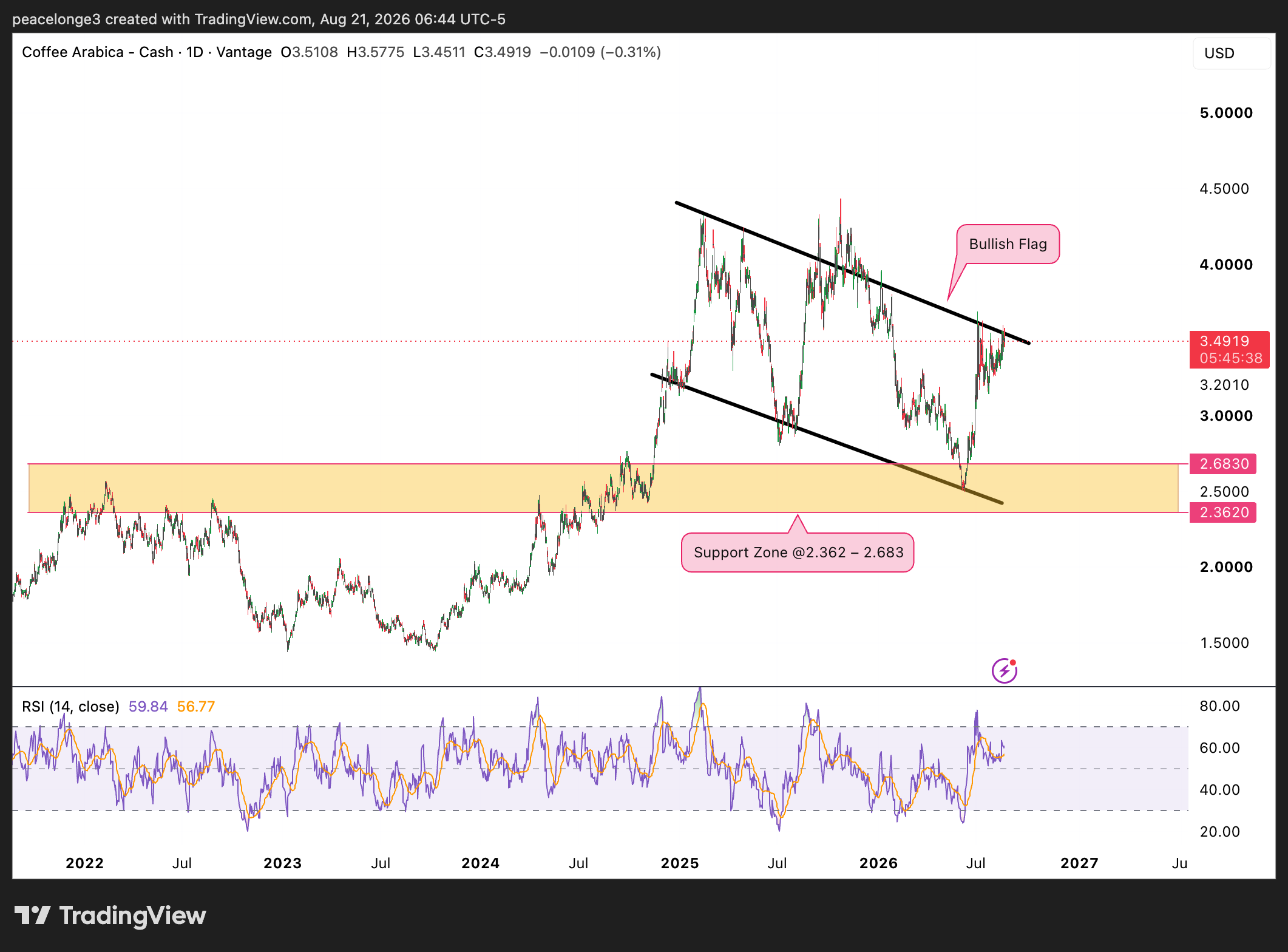
The RSI currently reads 57.68, which is slightly above the average level and well below the overbought region, meaning that there is still enough room for an upward run before the bulls get exhausted. Both the RSI and bullish flag are strongly indicative of a price move towards higher levels.
Where Does Price Go if the Flag Fails?
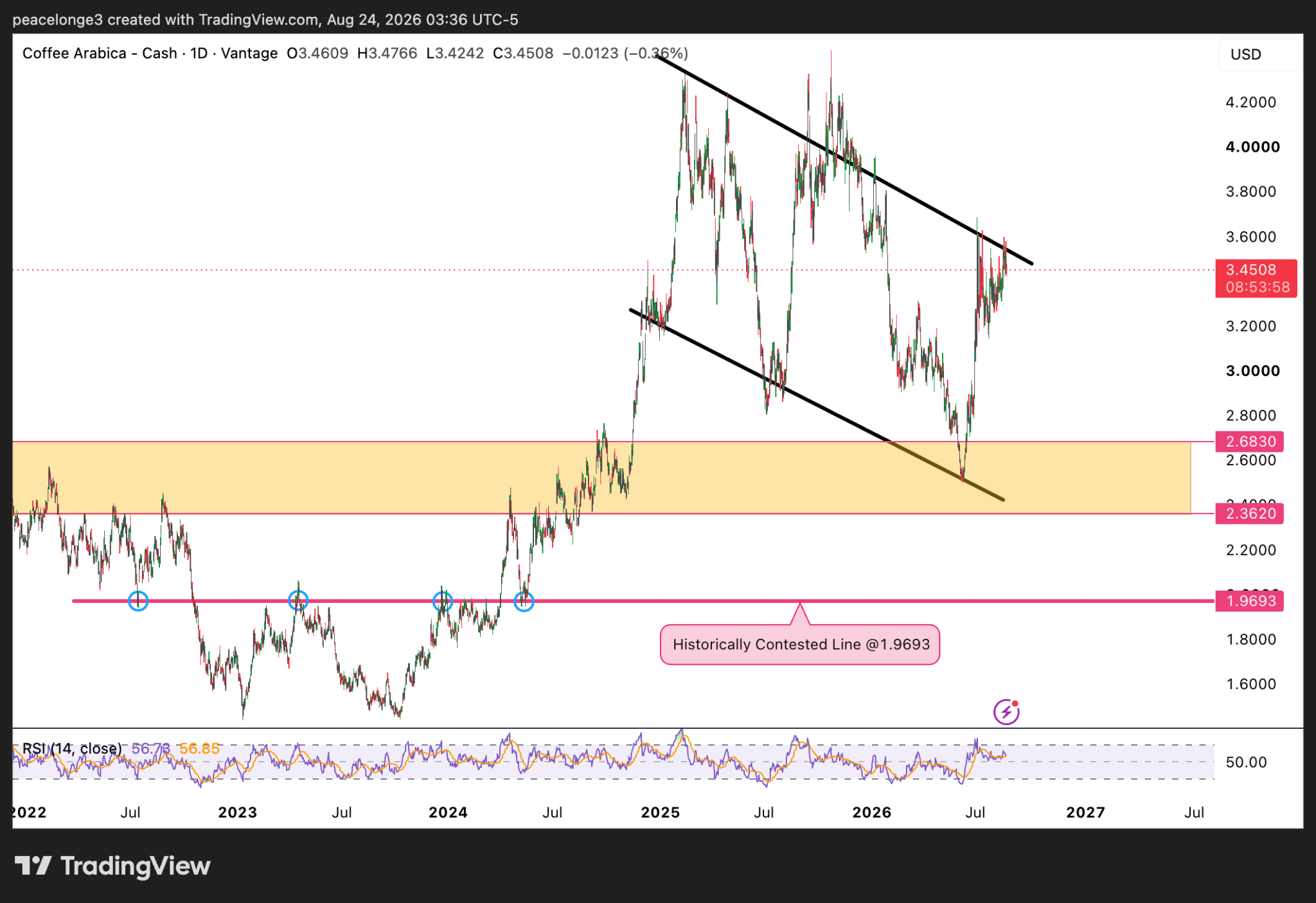
For the bears to win, the bullish flag has to be invalidated by a break and close outside the flag’s lower trendline. A strong rejection of the current upper trendline resistance at 3.508 can send price tumbling back to the 2.683 support line. If bearish momentum is maintained, price can keep falling through the 2.683 – 2.362 zone till it reaches the lower trendline of the flag. A daily close outside the support zone and the flag opens a downward path to the historically contested action line around 1.969
The bearish thesis is also supported by some fundamentals, although these ones are more likely to be felt in the long-term.
According to United States Department of Agriculture (USDA) forecasts, the total robusta and arabica coffee harvests for Brazil are expected to climb to a new high of 71.9 million bags in 2026/27, despite the currently low inventory record of 229,214 bags. What this means is that while the market’s current supply pace is slowed due to delayed crop harvest, the potential yield at the end of the day is still massive and very real. Once those delays are cleared, a serious wave of coffee beans will hit the market, shocking the bulls and diluting price, which ultimately leads to cheaper supply.
To that effect, it is worth noting that the USDA’s forecasts also predict Brazil’s arabica output to increase by 9.5 million bags from the last season. Additionally, the department forsees a 6% increase in global output of coffee to a record 189.7 million bags in 2026/27, with 26.3 million bags in reserves. Once these supplies hit the market, they will create a selling pressure on Coffee Arabica’s price that could keep the upper trendline of the bullish flag unbroken and send price lower.
The Key Risk to Each Thesis
The main risk for bulls is the impending full harvest of global Coffee Arabica, especially in Brazil. The weather is getting drier, which is bringing the previously slowed 2026/27 harvest rate to full completion. The expectation of a record harvest is keeping price trapped within the flag, and once the beans hit the market, price will be diluted and coffee arabica will potentially be sold cheaper, supporting the bearish thesis and a potential drop to the downside.
The risk to the bearish thesis lies in weather factors, as Global monitoring systems like the NOAA Climate Prediction Center and the World Meteorological Organization warn of a potential El Niño event that could cause extreme weather conditions and seriously impact the harvest yield of agricultural produce worldwide. All this is in addition to the already certified record low inventories, and any threat of the growth of those inventories will bring concerns that ultimately favor the bulls.