
Gold Tests Key Retracement Zone — Reaction Will Determine Next Move
Spot gold is extending its weekly gains on Wednesday, testing a key retracement zone that could determine the near-term direction of the precious metal. CNBC is also reporting that analysts believe further gains will depend on currency movements and interest rate direction.
At 12:52 GMT, XAUUSD is trading $5053.25, up $106.44 or +2.15%.

Normal Retracement After Steep Sell-Off — But Is This the Bottom?
What we are currently experiencing is a normal retracement following a steep sell-off from a record high. Typically, the first leg down from a major top is primarily long-liquidation. After establishing a bottom, a market will go on a huge run that retraces 50% to 61.8% of the first sell-off. That is where we are at now. Investors are facing a major decision: buy strength and proceed to test the all-time high, or sell the rally, looking for a better entry price.
We’re not confident whether the buying earlier in the week was for the long-run or just a quick rally chasing cheap prices amid lingering volatility. Trader reaction to the retracement zone should give us some clues. It’s not that they’re hesitant about the long-term prospects, it’s just that the volatility has shaken investor confidence at this time.
Wall Street Still Bullish — J.P. Morgan Sees $6300 by Year-End
J.P. Morgan appears to be ignoring the short-term policy and sticking with their long-term forecast of $6300 by the end of 2026. That’s about $700 higher than the current record high. They are citing forecasts calling for central-bank purchases of 800 tons this year, saying that the banks will continue to buy gold in an effort to shed their exposure to the U.S. Dollar.
“Even with the recent near-term volatility, we remain firmly bullishly convicted in gold over the medium-term on the back of a clean, structural, continued diversification trend that has further to run amid a still well-entrenched regime of real asset outperformance vs paper assets,” the brokerage said in a note on Monday.
Gold Price Forecast
Every new Gold analysis as it publishes, today's technical signal and key levels, live price — on one page.
See all Gold forecastsDeutsche Bank also sees a resumption of the rally with a forecast of $6000 in 2026. They see investor demand as the primary reason for the rally to continue.
Citibank has toned down its previous forecast to $5000, while HSBC and ANZ see prices hovering near the recent lows at $4450 and $4400, respectively.
Trend Remains Up — Watch the $5002-$5144 Zone
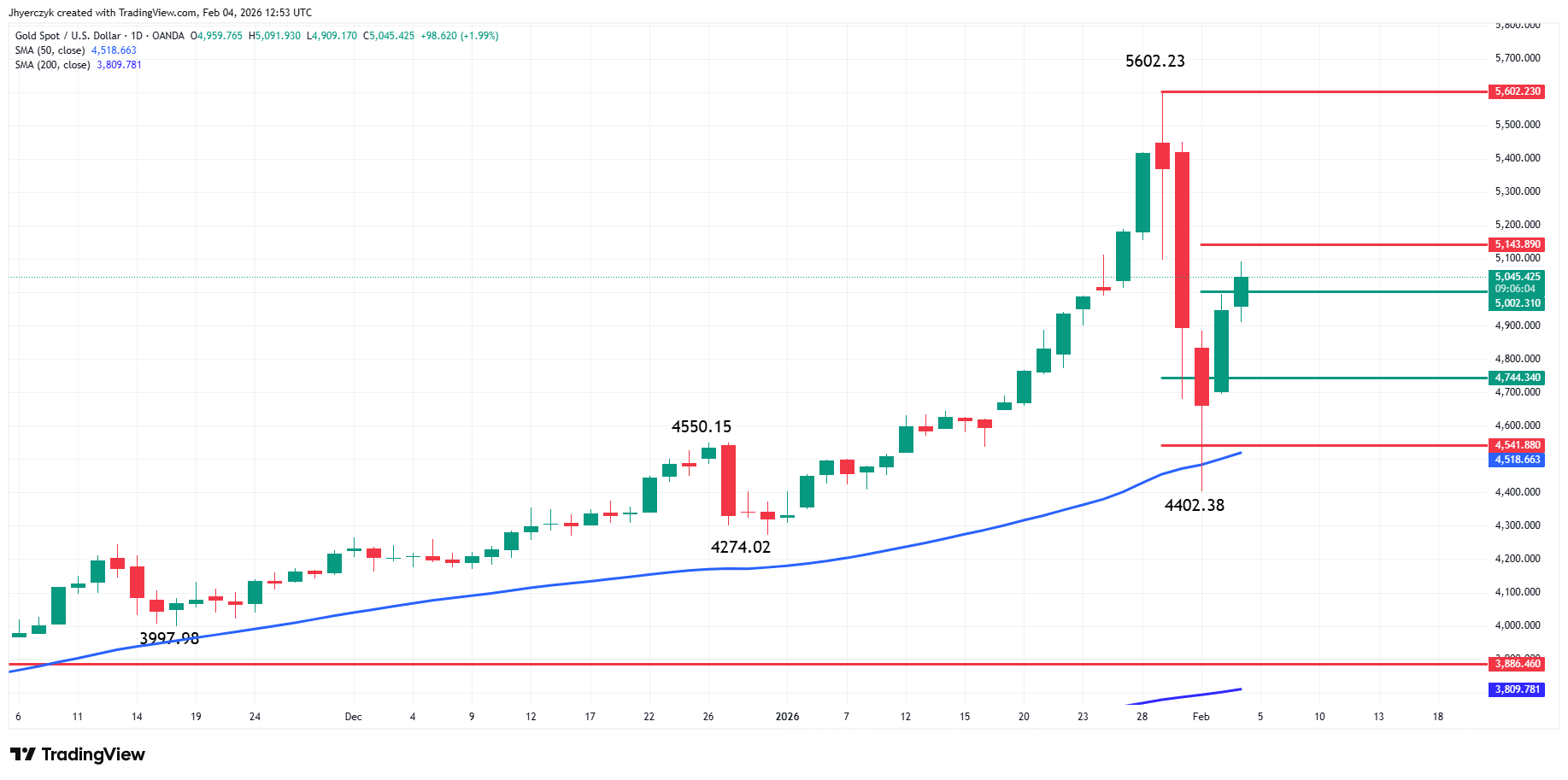
Technically, the trend is up. A trade through this week’s low at $4402.38 will shift momentum to the downside with a change in trend likely beginning under the December 31 main bottom at $4274.02.
Key support has been established near the 50-day moving average at $4402.38 and the retracement zone at $4744.34 to $4551.88.
The short-term range is $5602.23 to $4402.38. The market is currently testing its retracement zone at $5002.31 to $5143.89. Trader reaction to this zone will determine the near-term direction.
A sustained move over $5143.89 will signal the presence of strong buyers. This could lead to a test of the record high at $5602.23 if the momentum continues to build.
A sustained move under $5002.31 will indicate the return of sellers. This could lead to a retest of the retracement zone support and the moving average.
Until we break out of the $5602.23 to $4402.38 trading range, look for a rangebound trade and elevated volatility.
More Information in our Economic Calendar.