Tariff Shockwaves Hit Wall Street
US equity markets reeled Tuesday as tariff fears resurfaced, shaking confidence from Wall Street to Shanghai. The Nasdaq Composite Index slipped 0.05%, while the Dow and the S&P 500 fell 0.38% and 0.17%, respectively.
Boeing (BA) dropped 2.36% after Beijing reportedly ordered its airlines to suspend further deliveries, intensifying trade tensions.
US economic indicators took a back seat despite the NY Empire State Manufacturing Index rising more than expected in April.
Overnight, news of President Trump imposing export restrictions on Nvidia’s (NVDA) H20 chip dragged US futures markets lower, setting a negative tone for the Asian market session on Wednesday, April 16. The Nasdaq 100 Futures fell 265 points, while the Dow Jones Futures dropped 117 points.

China GDP Beats Forecasts But Tariffs Weigh on Outlook
China’s economy expanded by 5.4% year-on-year in Q1 2025, matching Q4 2024 growth and beating the 5.1% forecast.
March retail sales, unemployment, and industrial production figures also exceeded expectations. However, the market reaction was muted amid escalating US-China trade frictions. Alicia Garcia Herrero, Asia Pacific Chief Economist at Natixis, remarked:
Nikkei Price Forecast
Every new Nikkei analysis as it publishes, today's technical signal and key levels, live price — on one page.
See all Nikkei forecasts“China’s first quarter GDP data is out and it is very positive (5.4% versus 5.2% estimated by consensus) but nobody cares. Hong Kong’s stock market and Asia’s, more generally falling. Tariffs and a decelerating global economy (led by the US) are just much more important.”
Hang Seng Index Slides on Trade Risks
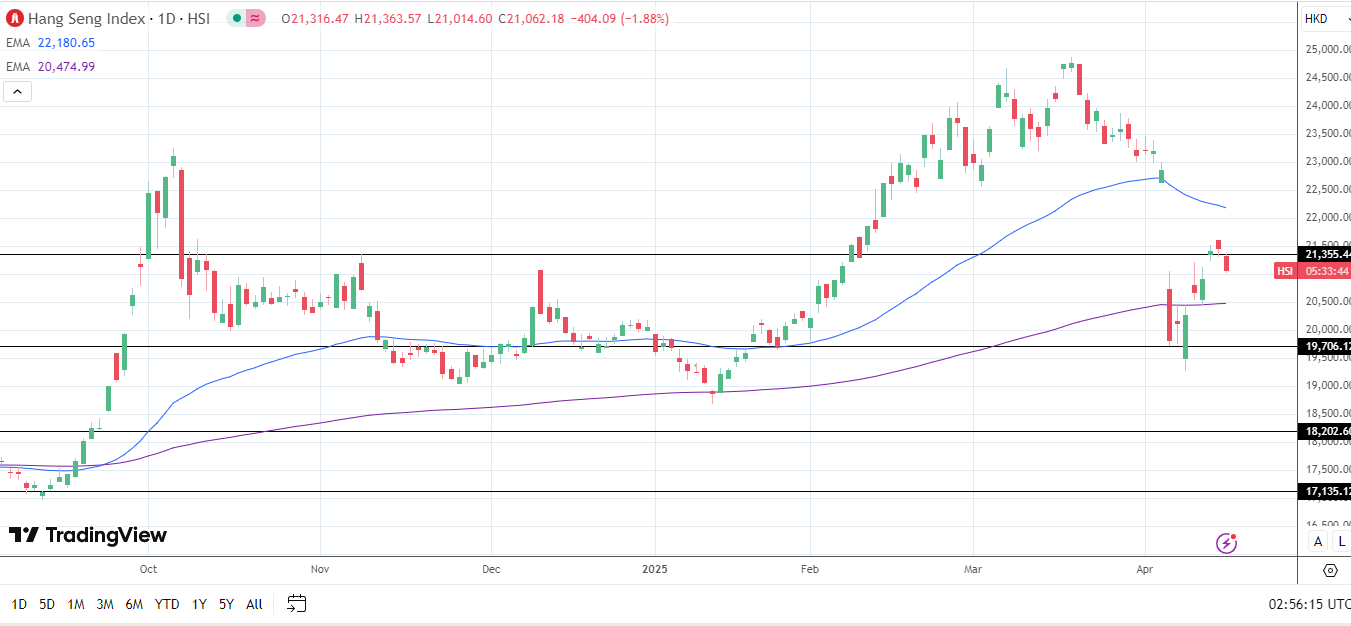
In Asia, the Hang Seng Index slid by 1.88% in early trade on April 16 as trade tensions overshadowed China’s upbeat economic data. Tech stocks led the losses as investors reacted to the Nvidia news, with the Hang Seng Tech Index tumbling 3.6%.
- Tech giants Alibaba (09988.HK) and Baidu (09888.HK) fell 4.09% and 2.43%, respectively.
- EV makers also faced selling pressure, with NIO Inc. (09866.HK) and Li Auto Inc. (02015.HK) dropping 4.65% and 3.49%, respectively.
Mainland China’s equity markets posted modest losses, buoyed by China’s latest stats. The CSI 300 and Shanghai Composite Index fell 0.73% and 0.53%, respectively.
Nikkei 225 Declines as Yen Strengthens
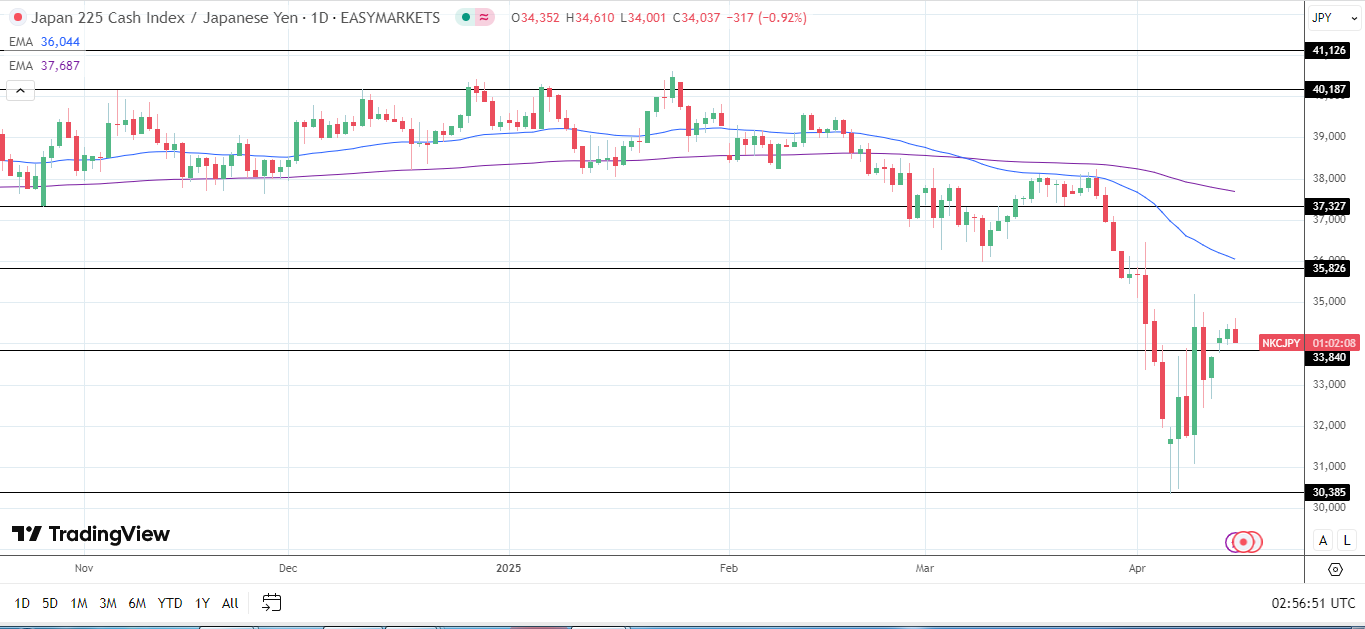
The Nikkei 225 declined by 0.73% in the morning session, pressured by tech sector weakness and a stronger Yen. The USD/JPY pair fell 0.44% to 142.606, raising concerns about export competitiveness and corporate profits.
Softbank Group Ltd. (9984) led the declines, falling 2%.
ASX 200 Advances on Gold Rally
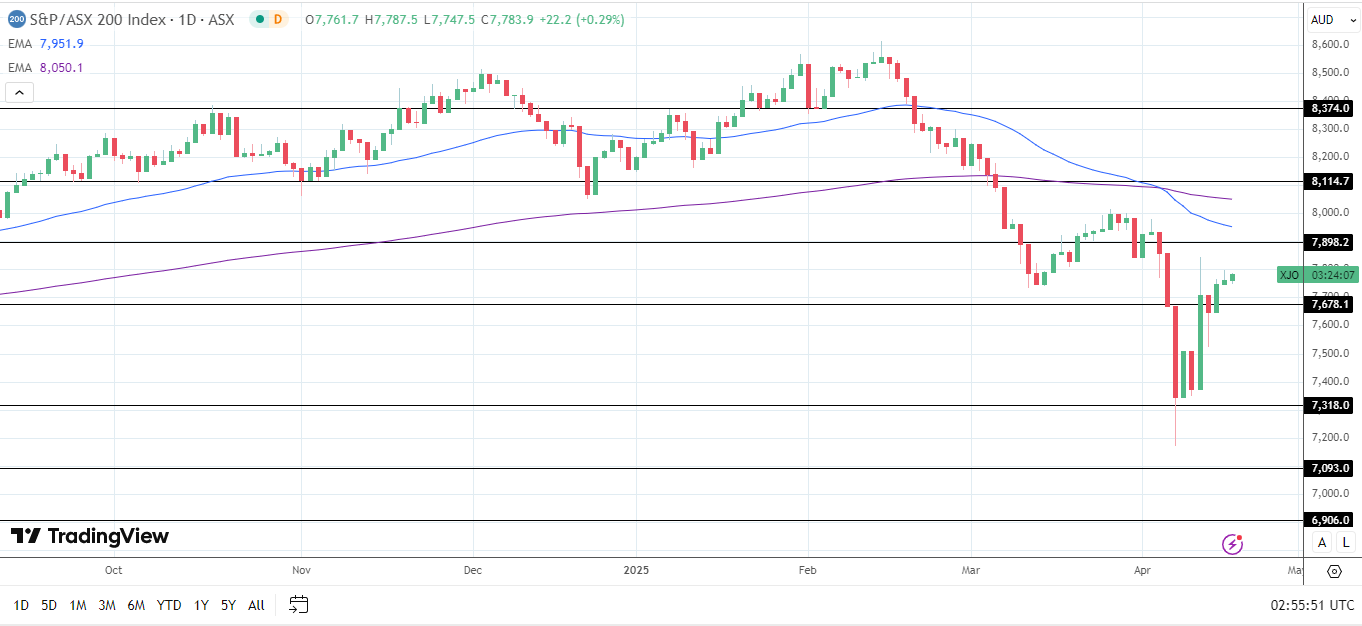
Australia’s ASX 200 extended its gains from Tuesday, rising 0.29% early in Wednesday’s session. Banking, gold, and tech sectors contributed to the gains.
- Westpac Banking Corp. (WBC) advanced 1.58%, while Commonwealth Bank of Australia (CBA) rose 0.87%. A further fall in 10-year US Treasury yields boosted demand for high-yielding Aussie banks.
- Northern Star Resources Ltd. (NST) gained 0.73% as gold climbed to a record high of $3,278, up 1.43% in the morning session.
Outlook: Tariffs and Central Banks Take Center Stage
Looking ahead, trade tensions remain a key driver of near-term market sentiment. A US-China trade escalation could weigh on risk assets, although supportive fiscal measures from Beijing may help cushion the regional impact.
Central bank commentary also requires consideration. Views on how trade policies may affect the US economic outlook and Fed rate trajectory could influence market sentiment.
In this environment, strategies that account for trade-related volatility may become increasingly important. See which assets may weather the storm by accessing our latest market analysis.