US Markets Soar as Trump Flip Flops on Tariffs
US markets rallied in the week ending April 25 amid a de-escalation in the US-China trade war and Trump’s shifting stance on Fed Chair Powell. The Nasdaq Composite Index jumped 6.73%, while the Dow and the S&P 500 posted gains of 2.48% and 4.59%, respectively.
US President Trump stated that Washington and Beijing had resumed trade negotiations, ending a series of tit-for-tat tariff measures. While Beijing dismissed the claims, Trump’s softer stance eased market concerns about a lengthy trade war.
He also changed his tone on Fed Chair Powell, saying he had no intentions to fire him, easing fears over Fed independence. The US President has frequently criticized the Fed for not cutting interest rates.
In corporate news, Alphabet (GOOGL) beat earnings estimates, announced a $70 billion buyback plan, and hiked dividends by 5%, boosting demand for tech stocks.
In the bond markets, 10-year US Treasury yields trended lower for the second week, while the US Dollar Index ended a four-week losing streak. Trump’s shifting stances on tariffs and Powell boosted demand for US dollar assets.
While earnings, particularly from Alphabet, lifted sentiment, economic data played a minor role.
IMF Slashes Economic Growth Forecasts
The IMF warned of tariff-related risks to the global economy. It cut its 2025 US growth forecast by 0.9 percentage points to 1.8%, down from 2.8% growth in 2024. The agency lowered China’s growth projection by 0.6 percentage points to 4%, attributing the modest cut to Beijing’s stimulus measures.
Hang Seng Index and Mainland China Markets Climb on Tariff Relief
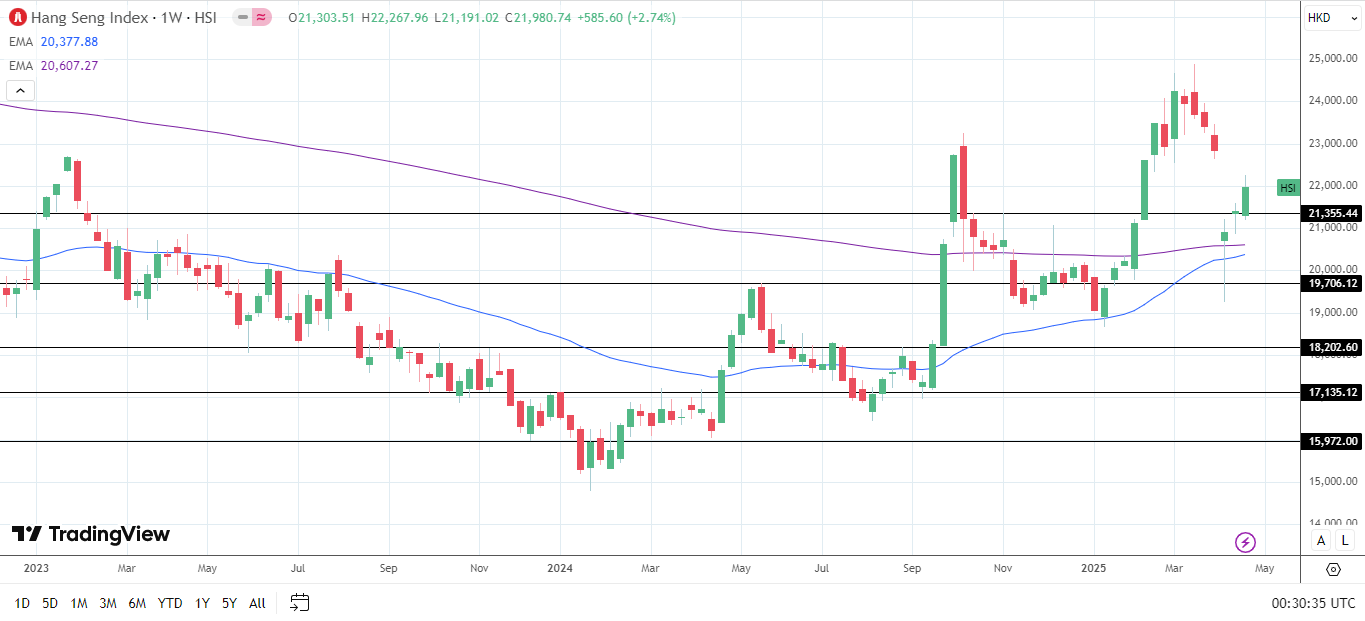
The Hang Seng Index extended its gains, rising 2.74% as trade tensions eased and Beijing announced fresh stimulus. On April 25, the People’s Bank of China injected 600 billion yuan via a one-year MLF, resulting in a net 500 billion yuan cash injection, the largest since December 2023.
The CPC Politburo also announced measures to stabilize the labor market and bolster the economy.
Tech stocks led the rally, with the Hang Seng Tech Index gaining 1.96%.
- Tech giants Alibaba (09988.HK) and Baidu (09888.HK) soared 6.35% and 6.12%, respectively.
- BYD Electronic Intl. (00285.HK) jumped 8.42%, while NIO Inc. (09866.HK) surged 15.9%.
Mainland China’s equity markets posted modest gains. The CSI 300 added 0.38%, while the Shanghai Composite Index gained 0.56%. Despite Trump’s claims, China’s MFA dismissed Trump’s declaration of trade talks, capping the weekly gains. An MFA spokesperson reportedly stated:
“China and the US are not having any consultation or negotiation on tariffs. The US should stop creating confusion.”
For more analysis on the Hang Seng Index and global market trends, click here.
Commodities Drop on Trade Headlines
- Gold fell 0.25% to $3,319 amid easing jitters over the Fed and China.
- WTI crude oil prices dropped 1.18% to $62.745.
- Iron ore spot prices declined 2.17% on demand uncertainty.
ASX 200 Tracks Wall Street Higher
The ASX 200 extended its gains, climbing 1.91% in the week ending April 25. Falling 10-year US Treasury yields drove demand for high-yielding Aussie banks, while mining stocks rallied on trade developments.
- Commonwealth Bank of Australia gained 2.15%, marking a six-week winning streak.
- BHP Group Ltd. (BHP) and Rio Tinto Ltd. (RIO) rallied 4.33% and 3.03%, respectively.
Nikkei Gains on Trade Optimism
The Nikkei Index advanced 3.33%, supported by expectations of a US-Japan trade deal and a weaker Japanese Yen. The USD/JPY pair gained 1.08% to close the week at 143.637, snapping a three-week losing streak. A weaker Yen and a US-Japan trade deal could boost demand for Japanese goods and corporate earnings.
- Nissan Motor Corp. (7201) rallied 4.36%.
- Softbank Group (9984) soared 6.06%.
- Tokyo Electron (8035) jumped 8.89%.
Looking Ahead: Stats, Trade Talks, and Central Banks
Investors should continue tracking updates from Beijing on policy measures and ongoing trade updates. US-China trade developments remain key drivers for regional markets.
Economic data, including April’s NBS and Caixin PMIs (April 30) and the Bank of Japan policy decision (May 1), could impact markets. A surprise rate hike or hawkish BoJ stance could weigh on risk appetite.
In a volatile landscape, staying updated on trade, policy, and central bank moves remains critical. Access deeper Hang Seng insights here.