
Tariff Pause Jubilation Turns Sour as Recession Risks Grow
Tariffs, trade, and recession concerns will likely influence USD/JPY trends on Friday, April 11, as earlier optimism over tariff relief fades. Speculation about an intensifying US-China trade war revived demand for safe-haven assets, including the Japanese Yen. On April 8, CN Wire reported that Beijing was planning countermeasures in response to President Trump’s tariff on Chinese imports. These include:
- Significant tariff increases on US agricultural products.
- Banning US poultry imports.
- Countermeasures targeting the US services trade sector.
- Banning US film imports.
- Investigating the intellectual property benefits of US companies operating in China.
A full-scale US-China trade war and a US recession could adversely impact Japan’s export-dependent economy. In February 2025, the US accounted for 20% of Japan’s exports. With a trade-to-GDP ratio of around 50%, weakening US demand may delay Bank of Japan rate hikes.
While a less hawkish BoJ policy stance would usually dampen Japanese Yen demand, US recessionary fears could sustain demand for safe-haven assets. Accordingly, trade developments will remain crucial for near-term USD/JPY trends.
Robin Brooks, Senior Fellow at the Brookings Institute, underscored China’s role:

“As long as China doesn’t devalue, there is hope, as this means China is still in negotiation mode with the US. In contrast, any material devaluation of the Yuan would signal severe escalation of the trade war that is now the only thing that matters for markets. Only China matters.”
USD/JPY Trends to Watch
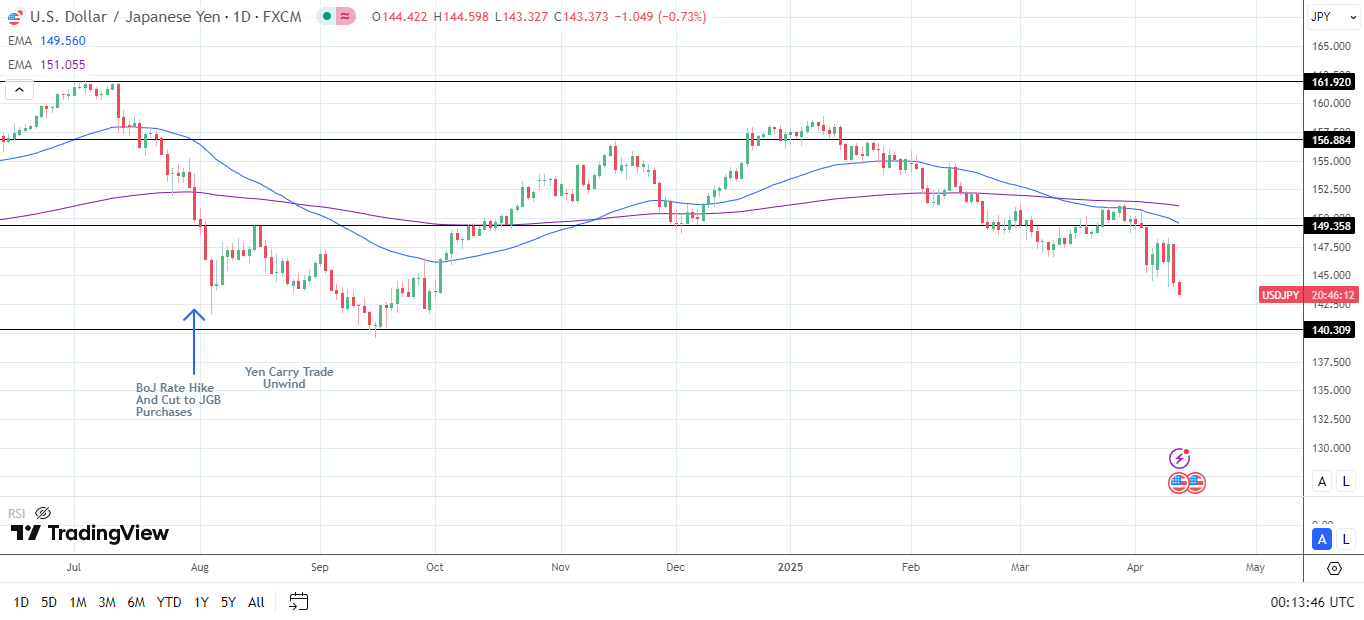
The USD/JPY pair can fall on safe-haven flows into JPY during trade escalations and rise on risk appetite during easing.
- Bullish Yen Scenario: An escalation in the US-China trade war, risk-off sentiment, or hawkish BoJ commentary may drag the USD/JPY pair toward the 140.309 support level.
- Bearish Yen Scenario: Easing trade tensions, improving risk sentiment, or dovish BoJ signals could send the USD/JPY pair toward the 149.358 resistance level.
USD/JPY Daily Outlook: Fed Commentary in Focus
Later in the US session, producer price data and consumer sentiment figures will influence US dollar demand. Economists expect producer prices to rise 3.3% year-on-year in March, up from 3.2% in February.
AUD/USD Price Forecast
Every new AUD/USD analysis as it publishes, today's technical signal and key levels, live price — on one page.
See all AUD/USD forecastsA stronger reading could signal rising consumer prices, potentially tempering bets on multiple Fed rate cuts. Conversely, weaker data, following the overnight CPI Report, may bolster expectations of multiple Fed rate cuts.
Economists expect the Michigan Consumer Sentiment Index to drop from 57.0 in March to 54.5 in April. A sharper fall could fuel recessionary fears, supporting a more dovish Fed rate path. Weakening consumer sentiment may impact private consumption, which contributes over 60% to USD GDP.
Potential USD/JPY Moves:
- Bullish US dollar Scenario: Better-than-expected US data, easing US-China tensions, or hawkish Fed chatter could drive the USD/JPY pair toward 145, a crucial resistance level.
- Bearish US dollar Scenario: Weaker US data, rising US recession risks, an escalation in the US-China trade war, or dovish Fed rhetoric could push the pair toward the 140.309 support level.
While the data will influence USD/JPY trends, tariff developments will remain the primary driver of USD/JPY moves.
Explore expert forecasts and trade setups for USD/JPY in our latest market analysis here.
Shifting focus to the Australian Dollar, trade developments, and potential stimulus measures from Beijing influence AUD/USD trends.
AUD/USD Outlook: Tariffs and China in Focus
Turning to AUD/USD, market attention stays on US-China trade tensions and Beijing’s potential stimulus measures. With a trade-to-GDP ratio exceeding 50% and more than one-fifth of Australian jobs tied to trade, deteriorating global trade conditions pose significant downside risks.
Importantly, stimulus measures from Beijing could mitigate tariff risks, potentially boosting Aussie dollar demand.
China, which accounts for one-third of Australia’s exports, is central to AUD/USD sentiment. Weaker Chinese demand could influence the RBA’s policy outlook. While RBA Governor Michele Bullock said on Thursday, April 10, that it was too early to assess the impact of tariffs, expectations for a May 2025 RBA rate cut have risen, impacting the AUD/USD pair.
Potential AUD/USD Moves:
- Bullish Aussie dollar Scenario: A de-escalation in the US-China trade war, risk-on sentiment, Beijing stimulus, or hawkish RBA commentary may drive the AUD/USD pair toward the 50-day EMA, potentially reaching $0.63.
- Bearish Aussie dollar Scenario: An escalation in the US-China trade war, risk-off sentiment, or dovish RBA signals could drag the AUD/USD pair toward the April 9 low of $0.59132.
For a comprehensive analysis of AUD/USD trends and trade data insights, visit our detailed reports here.
Australian Dollar Daily Outlook: US Economy in Focus
In the US session, upbeat economic data could temper bets on multiple Fed rate cuts. A more hawkish Fed stance could widen the US-Aussie interest rate differential in favor of the US dollar, pushing the AUD/USD pair toward $0.60.
Conversely, weaker-than-expected data could fuel recession concerns, supporting a more dovish Fed rate path. In this scenario, a narrower rate differential may drive the AUD/USD pair toward the 50-day EMA and $0.63.

Key Market Trends
The main drivers of the forex market include:
- USD/JPY: US-Japan tariff news and BoJ forward guidance.
- USD/JPY and AUD/USD: US economic data, Fed commentary, and trade risks.
- AUD/USD: China stimulus measures and US-China relations.
Do not miss today’s trade setups in our full USD/JPY and AUD/USD reports.