LNG Holds a Floor but Production Owns the Trade
Natural gas is lower Tuesday after Monday’s recovery failed to hold. LNG feedgas hit 18.0 billion cubic feet per day Monday, the highest level in five days, and it was not enough to keep buyers in control for more than one session. The export story is doing its job on the downside. It is keeping the market from falling apart. But summer maintenance at U.S. export terminals is limiting how many cargoes actually leave the country, and until that changes, production and storage keep sellers in charge.
September natural gas futures are trading $2.743, down $0.038 or 1.37% at 11:14 GMT.

Global Buyers Are Paying Up but Cargoes Are Not Following
U.S. LNG exports slipped to 10.48 million metric tons in July from 10.6 million in June, and that happened while global prices were screaming for more supply. The Japan Korea Marker averaged $19.10 per million British thermal units. Europe’s TTF benchmark averaged $18.07. Asia was paying a premium over Europe and U.S. exporters still could not ship more because Freeport LNG and other facilities were running summer maintenance.
That is the frustration for bulls right now. The demand signal from overseas is strong. The export system cannot respond to it.
Europe took 4.76 million metric tons of U.S. LNG in July, up from 4.41 million in June. European storage was 57% full as of August 1, well below the five-year average of 74%. That is not a comfortable position heading into winter and it keeps the bid under U.S. exports even if the volumes are not accelerating. Asia came in slightly higher at 3.32 million metric tons. Brazil added demand during the Southern Hemisphere winter. Egypt pulled back to 0.63 million metric tons from a record 1.06 million in June, which took some buying pressure out at the worst time.
The LNG story is not bearish. It is just stuck. Global buyers want the cargoes. U.S. plants cannot deliver enough of them right now to tighten the domestic balance. When maintenance ends and export capacity comes fully back online, that changes. It has not changed yet.
Natural Gas Price Forecast
Every new Natural Gas analysis as it publishes, today's technical signal and key levels, live price — on one page.
See all Natural Gas forecastsProduction and Storage Still Favor Sellers
Lower-48 dry gas production hit 112.5 billion cubic feet per day Monday, up 2.6% from a year ago. The EIA raised its 2026 production forecast to 111.2 Bcf per day in July. The rig count held at 127 last week, below February’s high but still enough to keep output elevated. There is nothing in the supply data that helps buyers right now.
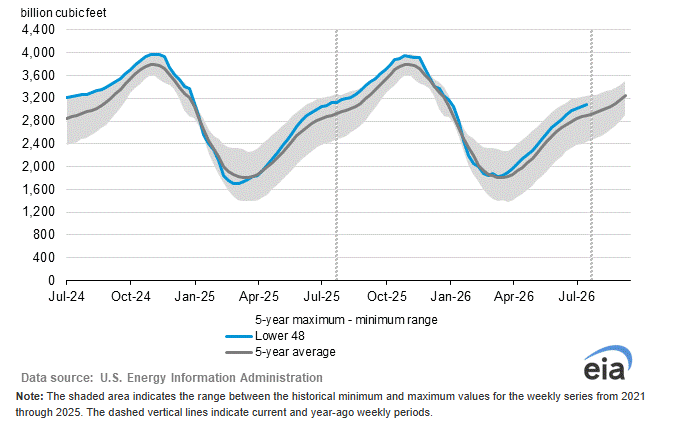
Storage is the same story. The EIA reported a 28 Bcf injection for the week ended July 24, below the 37 Bcf estimate but still above the five-year average build of 26 Bcf. Working gas is running 6.4% above the five-year seasonal average. One tighter build forced some shorts to cover. It did not erase the surplus.
Weather is the wild card and it has not committed to either side. Commodity Weather Group sees more normal conditions across the East through August 17, which limits cooling demand in the region that moves the needle. NatGasWeather sees broad heat building later this week with much of the country reaching the 90s to 110s. If the East stays moderate while the rest of the country bakes, it is not enough to change the storage trajectory. The market needs heat where the population is.
Daily September Natural Gas Futures Technical Analysis
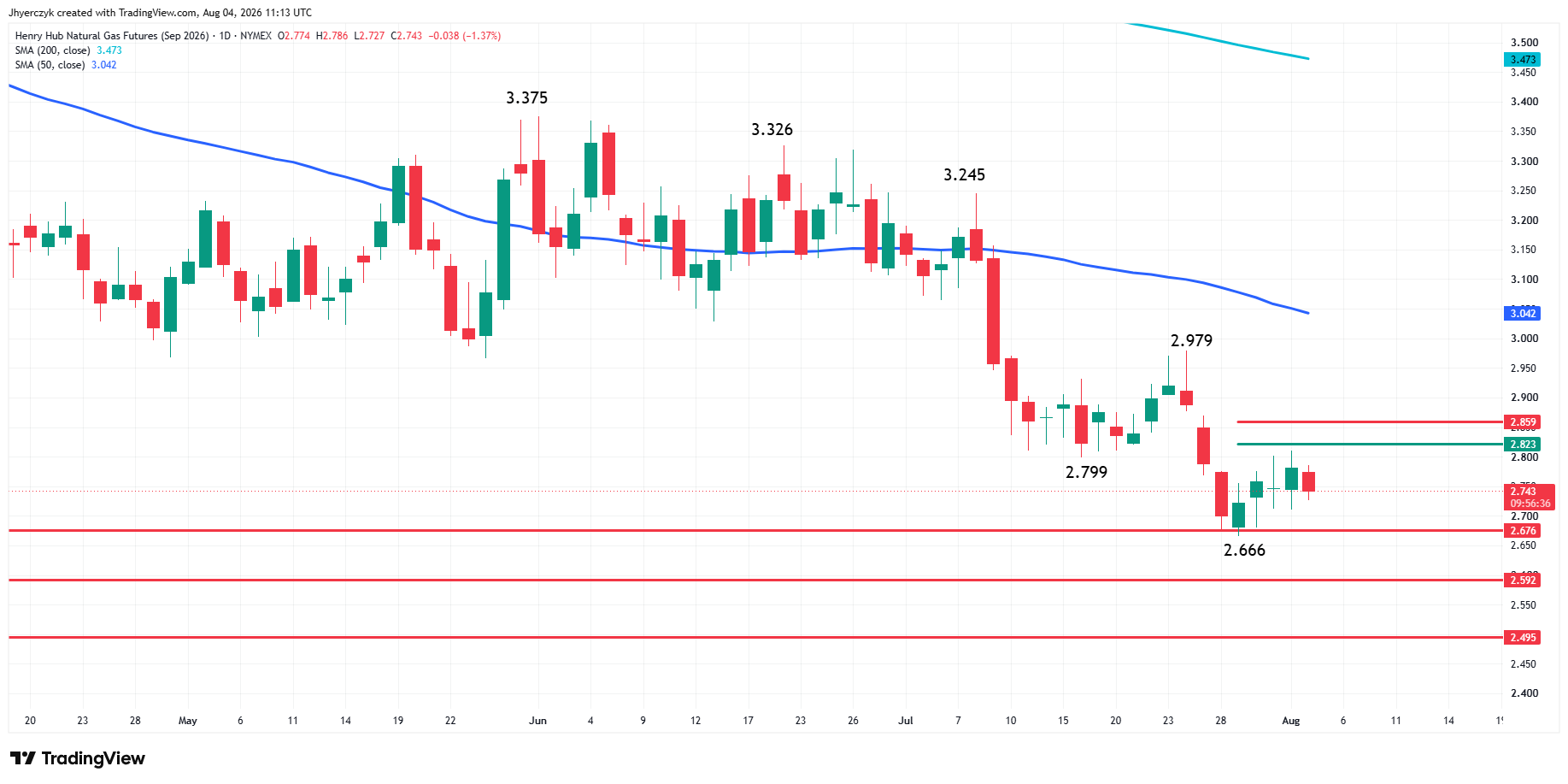
September Natural Gas futures are edging lower early Tuesday after failing to three straight days of higher-highs and higher lows.
The new minor range is $2.666 to $2.810. Traders are testing its 50% level overnight. We’ll be watch for counter-trend buyers attempting to form a secondary higher bottom.
The short-term range is $2.979 to $2.666. Its retracement zone at $2.823 to $2.859 is potential resistance. Overcoming $2.859 could trigger an acceleration to the upside, but any rally is likely to be met with new selling pressure by traders defending the main top at $2.979 and the 50-day moving average at $3.042.
If heavy sellers return, they may take a shot at the multi-month low at $2.666. If this fails then the next potential downside target will be $2.592.
What to Watch
LNG feedgas near 18 Bcf per day is the floor bulls have to defend. A sustained push higher would signal that maintenance is winding down and export plants are pulling more supply out of the domestic market. Europe’s storage deficit keeps the bid alive and global prices are already there. The missing piece is U.S. export capacity catching up to the demand signal.
The market is stuck between an LNG floor and a production ceiling. The next EIA storage report and the weather forecasts pick the winner this week. A smaller than expected build with hotter readings across the East and rising feedgas brings buyers back. Comfortable injections with moderate Eastern temperatures put the recent lows back in play and give sellers a shot at the multi-month bottom.
Traders are trying to build a secondary higher bottom after three days of higher highs and higher lows. Any rally runs into resistance near the 50-day moving average and sellers have been defending that area consistently. The structure says base-building, but the burden of proof is on buyers until the market can clear that overhead.
More Information in our Economic Calendar.