
The Storage Report Finally Matched the Heat but Production Has Not Flinched
Nymex Natural Gas found buyers Friday after Thursday’s EIA report showed the smallest injection relative to the five-year average in weeks. The forecast is reaching into early September with above-normal heat across much of the Lower 48. That gives the weather trade more time than it had on Monday when cooler models gapped the market lower.
Production is still running above July’s record. The storage surplus is still there. Friday’s bounce has the demand side of the argument working for the first time in weeks. The supply side has not given an inch.
At 13:46 GMT, September natural gas futures were trading at $2.780, up $0.047 or 1.72%. The contract reached $2.798 and traded as low as $2.741.

Record Output and Steady Exports Are Still Running the Supply Side
Lower-48 dry gas output has averaged roughly 111.4 to 111.6 Bcf per day in August, above July’s record monthly average. There have been modest daily dips that traders noticed because the market is sensitive to supply changes when temperatures are near 100 degrees. The daily moves have not changed the monthly trend. Production remains high enough to keep storage comfortable even after several hot weeks.
Associated gas from Permian oil drilling keeps showing up. The major shale basins have not adjusted to lower prices. Every rally this summer has run into the same wall of output before the move could build into anything sustained.
LNG feedgas deliveries to major U.S. export terminals have averaged near 17.2 Bcf per day in August, close to recent highs. Middle East disruptions through key shipping routes have reduced LNG supply available to international buyers. Europe and Asia are pulling on U.S. cargoes for replacement volumes. That demand is steady and it is pulling gas toward the coast at a time when the domestic market already has record production hitting it from the other side.
The EIA Report and the Forecast Are Finally Pointing the Same Direction
Utilities injected 16 Bcf into storage during the week ending August 14. Analysts expected closer to 19 Bcf. The five-year average for the same week is about 29 Bcf. That is not a draw. Inventories are still high. Working gas in storage rose to about 3,169 Bcf, roughly 6.2% above the five-year average. The surplus is still there, but for the first time in weeks it narrowed instead of widening.
Natural Gas Price Forecast
Every new Natural Gas analysis as it publishes, today's technical signal and key levels, live price — on one page.
See all Natural Gas forecastsSouth Central salt facilities posted a draw that helped limit the overall build. The heat is reaching the storage data in a region where summer power demand moves fast. Houston is expected to average near 100 degrees for several days. Warmer-than-normal conditions are projected across much of the Lower 48 through the first week of September. The calendar is still working against bulls. Summer demand has a limited window. But the forecast reaching into September gives the market more time than it had when the week started on cooler models and a gap lower opening.
Daily September Natural Gas Futures Technical Analysis
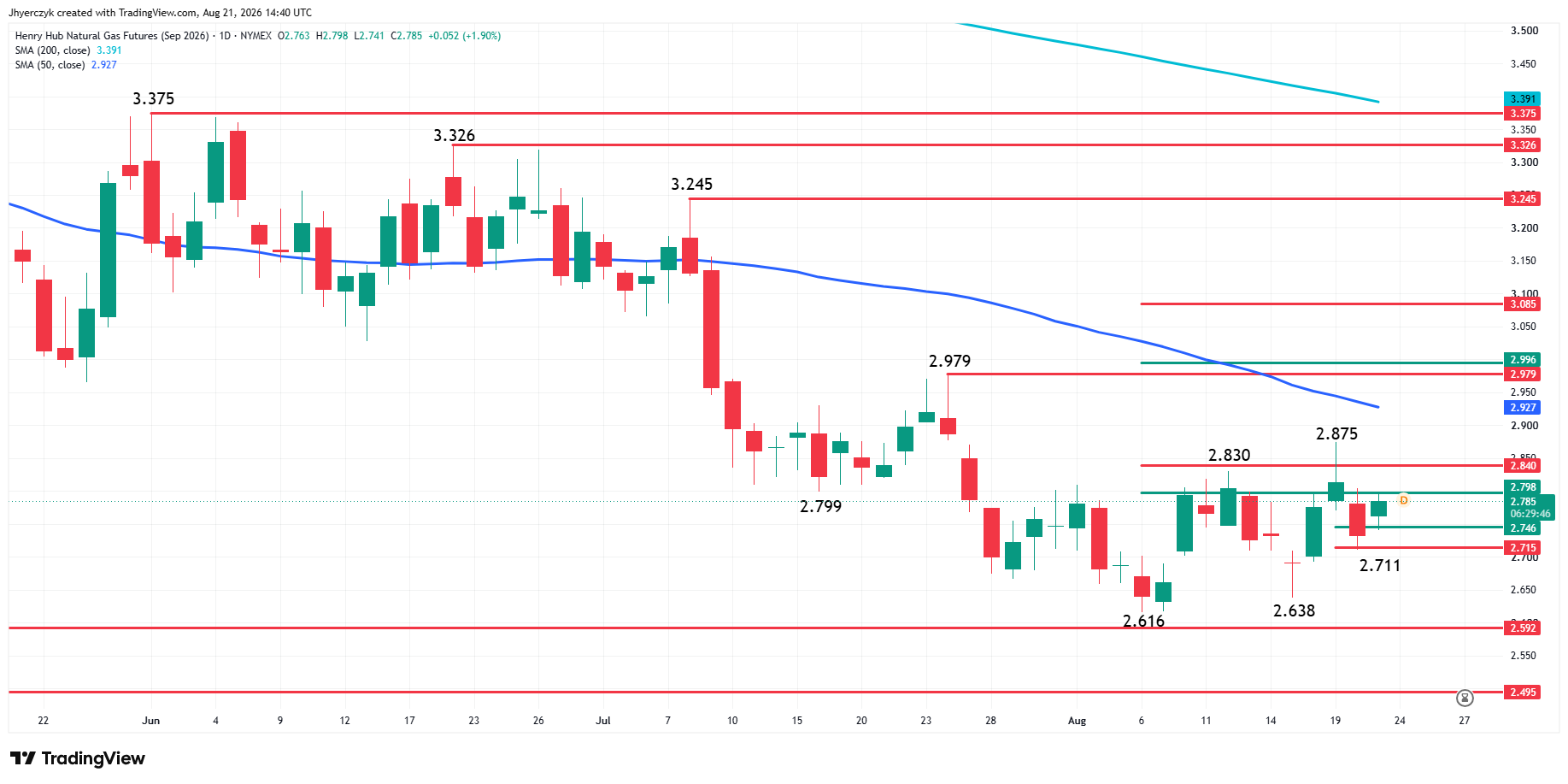
September natural gas futures are edging higher on Friday with the market barely holding on to its weekly gains, even after hitting its highest level since July 24 on Wednesday. The short-term swing-chart trend is up as a result of that rally, but there has been no follow-through buying to confirm the move. Instead, we’re retesting support.
Swing chart resistance is at $2.875. A trade through this top would signal a resumption of the uptrend. However, gains could be limited by the 50-day moving average at $2.927. This is acting as both resistance and a trend indicator. On the downside, swing-chart support is a pair of bottoms at $2.638 and $2.616.
While the swing chart controls the trend, a pair of retracement zones is keeping tabs on the trading range. The nearest retracement zone keeping a lid on the rally is $2.798 to $2.840. The closest support zone underpinning the trade is $2.746 to $2.715.
The price action suggests the market could remain rangebound until the next major catalyst hits the headlines.
What to Watch
The next storage report carries the weight. Thursday’s 16 Bcf injection was the first number that matched what the thermometer has been showing all month. The forecast is extending into early September with heat across the South and much of the Lower 48. Texas demand can keep gas burn elevated for several days and the models have not reversed the way they did Monday. Production above 111 Bcf per day and LNG exports near 17.2 Bcf per day are pulling the balance in opposite directions. The storage data is where the market finds out which side is doing more work.
The swing top overhead at $2.875 and the 50-day moving average at $2.927 is where the trend change from Wednesday gets tested again. The market has been rangebound between the support and resistance zones all week. Friday’s bounce is holding but the follow-through from Wednesday’s breakout never arrived. The next EIA number and the next round of weather models will tell traders whether Thursday’s lighter injection was an outlier or the start of something the bulls can build on.
More Information in our Economic Calendar.