
Storage Is the Test After Wednesday’s Break
November natural gas futures are working higher Thursday after Wednesday’s sharp reversal from a three-month high. Buyers had LNG flows, a smaller-than-average storage build and the TCO pipeline outage on their side. The warm October 19–23 outlook brought in the sellers.
At 14:21 GMT, November Natural Gas Futures are trading $3.249, up $0.051 or +1.59%.

Daily November Natural Gas Futures Technical Analysis
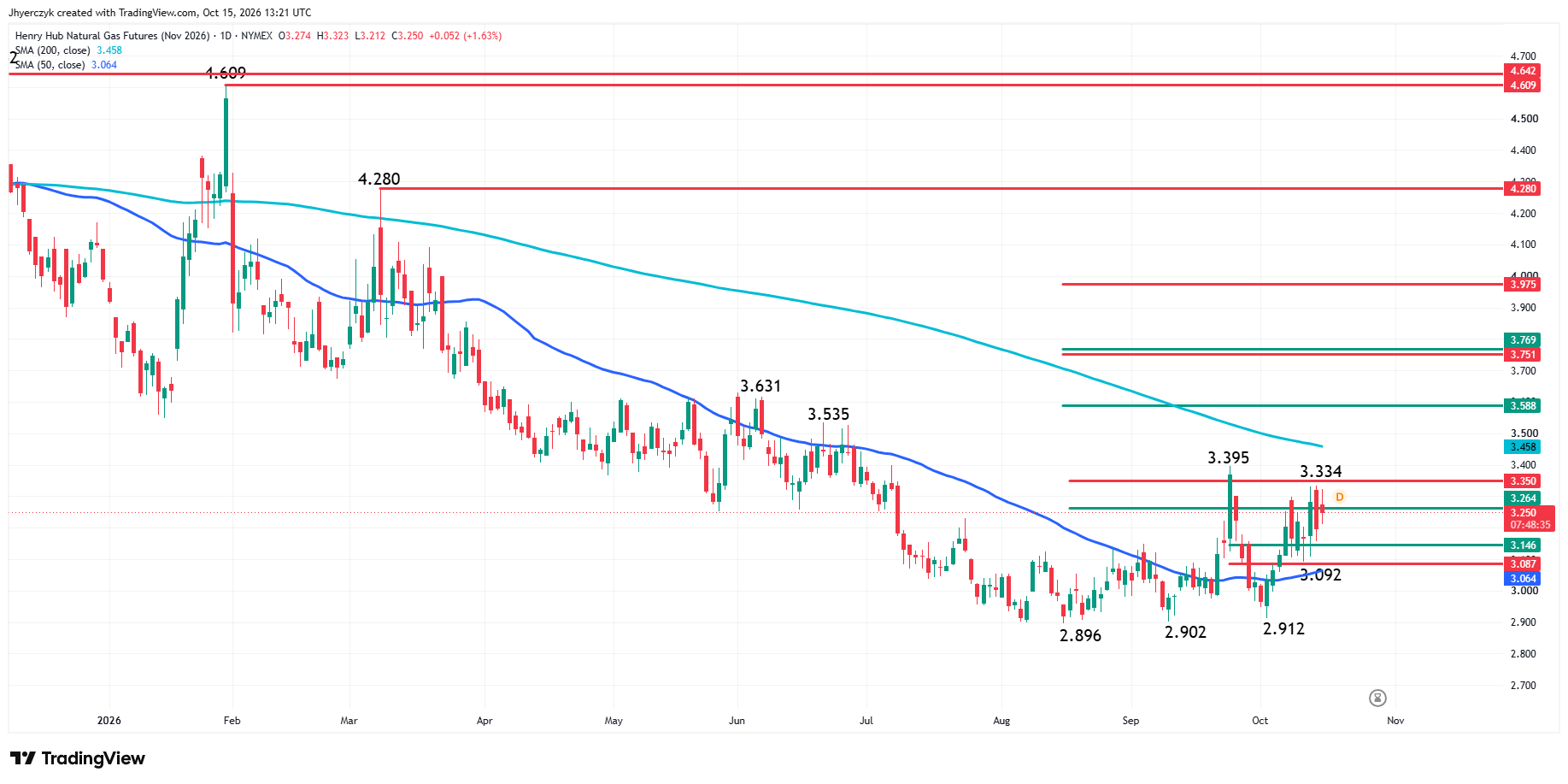
November natural gas futures are edging higher after Wednesday’s violent reversal to the downside. The market is trading inside Wednesday’s range. This indicates traders may still be undecided about today’s direction ahead of the EIA weekly storage report.
The main trend is up according to the daily swing chart. On Wednesday, the market formed a closing price reversal top. A trade through $3.157 will confirm the move and could trigger the start of a two-to-three-day sell-off. Taking out $3.334 will negate the chart pattern and signal a resumption of the uptrend, with the swing top at $3.395 the next target.
A confirmation of the closing price reversal top is not a change in trend. That will take place on a breakdown under $3.092.
The two-sided trade over the past two months has produced a number of retracement levels that are adding to the volatility and the wicked price swings. The key retracement zone support is $3.146 to $3.087. The key retracement zone resistance is $3.264 to $3.350.
The 50-day moving average at $3.064 is both support and a bullish trend indicator at this time. The 200-day moving average at $3.458 has been providing directional resistance since March. It is currently an upside target, but also a potential trigger point for an acceleration to the upside.
Natural Gas Price Forecast
Every new Natural Gas analysis as it publishes, today's technical signal and key levels, live price — on one page.
See all Natural Gas forecastsStorage Report Is the First Test
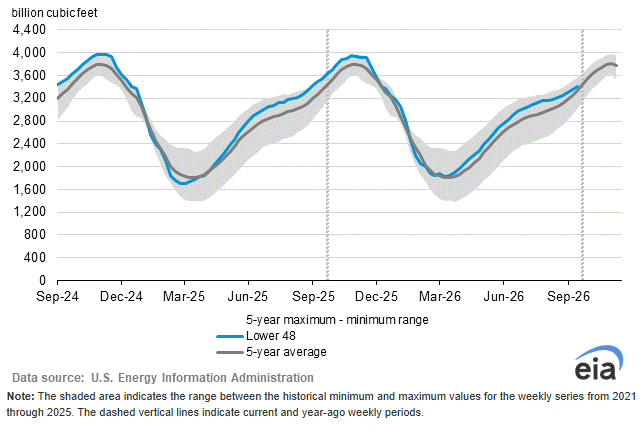
Traders are looking for a build of 73 Bcf to 77 Bcf for the week ended October 9, versus the five-year average increase of 90 Bcf. NatGasWeather is calling for a 73 Bcf to 75 Bcf injection.
The sample week was warmer than normal across most of the country. Wind generation ran about 20% below the prior week’s report. The market sees a below-average injection anyway.
Wednesday’s high came before the number. A build near 73 Bcf gives buyers another shot at the market. A print near 77 Bcf leaves room for the sellers who hit the market late Wednesday.
Warm Weather Comes Back Next Week
Highs in the 80s and 90s are running from East Texas to the Mid-Atlantic Coast Thursday. A cold system is crossing the Midwest with highs in the 40s and 50s. It reaches the Great Lakes and Northeast this weekend, with lows in the teens to 30s.
NatGasWeather sees moderate demand from Friday through Sunday, then low demand next week. The Commodity Weather Group sees above-average temperatures spreading across the central third of the country from October 19 through October 23.
The cold is in the forecast. So is the warmth behind it.
LNG and TCO Are Holding the Bullish Side Together
Estimated LNG net flows to U.S. export terminals were 19.7 Bcf per day Wednesday, up 9.6% from the prior week, according to BNEF. European gas storage was 74% full as of October 12, compared with the five-year seasonal average of 89%.
The TCO pipeline outage has also put future storage builds back on the board. LNG demand, lower European storage and the outage are the three supply-side issues traders are carrying into the EIA report.
Lower-48 dry gas production was 111.2 Bcf per day Wednesday, up 2.9% from a year ago, according to BNEF. Lower-48 gas demand was 72.7 Bcf per day, up 3.8% from a year ago.
Production Is Not Getting Out of the Way
LNG is making the dips harder to sell, but the market is not short gas. The EIA still sees end-of-October storage at 3,985 Bcf, the highest level in 10 years and 5% above the five-year average. It also raised its 2027 dry gas production forecast to 116.0 Bcf per day from 115.3 Bcf per day.
Last week’s 85 Bcf build was a little above the 82 Bcf estimate, but still below the five-year average of 96 Bcf. Inventories are 2.0% above the seasonal average and 3.9% below last year. That is not a supply squeeze.
Baker Hughes took one gas rig out of the count, leaving 132. That is down from 135 two weeks ago. Meanwhile, Lower-48 output is running at 111.2 Bcf per day. One rig is not going to change that story.
What to Watch
The storage report is the first real answer after Wednesday’s break. A light injection gives the buyers another reason to stay with LNG demand and the TCO outage. A larger build brings the warm weather trade right back into the market. Next week is the harder problem. Demand fades, the central United States stays warm and production remains heavy.
Wednesday’s reversal top is still sitting on the chart. The main trend held up, but buyers have to take out Wednesday’s high to dismiss the reversal. Sellers need a break under Wednesday’s low to prove it. Until then, neither side has finished the job.
More Information in our Economic Calendar.