Gold is facing a fresh inflation challenge after the September Producer Price Index showed final demand pricing rising 1.3% month-on-month, seasonally adjusted, and 6.3% over 12 months, unadjusted. The monthly increase accelerated from August’s revised 0.5%.
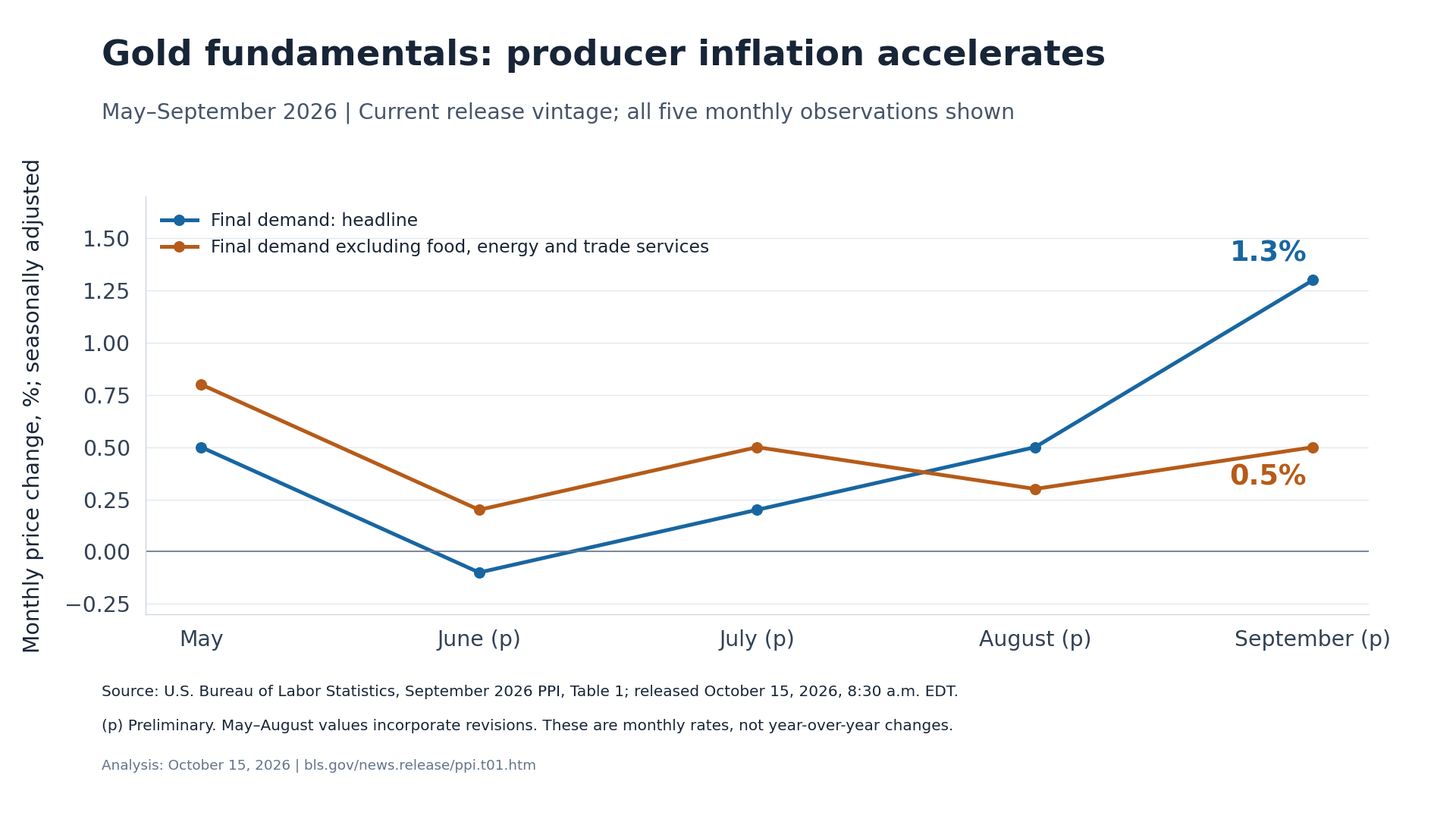
The detail requires precise labeling in the sense that final demand excluding food and energy rose 0.7% monthly, while the measure excluding food, energy, and trade services increased 0.5%. The latter rose 5% annually. The headline also sits above a mixed set of components. Final demand goods prices increased 2.6%, while services rose 0.8%.

Is Pressure Spreading?
For gold analysis, that breadth makes it useful to ask whether the pressure is spreading or remains concentrated in some of the more volatile categories, such as energy. The report strengthens the case for taking inflation persistence very seriously in America. It does not establish that every producer price increase will pass through to customers, but businesses can only absorb so much through margins, change suppliers, or adjust output. Nevertheless, a sharp rise in selling prices complicates an argument that inflation pressures are already fading convincingly.
Yesterday and CPI
Yesterday’s CPI release supplies complementary evidence in the sense that September consumer prices rose 0.6% monthly and 3.7% annually. Core CPI increased 0.3% monthly and 2.6% annually. Consumer and producer price measures cover different transactions and baskets, so their percentage changes should not be added together or treated as forecasts of one or another.
Persistent inflation may encourage demand for purchasing power protection.
For gold, the economic transmission can work in an opposing direction. Persistent inflation may encourage demand for purchasing power protection. At the same time, it can encourage expectations of interest rate hikes coming out of the Federal Reserve, raising the opportunity cost of holding an asset without contractual income or yield. Which influence dominates depends on the market’s response, and so far it certainly looks as if it does not like the non-yielding asset as much.
Gold Price Forecast
Every new Gold analysis as it publishes, today's technical signal and key levels, live price — on one page.
See all Gold forecastsThe Federal Reserve’s completed policy action remains its September 16 quarter-point interest rate increase, taking the federal funds target range to 3.75% to 4%. The statement emphasized elevated inflation and restoring price stability. Today’s PPI number is yet another input into that assessment.
The latest real yield daily observation predates the PPI release, with the 10-year inflation-protected constant maturity par yield at 2.84% yesterday, down from 2.8% the day before. That decline potentially eases gold’s opportunity-cost headwind, but it cannot demonstrate how real yields responded, or will respond, to increased inflation.
Nominal Rates Should Be Paid Attention to as Well
Nominal rates also deserve separate attention. On October 14, the 2-year par yield was 4.82% and the 10-year was 5.19%. These show a rise in nominal yields alone could not necessarily settle the gold argument, but it does suggest that there will remain some pressures on gold as changing inflation compensation can alter the relationship.
The PPI series of numbers, along with the price of gold and interest rates, has become an interesting comparison, and it provides inflation context rather than a forecast of gold’s next price move. The next scheduled FOMC meeting is October 27 and 28. Before then, further official data and policymakers’ explanations might be able to clarify whether inflation pressure is broadening or losing momentum. Tomorrow’s import and export price release is another minor scheduled report, although it measures a different part of the price system altogether.
Technical Outlook
From a technical standpoint, it looks like gold is trying to find a bit of a floor, but we’ll have to wait and see how this plays out. We continue to see a lot of noise and a lot of choppiness, and as a result, the markets will be very difficult to deal with in this environment.
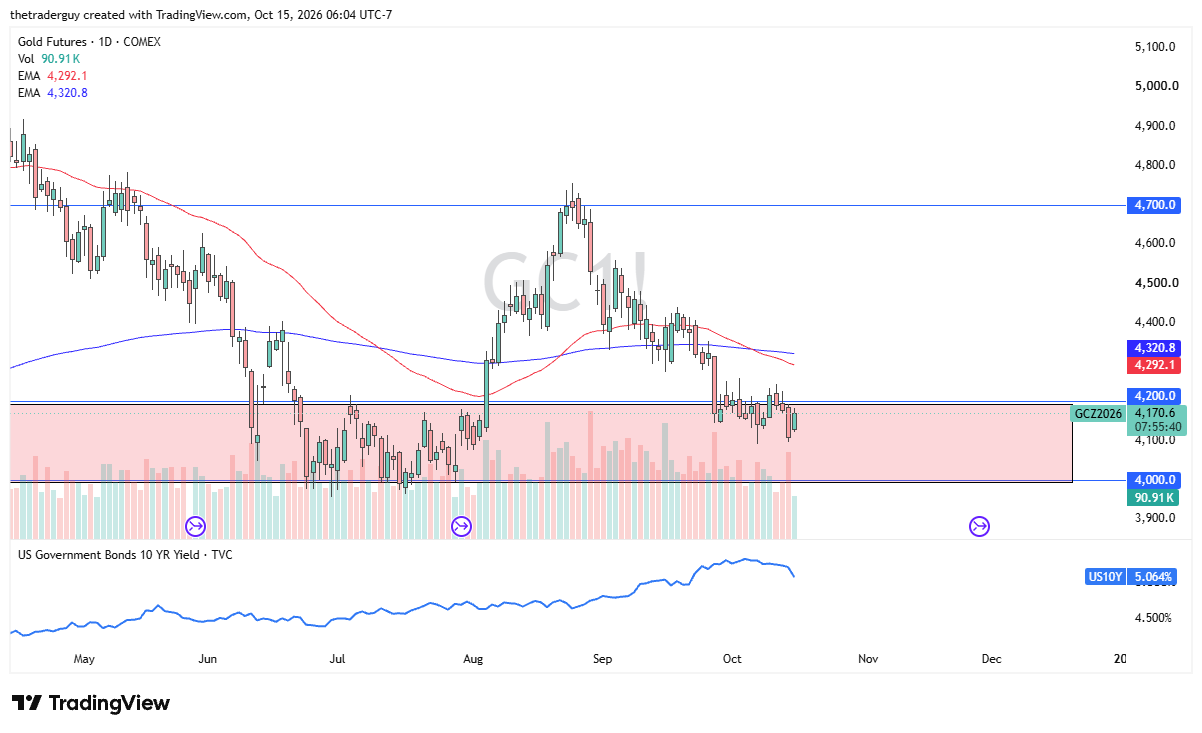
The $4,200 level is the top of a major demand zone extending down to the $4,000 level. If the market breaks above the $4,250 level, then I might be tempted to start buying gold again, but not until then, and especially not until rates really start to fall in America.