Monday’s Bounce Needs More Than Heat to Survive the Week
September natural gas futures settled last week at $2.671, down $0.121 or 4.33%. Early Monday the contract is trading $2.738, up $0.067 or 2.51% at 05:34 GMT. Buyers came back near the lows but they are walking into the same wall that sent the market to three-month lows last week. Storage is 6.7% above the five-year average. Production is holding near record levels. Energy Transfer’s Hugh Brinson pipeline reaches full capacity September 1 and pushes another 1.5 Bcf per day of Permian gas into Henry Hub right as cooling demand fades. The downtrend is intact with the 52-week moving average at $3.522 well above as the long-term resistance.

Thursday’s EIA Report Needs the Heat to Show Up
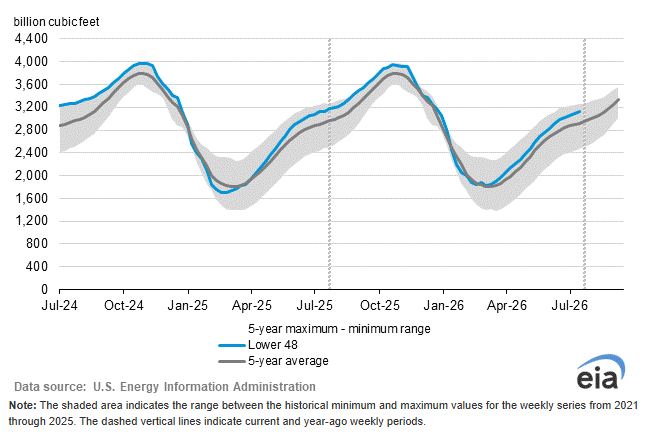
Last week’s 33 Bcf injection came in above the 30 Bcf estimate and 10 Bcf above the five-year average. Working gas hit 3,117 Bcf, pushing inventories to 195 Bcf or 6.7% above the seasonal norm. Summer heat was already running and the market still could not tighten. Thursday is the next chance to change that. A build below the seasonal average shifts the argument. Another heavy print and the calendar does the rest of the work against the longs as September approaches.
The latest forecasts call for temperatures in the upper 80s to 110s across most of the country over the next seven days with the Northeast and West running above normal through August 12. Friday’s short covering came on that forecast. A hotter revision centered on the Midwest and major Northeast cities keeps Thursday’s EIA number in play for a downside surprise. A cooler update and sellers reload.
Supply Is Heavy and More Is Coming
Lower-48 output averaged about 110.6 Bcf per day in early August, barely off July’s record. Baker Hughes reported the gas rig count fell by three to 124 last week. Fewer rigs, but 124 is still keeping output near the top of its range. The decline has not been steep enough to show up in the monthly numbers yet and nobody is shutting in production at these prices. Hugh Brinson hitting full capacity September 1 adds 1.5 Bcf per day from the Permian straight to the Gulf Coast in the month when air-conditioning demand starts rolling off and before winter heating picks up.
Natural Gas Price Forecast
Every new Natural Gas analysis as it publishes, today's technical signal and key levels, live price — on one page.
See all Natural Gas forecastsEuropean storage at 58% entering August is the lowest for this time of year on record, and Asia is bidding for the same cargoes. U.S. terminals shipped about 3.3 million metric tons to Asian buyers in July while Europe remained the top destination. July exports came in at 10.48 million metric tons, down from 10.6 million in June. Freeport LNG has been running maintenance and Golden Pass has been operating below normal rates. Those two plants are the bottleneck. When they come back the export pull strengthens, but feedgas is not there yet and the surplus keeps building while the market waits.
Weekly September Natural Gas Futures Technical Analysis
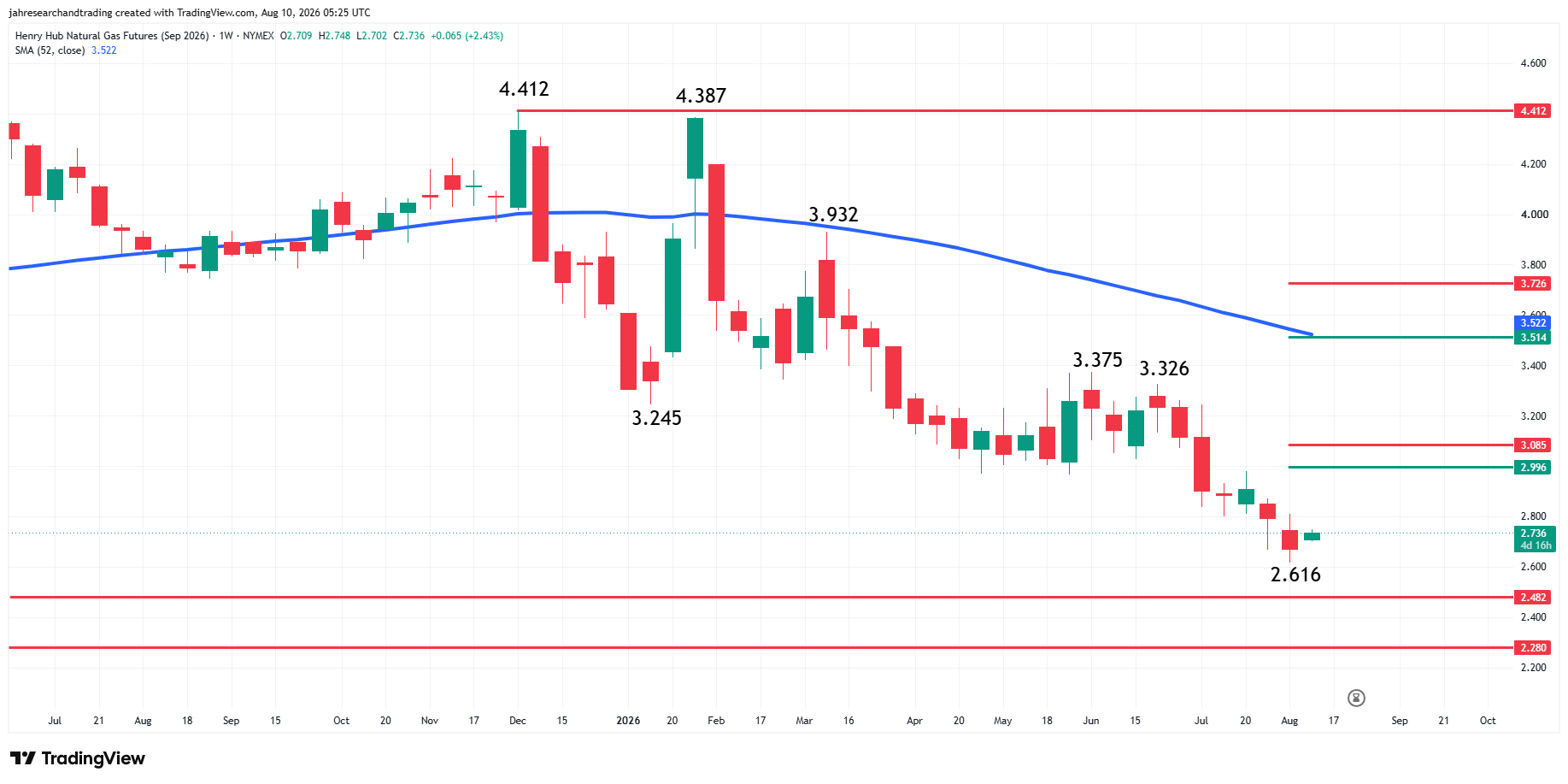
September natural gas futures are edging higher early Monday after last week’s sell-off into a multi-month low at $2.616. The main trend is down so a trade through that low will signal a resumption of the downtrend and likely lead to a test of another multi-month low at $2.482. The main trend will change to up on a trade through the swing tops at $3.326 and $3.375. The 52-week moving average at $3.522 is the major long-term trend indicator and resistance.
The current downswing from $3.375 to $2.616 is bearish, but it also reveals that there is plenty of room to the upside for a counter-trend short-covering rally. This makes its retracement zone at $2.996 to $3.085 a potential upside target. The trigger for the start of a potential rally is last week’s high at $2.810.
On the flipside, a trade through $2.616 will signal a resumption of the downtrend with $2.482 the next potential target.
What to Watch
Thursday’s storage number decides whether this bounce has a second week. The last injection came in heavy with summer demand already running, and the surplus has not shrunk. Hugh Brinson adds Permian supply in September. Production is near record. The bearish case is intact until the data says otherwise.
LNG demand and record-low European storage are the supports keeping this from going one-sided. Whether Freeport and Golden Pass can get feedgas moving higher decides how much pull exports have on the domestic balance. A tight EIA print with the heat holding across the Midwest and Northeast gives buyers a window to press the recovery.
A trade through $2.810 triggers the move toward the retracement zone at $2.996 to $3.085. A loose build sends the contract back toward $2.616 and below that $2.482 is where the downtrend finds its next footing.
More Information in our Economic Calendar.