



Sanctions Land Monday Into a Market That Already Priced the Supply Risk
Crude oil is lower Monday morning after both contracts gained more than 5% last week. The pullback is profit-taking after five sessions of buying and the sellers have not delivered a single fact that changes the supply picture. The Strait of Hormuz is still restricted, U.S.-Iran talks remain stalled and Iranian exports keep shrinking under a naval blockade.
Treasury Secretary Bessent speaks later today on new sanctions Washington has called the toughest in history and an economic D-Day against Tehran. The market rallied all last week without the sanctions details. Monday’s press conference tells traders whether the pressure matches the language or falls short of it. Both contracts are sitting just below major resistance on the weekly charts after the strongest run since July. The supply disruption is the floor underneath Monday’s decline.
At 07:45 GMT, October WTI crude oil futures were trading at $85.09, down $1.55 or 1.79%. October Brent crude oil futures were at $92.72, down $0.88 or 0.94%.
The Sanctions Have to Match the Rhetoric or the Rally Stalls at Resistance
Washington spent last week building expectations. Bessent called it the toughest sanctions in history. Trump talked about economic warfare and isolation. The market heard all of it and bought crude for five straight sessions without seeing a single detail.
Monday’s press conference is where the language meets the specifics. The package matters because it can reach beyond Iranian barrels into the buyers, banks, insurers and shippers that keep the trade moving. Pressure on those companies closes another outlet at a time when Iranian exports are already shrinking under a naval blockade.
Iran warned last week that continued pressure could halt oil shipments from the wider Gulf region. That threat is still priced into both contracts Monday morning despite the pullback. The UAE already suspended all financial and economic transactions with Iran. That is a major Gulf oil producer and financial hub cutting ties during an active conflict. The sanctions are arriving into a region that is already fracturing economically, not just militarily.
Hormuz traffic remains well below normal. Tanker operators are still rerouting or refusing the trip. The market has been trading restricted shipping, stalled diplomacy and shrinking Iranian exports for weeks. Monday’s decline is the first session where sellers had any room to work and they are working with profit-taking, not a change in the physical picture.
PCE, Inventories and Jackson Hole Put the Demand Side on the Clock
The supply side drove last week’s rally. The demand side gets its turn starting Tuesday with consumer confidence and running through Friday with Warsh at Jackson Hole.
Wednesday’s Personal Consumption Expenditures report is the heaviest release on the calendar. The FOMC minutes last week showed officials are still prepared to raise rates. The market cut September hike odds on softer data earlier this month, but the Fed has not confirmed that the door is closed. PCE is the number that tells traders how much room the Fed actually has.
Warsh speaks Friday at Jackson Hole after the market has absorbed the sanctions, PCE and the inventory numbers. He arrives with crude near multi-week highs and a committee that spent last week reminding traders the hike door is still open.
Weekly October WTI Crude Oil Futures Technical Analysis
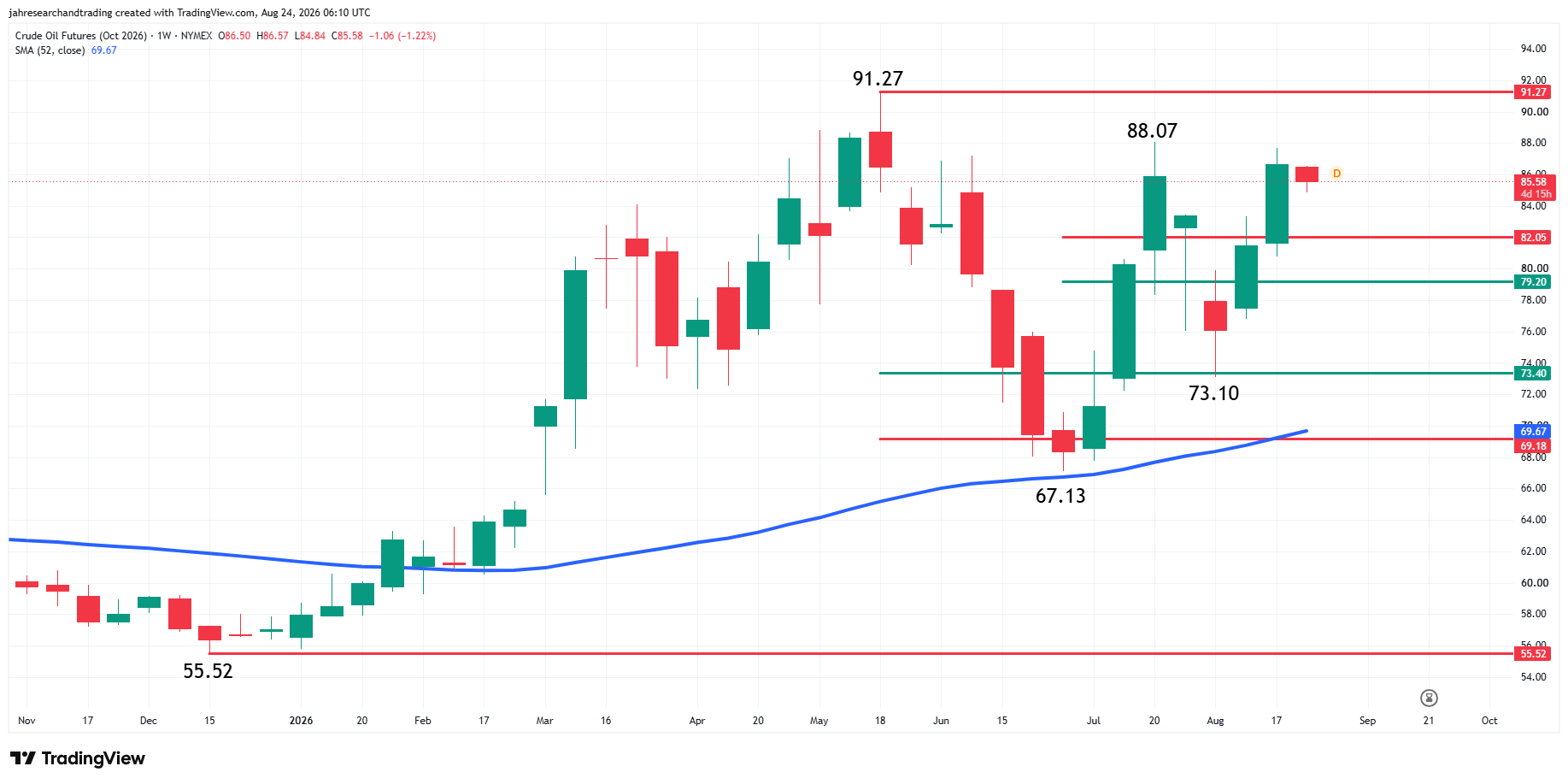
October WTI crude oil futures opened the week lower. This puts it within striking distance of the main tops at $88.07 and $91.27. A trade through $88.07 will put $91.27 on the radar. A move through $91.27 will reaffirm the rally.
On the downside, the nearest support is the 61.8% retracement level at $82.05, followed by the 50% retracement level at $79.20.
A trade through $73.10 will change the main trend to down. Major support the long-term retracement zone at $73.40 to $69.18. Inside this zone is the 52-week moving average at $69.66.
Weekly October Brent Crude Oil Futures Technical Analysis
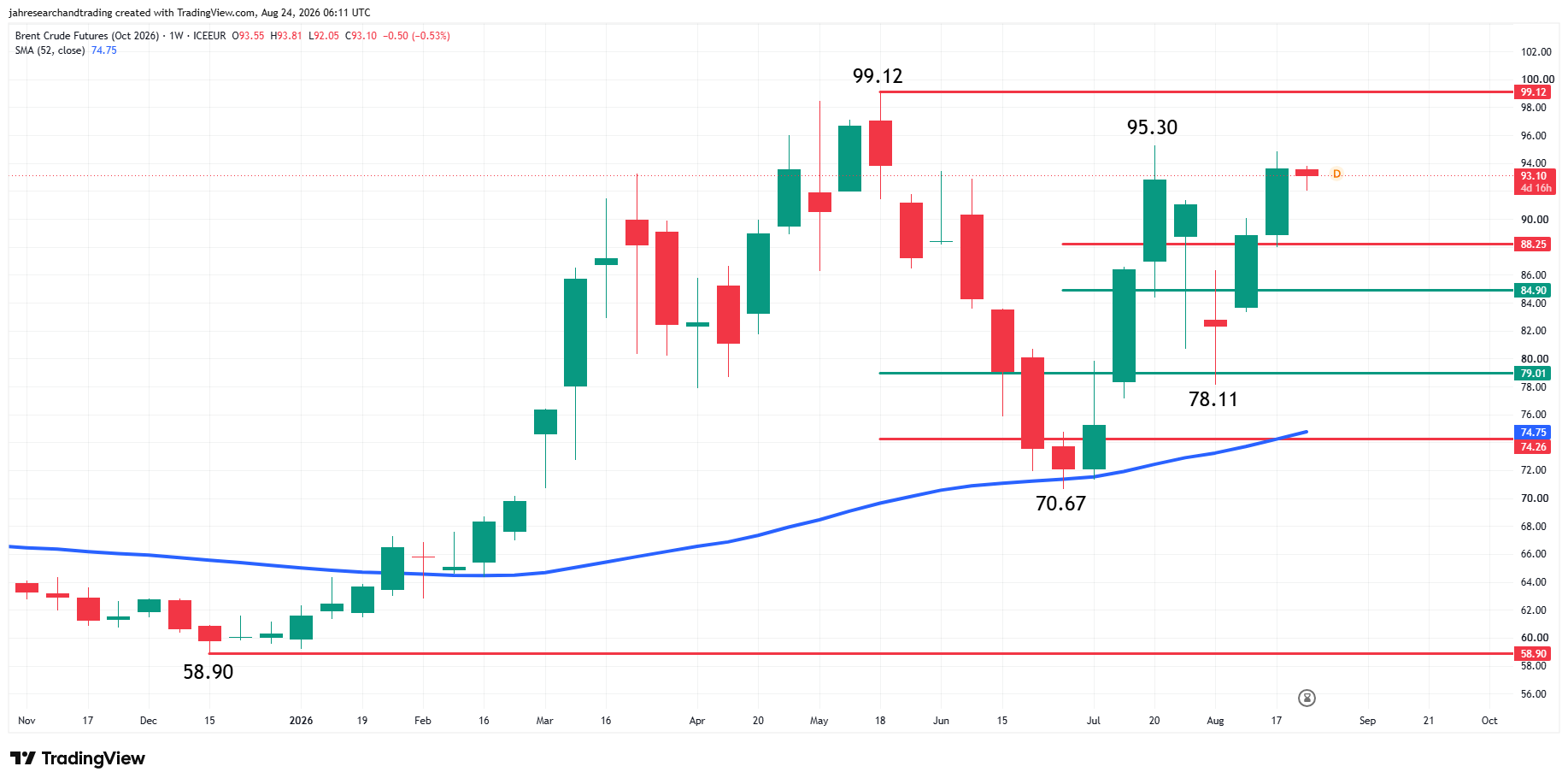
October Brent crude oil futures are edging lower early Monday. The nearest swing top resistance is $95.30. A trade through this level will signal a resumption of the uptrend and put $99.12 on the radar.
On the downside, the nearest support is the retracement zone at $88.25 to $84.90.
The major support is the long-term retracement zone at $79.01 to $74.25. This includes the swing bottom at $78.11 and the 52-week moving average at $74.75.
What to Watch
Monday’s sanctions press conference is the first event and it carries the most weight for the supply trade. The market rallied 5% last week on the threat alone. The details decide whether the squeeze on Iranian crude and its buyers gets tighter or whether Washington left enough ambiguity for sellers to challenge the premium. Hormuz traffic has not improved. The diplomatic path is closed. The UAE broke with Iran financially. The physical picture has not given sellers a single opening since the rally started.
The demand side loads up after Monday with consumer confidence Tuesday, PCE Wednesday, inventories midweek and Warsh on Friday. Both contracts are just below their main tops on the weekly charts and the supply disruption has been the floor underneath every pullback. This week’s calendar tests whether the demand side and the rate trade can build a ceiling above it. The sanctions come first and everything else follows from how the market reads them.