Record Texas Heat Cannot Outrun the Supply Side
Natural gas settled higher Friday as heat forecasts turned hotter across Texas, the Southwest and the Interior West. The weather model shift runs through September 4. West Texas is expected to see record heat over the next week, and ERCOT expects peak power demand from Friday through Tuesday to exceed the all-time high set in July.
Power generators need gas when air conditioners are running at that level, and the demand side finally has a story worth trading. The problem for buyers is that everything on the supply side is still working against them. Storage is heading for a 10-year high by the end of October, production is running 4.4% above last year, LNG export flows slipped from the prior week, and more Permian gas is set to reach Henry Hub in September.
The 50-day moving average is still overhead and the market spent Friday stuck inside a retracement zone it has not been able to break.

Daily September Natural Gas Futures Technical Analysis
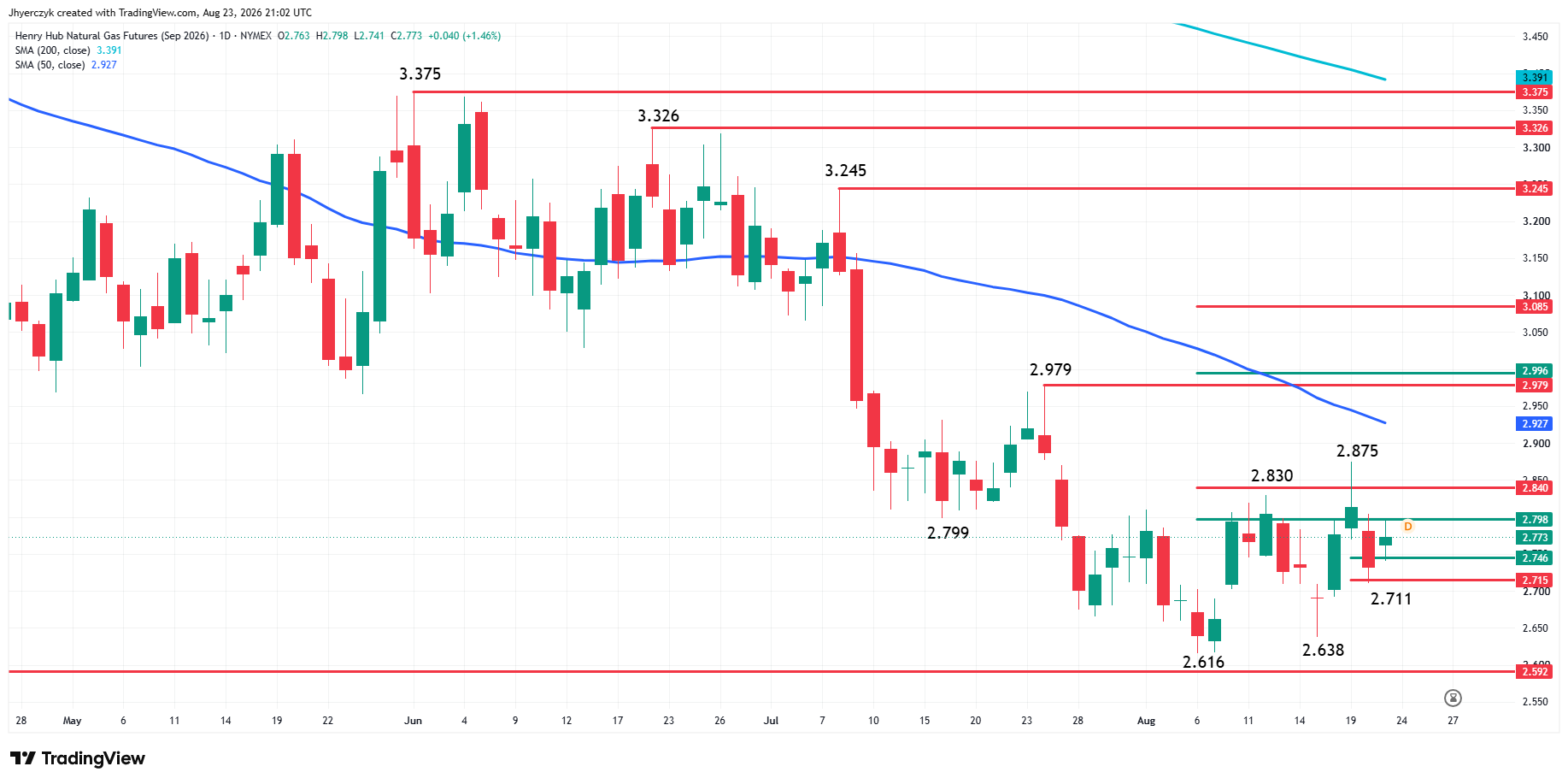
September natural gas futures traded quietly on Friday as buyers continued to face retracement zone resistance at $2.798 to $2.840, while the market found support inside the $2.746 to $2.715 retracement zone.
The main trend is up according to the daily swing chart. It turned up last week when buyers took out $2.830 and traded up to $2.875. The market is supported by a pair of swing bottoms at $2.638 and $2.616.
Bullish traders are trying to establish a new support base inside the $2.746 to $2.715 retracement zone. The next upside barriers are the $2.798 to $2.840 resistance zone, the swing top at $2.875 and the 50-day moving average at $2.920.
Without a fresh catalyst, the market is likely to remain range-bound with a slight bias to the downside.
Natural Gas Price Forecast
Every new Natural Gas analysis as it publishes, today's technical signal and key levels, live price — on one page.
See all Natural Gas forecastsERCOT Demand Is Breaking Records but Storage Keeps Filling
The southern two-thirds of the United States is expected to remain hot to very hot over the next seven days, with highs ranging from the 90s to 110s. Texas and the ERCOT region are forecast to see highs in the mid-100s. ERCOT is already projecting peak demand above the record set in July, and the weather is showing up in the power data. U.S. electricity output rose 2.36% from a year earlier in the week ended August 15, reaching 101,498 gigawatt hours. Output over the past 52 weeks rose 2.24% to 4,359,446 gigawatt hours.
The EIA weekly storage report showed a 16 billion cubic foot build for the week ended August 14. The injection came in above the market estimate of 14 billion cubic feet but below the five-year average increase of 29 billion cubic feet. Both sides had something to trade on that number.
As of August 14, inventories were down 0.9% from a year ago but 6.2% above the five-year seasonal average. The EIA projects U.S. natural gas storage will reach 3,985 billion cubic feet by the end of October, 5% above the five-year average and the highest level in 10 years. Record heat is keeping power burn elevated. It is not keeping storage from filling.
Production Keeps Growing and More Supply is on the Way
Lower-48 dry gas production reached 113.1 billion cubic feet per day Friday, up 4.4% from a year ago. Lower-48 gas demand was 80.9 billion cubic feet per day, up 2.7% from a year earlier. Production is growing faster than demand and that gap has not closed even with record heat pulling gas into the power grid.
LNG net flows to U.S. export terminals were 17.7 billion cubic feet per day, down 2.6% from the previous week. The export side slipped when the market needed it to accelerate. Domestic production rising and export demand falling at the same time is not the combination bulls wanted heading into September.
Baker Hughes reported active U.S. natural gas rigs fell by one to 127 in the week ended August 21. The rig count remains close to the three-year high of 134 reached in February. One rig is not a drilling retreat. Producers are still active and there is nothing in this report that changes the production outlook.
Energy Transfer said the Hugh Brinson pipeline will reach its full transportation capacity of 1.5 billion cubic feet per day by September 1. The pipeline will move more Permian Basin gas to Henry Hub in Erath, Louisiana, adding to supply at the benchmark delivery point just as storage season is nearing its peak. The weather is hot now. Additional pipeline capacity arrives in early September and that supply does not care about the temperature in West Texas.
European storage was 62% full as of August 19, below the five-year seasonal average of 79%.
The medium-term weather risk is a powerful El Niño pattern that could bring warmer-than-normal conditions to the Northern Hemisphere during the fall and winter. That is not Friday’s trade, but it will move closer to the front of the market as summer ends.
What to Watch
The next weather forecasts are the immediate trigger. Buyers need the heat centered on Texas and the Southwest to hold long enough to keep ERCOT demand near record levels, and any change in the model that shortens the hot pattern or pulls temperatures back takes the bid with it.
Production and LNG flows are the supply side numbers that matter with the next update. Storage is above the five-year average and production is running higher than last year. The Hugh Brinson pipeline coming online in September adds more Permian gas to Henry Hub just as the market heads into the final stretch of injection season. Hot weather can keep natural gas supported in the short term. It has not changed the larger supply story.
The market is stuck between two retracement zones with the 50-day moving average still overhead at $2.920. That range holds until something on the fundamental side breaks it.
More Information in our Economic Calendar.