


WTI Crude Plunges Through Two-Month Trendline on Inventory Surge and Iran Optimism
U.S. West Texas Intermediate (WTI) Crude Oil futures are sharply lower on Thursday after plunging through a two-month trendline at $65.27. The catalysts behind the move were a huge jump in U.S. crude inventories and positive expectations from today’s U.S.-Iran meeting in Geneva.
At 14:51 GMT, April WTI crude oil is trading $64.16, down $1.26 or 1.93%.
Trendline Fails but Moving Averages Still Represent War Premium Support
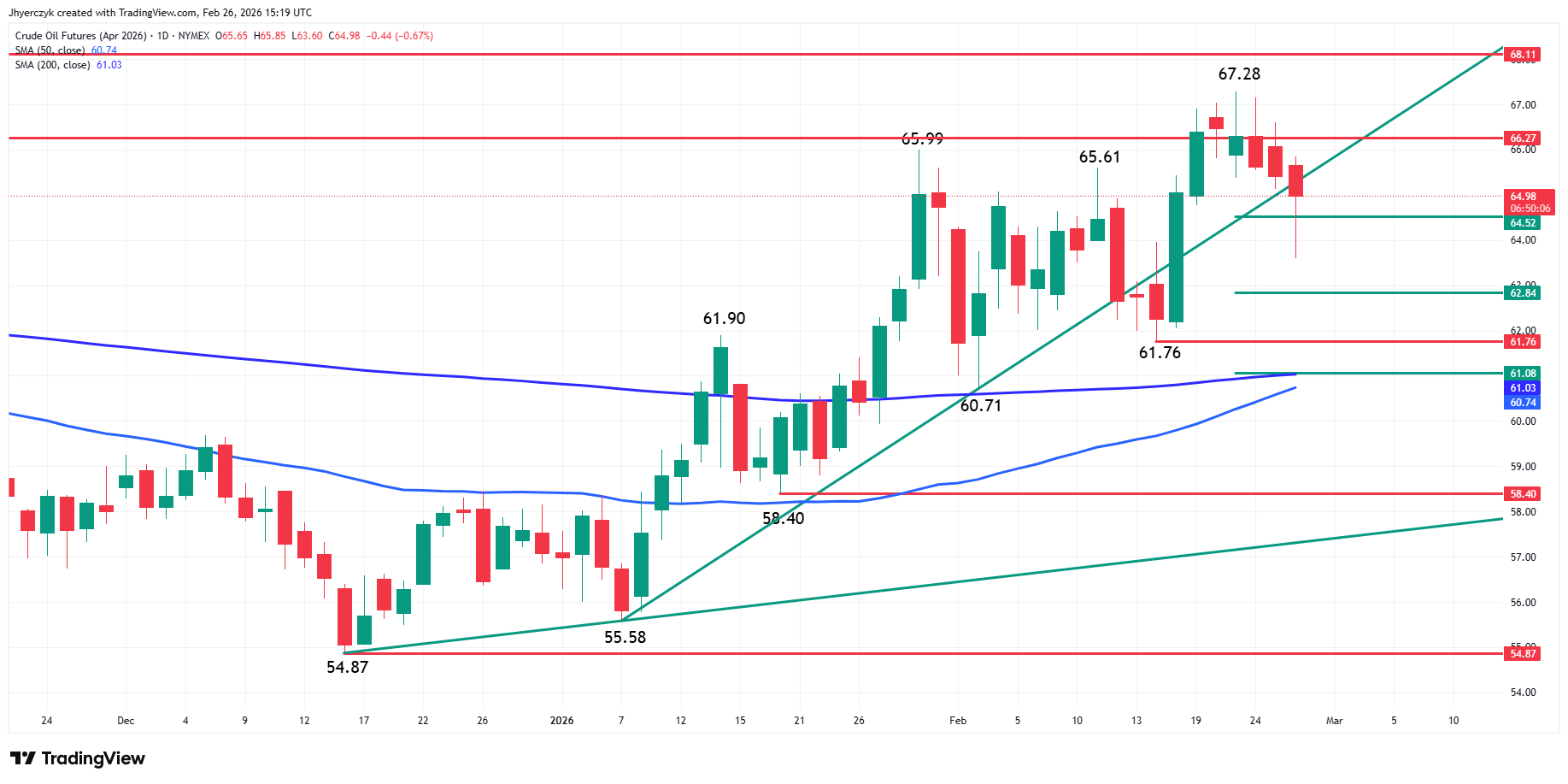
Technically, the main trend is still up according to the daily swing chart and the moving averages; however, the overall picture weakened with the failure of the trendline support.
The short-term range is $61.76 to $67.28. The market is currently straddling its 50% level at $64.52. The next major range is $58.40 to $67.28. If the selling pressure continues then look for the selling to extend into its pivot at $62.84.
The swing chart trend will change to down if $61.76 is taken out, but the market is expected to remain supported by a pivot at $61.08, the 200-day moving average at $61.03 and the 50-day moving average at $60.72.
In my opinion, the moving averages represent supply disruption support. As long as they hold, it will mean the Middle East War Premium is still intact. If the market breaks the moving average support then consider the war premium gone. At that point, we’ll assume that massive global supply concerns have taken over the market again.
Brent Oil Price Forecast
Every new Brent Oil analysis as it publishes, today's technical signal and key levels, live price — on one page.
See all Brent Oil forecasts16 Million Barrel Inventory Build and Saudi Output Boost Hammer Prices
Fundamentally, traders are reacting to Wednesday’s U.S. Energy Information Administration (EIA) weekly inventories report that showed a huge increase of 16 million barrels. This was the highest build in three years.
Also impacting the supply side was Saudi Arabia’s boost of oil production and exports in a contingency plan should any U.S. strike on Iran disrupt supplies from the Middle East, sources told Reuters.
These sources also said OPEC+ is likely to consider raising oil output by 137,000 barrels per day in April to cover peak summer demand as long as prices remain favorable.
Geneva Talks Shift the Narrative from $70 Oil to $10 Risk Premium Unwind
Market conditions surrounding the U.S.-Iran negotiations have changed over a week with traders now looking at the downside. Earlier this week, traders were eyeing $70 crude oil. Today, the talk is a constructive outcome from the Geneva meeting could lead to the gradual unwinding of about $10 per barrel in risk premium.
Trendline Break Sends a Serious Signal but War Premium Still Alive
Looking ahead, the trend line break sent a serious signal to traders that the oversupply situation is a major concern. It also may be signaling an optimistic outcome for the U.S.-Iran negotiations. However, as long as the moving averages remain support, the risk premium is still on just a little shakier than yesterday.
More Information in our Economic Calendar