The international outlook remains pretty much the same on Wednesday as rising oil prices collide with elevated government borrowing costs and renewed concerns about European public finances, especially in France. This matters more than any single headline. Expensive energy threatens inflation, higher yields tighten financial conditions, and fiscal uncertainty changes where investors are willing to hold capital.
European equities and the euro are weakening while investors await the Federal Reserve minutes that could reshape expectations for American interest rates, although it is worth noting that the recent jobs report was released after that meeting.

Energy Sector Remains the Most Immediate International Transmission Channel for Risk Appetite
Brent trades above $100 while traders assess Middle East supply risk and a storm approaching U.S. oil-producing regions. Separately, the markets have to deal with Yemen’s Houthis claiming attacks on Saudi military facilities and airports, while noting that there is no immediate evidence.
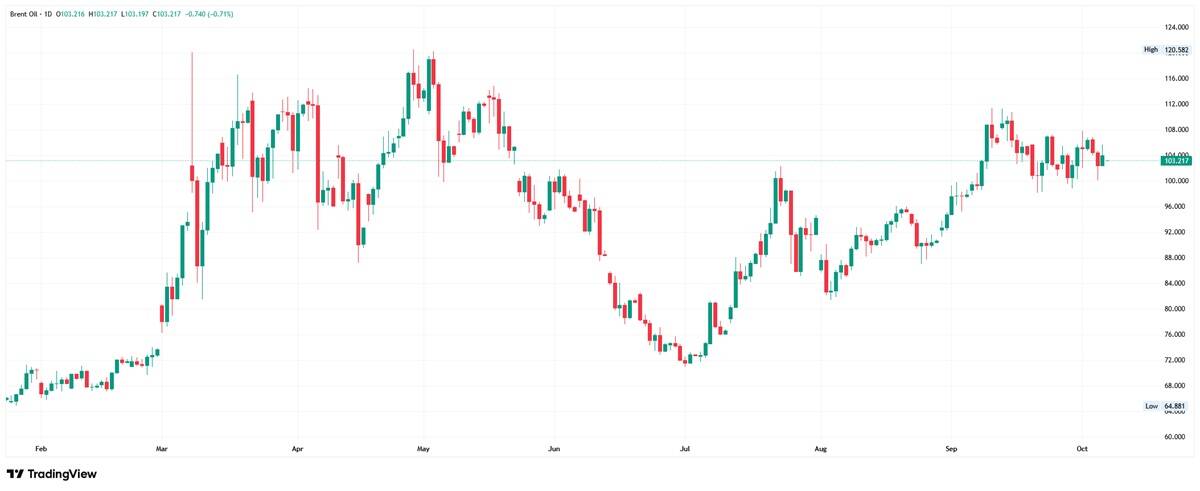
For importing economies, sustained oil strength raises transport and production costs, which could have the effect of reducing consumers’ purchasing power. This creates an uncomfortable combination of inflation pressure and weaker growth, so this is something worth watching in specific countries like Germany and Japan.
Exporters could benefit from higher petroleum revenues, but their currencies do not automatically strengthen. Broader dollar demand has a major input as well, and of course domestic policy in some of these countries will continue to be in focus. The energy sector has different implications across differing regions and therefore should be looked at through that prism.
The bond market is amplifying these pressures, with U.S. Treasury yields for 10-year debt at 5.33% and 5.71% for 30-year debt. The market is looking at this through the distinction of putting downward pressure on metals, as you get paid to hold debt a little higher than usual, and non-yielding assets will continue to suffer.
Brent Oil Price Forecast
Every new Brent Oil analysis as it publishes, today's technical signal and key levels, live price — on one page.
See all Brent Oil forecastsEuropean Issues
Europe faces an additional problem. Investors are differentiating between sovereign borrowers. For example, the 10-year yield premium over the equivalent German debt is widening to approximately 1.4% after narrowing earlier this week. That spread reflects compensation demanded for holding French debt relative to German Bunds. Fiscal concerns and political uncertainty ahead of France’s 2027 election keep that premium elevated.
This is why higher yields are not necessarily supporting the euro. It is a bad-news story. While a yield increase associated with stronger growth or tighter monetary policy can attract capital, one associated with deteriorating fiscal confidence can repel demand. The euro was down near the 1.1180 level at one point, and the currency is confronting both sovereign risk concerns and the relative appeal of U.S. interest rates. This will continue to be a situation worth watching.
Britain Isn’t Immune
Great Britain is also feeling the international financing squeeze. Reuters reports 10-year gilt yields at around 5.44% this morning, while sterling reached a 16-month high against the euro but has weakened against the U.S. dollar. The divergence illustrates the importance of the comparison currency. The pound can outperform a euro burdened by French fiscal concerns while still losing ground to the U.S. dollar.
Equities reflect the same tension. European shares declined, especially in Paris. The Asia-Pacific area has also seen quite a bit of selling, with weakness in Hong Kong and Singapore. Emerging markets will continue to see concern regarding their local-currency burden due to dollar debts and imported commodities. The impact depends on reserves, external financing needs, and export earnings. Vulnerability could be assessed country by country rather than assumed across markets, though.
FOMC Minutes
The next major catalyst will be later today with the Federal Reserve’s September meeting minutes, which are set to be released at 2 p.m. Eastern Standard Time. Investors will examine the discussion for clues about additional tightening. That being said, we have seen a very poor jobs report coming out of the United States since then, so the impact could be somewhat limited.