
Countries are restricting fuel exports. Europe is debating whether to draw heavily on emergency reserves. Diesel has reached record breaking prices. And according to The Gold & Silver Club’s supplied tally – Brent has traded above $100 a barrel on twelve distinct occasions in 2026.
The global economy may be confronting a structural shift with profound implications: what happens when a world built around abundance is suddenly forced to compete for scarcity?
For decades, markets operated on a reassuring assumption: there would always be more.
More Energy. More Metals. More Agriculture. More production. More refining capacity. And if one country could not deliver what the world needed, another probably would.
That assumption is being tested, which leaves one increasingly uncomfortable conclusion:
None of us own enough Hard Assets.

The Scarcity Trade Is Moving Into the Real Economy
China has suspended October fuel-product exports as it prioritises domestic availability. Russia has banned Diesel exports through October. Refinery damage in Russia and the Middle East has constrained refined-product supply, while European dependence on imported Diesel has increased following decades of declining domestic refining capacity.
These are no longer isolated Commodity market events.
They represent governments and producers increasingly prioritizing security of supply over maximum participation in global trade.
“This is where the Scarcity Trade becomes much bigger than another Commodity cycle,” says Lars Hansen, Head of Research at The Gold & Silver Club. “When nations protect strategic resources for themselves, the question changes from who can buy supply most cheaply to who can secure it at all.”
That distinction could define the next decade.
Brent Oil Price Forecast
Every new Brent Oil analysis as it publishes, today's technical signal and key levels, live price — on one page.
See all Brent Oil forecastsDiesel Is Flashing a Warning
Diesel may be providing the clearest indication of how quickly conditions have changed.
U.S Diesel recently reached a record $6.50 a gallon. Almost 49% of Oil and Gas companies surveyed by the Federal Reserve Bank of Dallas expect prices to take more than four quarters to return to 2025 levels.
One respondent to the Fed’s Energy survey described Diesel as “the mother’s milk of the economy”, warning that its wider economic effects were only beginning to emerge.
Diesel is not simply another fuel.
It powers agriculture, freight, mining, construction and much of the industrial economy. Higher diesel costs can therefore migrate through supply chains, increasing the cost of producing and transporting everything from food to metals.
“Diesel scarcity does not stop at the petrol station,” Hansen says. “It reaches farms, factories and building sites. That is how an Energy shortage becomes an economy-wide cost pressure.”
Brent’s Rebounds Put Speed in Focus
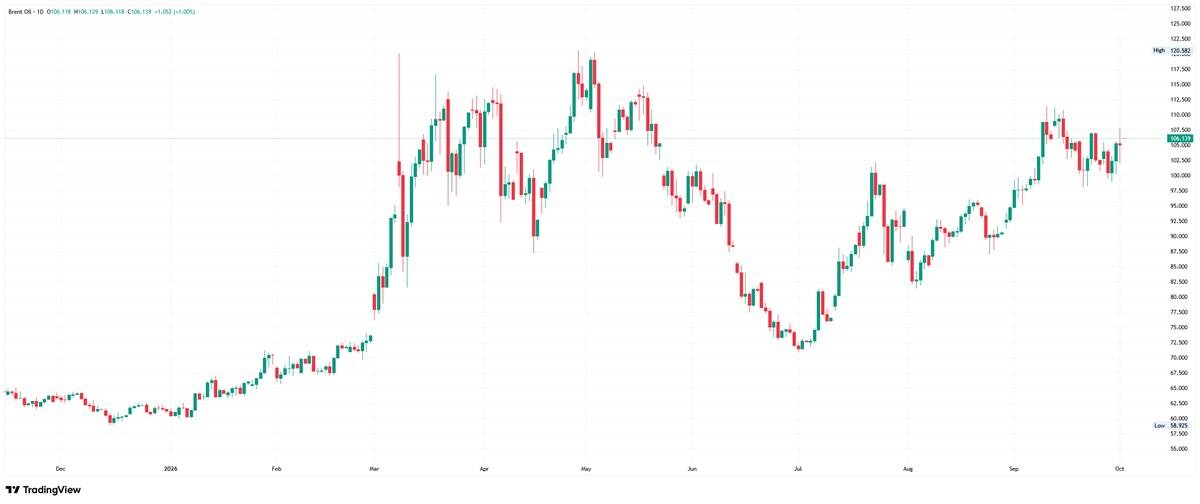
Brent is responding too. Data compiled by GSC Commodity Intelligence reports twelve separate moves above $100 in 2026.
GSC’s supplied figures also identify twelve distinct Brent spot price rallies of 12% to 19% following single-digit pullbacks, occurring within just three to five trading sessions alone. The pace at which Crude Oil is moving in today’s macro environment is unprecedented.
But outright price tells only part of the story. Backwardation – nearby contracts commanding a premium over later deliveries can indicate immediate supply tightness without establishing a permanent price floor.
“A correction in price is not automatically a correction in scarcity,” Hansen says. “Financial prices can retreat while the physical market remains tight.”
Europe Is Considering Spending Its Insurance Policy
Perhaps the most striking development is occurring in Europe.
Washington has reportedly asked the EU to release 120 million barrels of diesel over six months. GSC Commodity Intelligence calculates that such a release would consume more than 42% of the bloc’s emergency Diesel and Gasoil inventories.
The timing matters.
Europe is approaching winter after years of shrinking refining capacity. Across Europe and neighbouring countries, capacity fell from 17.5 million barrels a day in 2009 to 14.4 million in 2025.
Emergency reserves exist to cushion severe disruptions. Releasing them can ease today’s shortage, but also reduces protection against tomorrow’s unless supplies are replenished.
“Reserves buy time,” Hansen says. “They do not rebuild a refinery or create permanent production capacity. The longer disruption lasts, the more important replenishment becomes.”
Energy analysts describe strategic reserves in the current environment as the “last bullet in the chamber”, reflecting concern about drawing them down too aggressively while major geopolitical conflicts remain unresolved.
Scarcity Can Become Self-Reinforcing
The potential feedback loop extends beyond Oil.
“Shortages can encourage export restrictions,” Hansen says. “Fewer internationally available resources can intensify competition. Together, those pressures can increase scarcity premiums.”
Diesel’s role across transport, agriculture and industry explains why the consequences need not remain confined to fuel markets.
The world does not merely consume Hard Assets. It uses Hard Assets to produce almost everything else.
From The Year of Hard Assets to the Hard Asset Decade
The Gold & Silver Club’s “Year of Hard Assets” framework raises a larger possibility: 2026 could prove an opening chapter rather than the climax.
The Gold & Silver Club’s thesis is that greater emphasis on supply security could increase the value of ownership, productive capacity and access to essential resources.
There will be corrections. Supply can respond, demand can weaken and disruptions can reverse. Today’s geopolitical disruptions will not necessarily persist.
But physical supply cannot expand at the speed of financial demand.
Governments can create liquidity. Central banks can change interest rates.
They cannot print another barrel of Oil, tonne of Copper, cargo of Wheat or functioning refinery when the world needs it immediately.
“Scarcity changes the value equation,” Hansen says. “Hard Assets may prove to be more than another allocation. They could be the resources the world can least afford to be without.”
The world spent decades pricing abundance. It may now be entering a decade forced to price scarcity.
And that leaves one increasingly uncomfortable conclusion at the heart of GSC’s thesis:
“None of us own enough Hard Assets.”
For The Gold & Silver Club, the question is no longer whether the era of scarcity for Commodities and the broader Hard Asset economy is coming. This era has arrived.
The question now is whether you are positioned to capitalize on what could become the greatest wealth creation opportunity of this decade.
Where are prices heading next? Watch The Commodity Report now, for my latest price forecasts and predictions: