
Gold and silver just got smoked. Friday was ugly. Monday’s not looking much better. But here’s the thing — I’m not interested in recapping the carnage. We all saw it. What matters now is figuring out where we go from here.
I think excessive speculation wrecked this market. The rally got too crowded, too fast, and now we’re paying for it. So instead of obsessing over what just happened, let’s hit reset. Let’s go back to the forecasts from late 2025 — before the hype train left the station — and see what the pros were actually expecting for 2026.
Jaime Martinez Medina, Global Market Strategist at PU Prime commented:

The sharp selloff in gold and silver over recent sessions marks less a breakdown in fundamentals and more a necessary reset after an overcrowded rally. Prices had moved well beyond the scenarios originally envisioned by most institutional forecasts, driven by aggressive positioning and the assumption of rapid and deep monetary easing. When those expectations began to shift, the speculative premium quickly unwound.
Importantly, the decline does not reflect a collapse in physical demand or a sudden deterioration in long-term fundamentals. Instead, markets are recalibrating probabilities. Rate cut expectations have been pushed further out, inflation has proven more persistent, and confidence in imminent aggressive easing has faded. Under these conditions, assets priced for “worst-case-everything” outcomes were vulnerable.
Looking back to late-2025 forecasts provides a useful anchor. Institutions such as Goldman Sachs, JPMorgan, Bank of America, and Citi framed their 2026 outlooks around gradual easing, steady central-bank demand, and a challenging but manageable macro environment. None of those projections assumed a leveraged blow-off driven by universal conviction. As speculative excess fades, prices are gravitating back toward ranges consistent with those baseline assumptions.
Gold is now transitioning from a momentum trade to a valuation discussion. If rate cuts are delayed or fewer than expected, the short-term policy hedge premium diminishes, even as longer-term drivers such as debt accumulation and reserve diversification remain intact. Silver’s adjustment has been sharper, reflecting its thinner liquidity and greater sensitivity to leveraged flows. While its structural supply story remains valid over the long run, the metal is more exposed to rapid repricing when sentiment turns.
Crucially, a reset is not the end of the bull case. It is a rebalancing between enthusiasm and realism. The next phase will depend less on narrative momentum and more on stabilization and base-building. In that sense, the market is not rejecting precious metals, it is simply relearning how to price them without hype.
The Rally That Went Too Far
Look, gold and silver didn’t crash because the story broke. Physical demand didn’t collapse. The long-term fundamentals didn’t suddenly fall apart. What happened is simpler: the market got way ahead of itself.
Traders piled in hard coming into the year. The narrative was bulletproof — or so it seemed. Rate cuts were coming. The economy was softening. Geopolitical chaos and fiscal uncertainty were ramping up. Gold was the safe haven. Silver was the leveraged play on that same trade.
Prices ripped past every reasonable forecast published in late 2025. The market wasn’t pricing in a likely scenario anymore. It was pricing in the worst-case everything, all at once.
Silver crossed $55 on November 28 and never looked back — straight to $121.67 by January 29. Gold ran from $3886 in late October to $5602 at the same peak. Both markets were respecting their 50-day moving averages through November, then momentum took over and technical discipline went out the window.
Gold Price Forecast
Every new Gold analysis as it publishes, today's technical signal and key levels, live price — on one page.
See all Gold forecastsThen Reality Showed Up
The certainty cracked. Rate cut expectations got pushed out. Some folks started wondering if we’d even see meaningful easing in 2026 at all.
Inflation’s not cooperating. The labor market’s holding up better than expected. And the Fed’s credibility is back in focus. When Kevin Warsh got appointed, the market read it as confirmation: easy money isn’t coming anytime soon.
For assets priced on what happens next, that shift mattered. A lot.
Speculation Turned Into a Liability
Once expectations changed, the speculative premium became a problem. Margin requirements went up. Volatility spiked. Positions that were built on momentum — not valuation — had to get cut.
Silver got hit harder because it always does. It’s thinner, more volatile, and when leverage exits fast, prices move fast. Within two days of that January 29 high, silver was back at its 50-day moving average near $75. That’s a complete round trip in 48 hours. Gold dropped to $4402 on Monday — testing its own 50-day at $4484.
This wasn’t the market rejecting gold as a store of value. It wasn’t saying silver’s supply story is dead. It was just repricing how much premium traders were willing to pay under a less friendly policy outlook.
Why the Old Forecasts Matter Now
The way I see it, those late-2025 forecasts become useful again. Not because they were right or wrong — but because they were clean.
Goldman, Citi, JPMorgan, Bank of America — they all framed their 2026 outlooks around gradual easing, steady central-bank buying, and a bigger picture that was uncertain but manageable. Nobody was modeling a speculative blow-off fueled by leverage and universal conviction that rate cuts were right around the corner.
So if we strip away the excess, where do prices naturally settle? Probably somewhere closer to those original ranges. That doesn’t require a bearish economic story. It just requires that reality falls short of the most extreme outcomes that got priced in during the rally.
Gold’s Going Back to Fundamentals
Gold’s shifting from a momentum trade back to a valuation discussion. If rate cuts get delayed or scaled back, the near-term policy hedge premium fades — even if the long-term concerns about debt, currency risk, and reserve diversification stay intact.
The 50% retracement of gold’s October-to-January run
sits at $4744. The 61.8% level is at $4542. Right now we’re testing the zone between the 50-day moving average at $4484 and that deeper Fibonacci level. If this area holds and a base forms here, that’s your reset. If it fails, the 200-day moving average at $3793 becomes the next logical target — and that would be a full do-over.
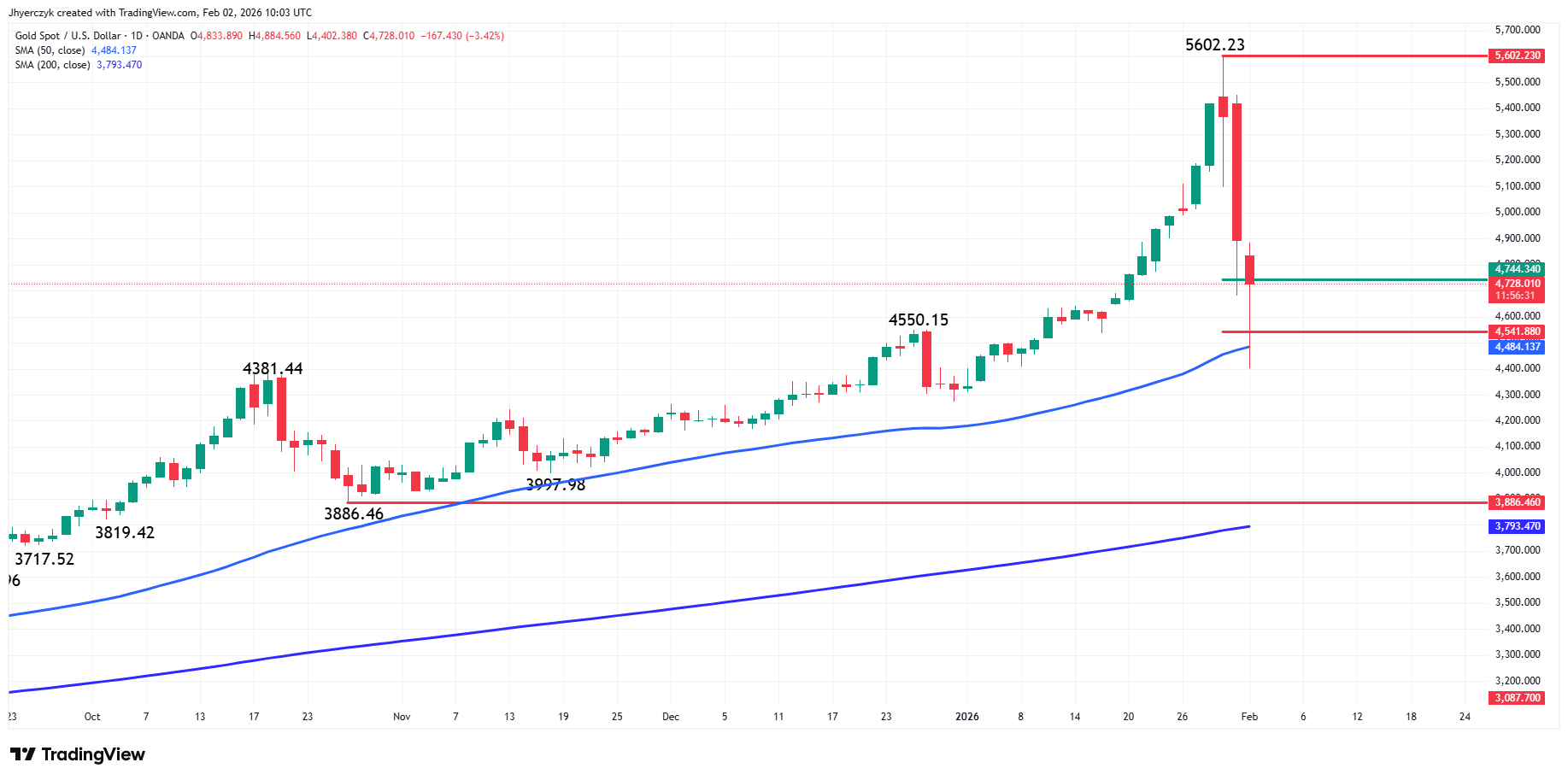
Gold Spot / U.S. Dollar (XAUUSD), daily chart. Source: TradingView.
Gold doesn’t lose its appeal. But it gets harder to justify prices that assume rapid, aggressive easing when that’s not what’s actually happening.
Silver’s Adjustment Is Sharper
Silver’s dealing with the same reset, just louder. The structural supply story still works over the long haul. But high prices already pushed industrial users toward thrifting and substitution.
The 50% retracement level from October to January
comes in at $83.61. The deeper 61.8% level is at $74.63. Silver’s now sitting right on top of a support cluster — the 50-day moving average at $75.23 and that Fibonacci level at $74.63. This is fair value territory, maybe. If it holds, we’ve got a floor. If it breaks, the 200-day moving average at $49 is staring us in the face. That’s where a complete reset happens.
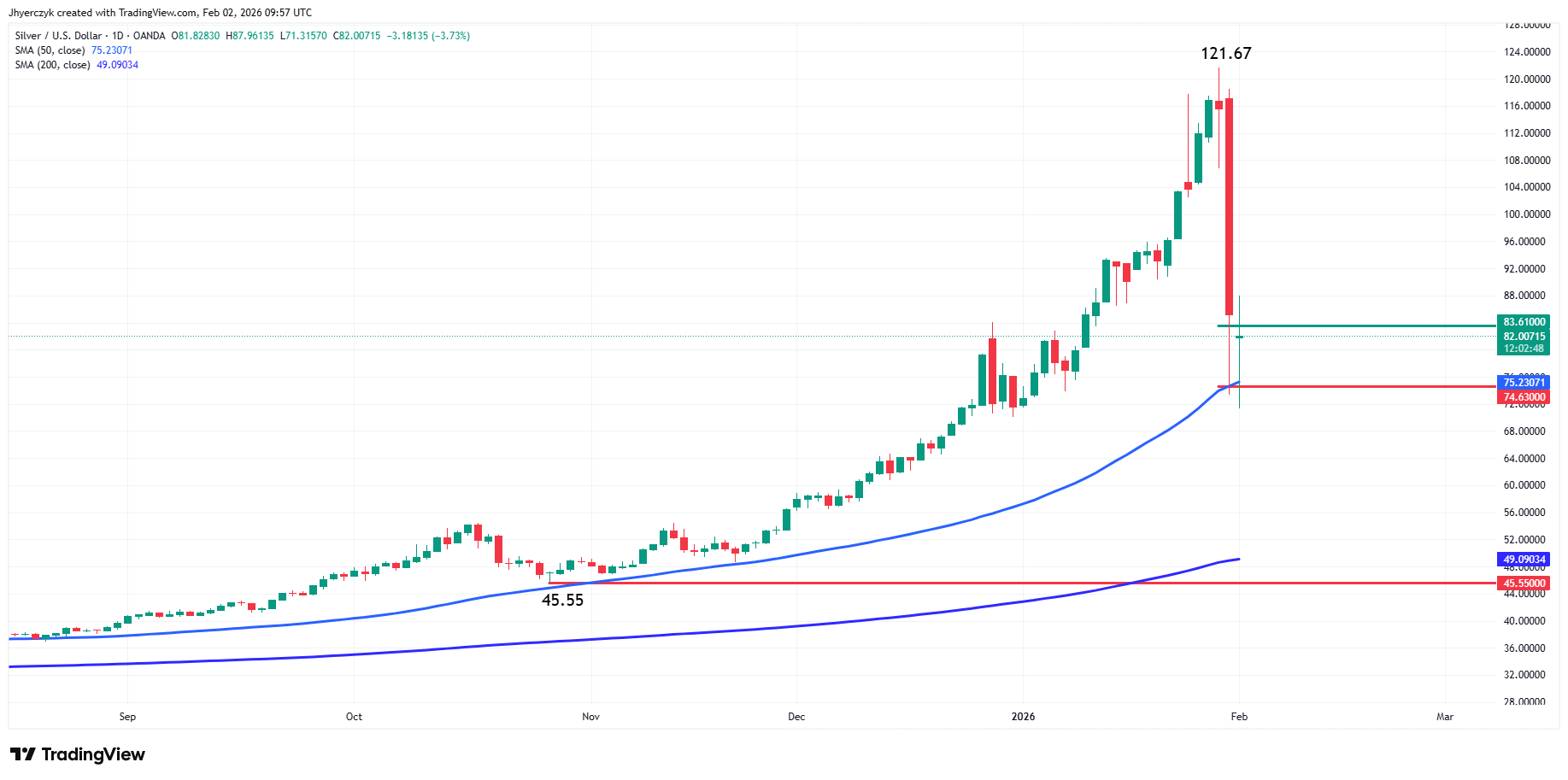
Silver / U.S. Dollar (XAGUSD), daily chart. Source: TradingView.
Without central-bank demand to anchor things, silver’s more exposed to speculative swings. When leverage comes in hot and exits even hotter, prices overshoot in both directions.
A Reset Isn’t a Breakdown
Here’s what matters, in my opinion: a reset doesn’t kill the bull case for precious metals. It just rebalances it.
Markets need to reconcile enthusiasm with probability every now and then. The late-January highs reflected a market trading every worst-case assumption at the same time. The recent selloff suggests we’re moving back toward a more selective, scenario-based approach.
For both metals, the next step is building a support base. Spiking down and spiking back up only feeds the speculative narrative. What we need is stabilization — a bottom that actually holds, not just another head-fake.
What This Means for Traders
The market’s not trading one dominant narrative anymore. It’s reassessing. How much easing? How sticky is inflation? How much risk premium actually belongs in these prices?
In that environment, those original 2026 forecasts become useful what-if scenarios. What if rate cuts are fewer and later than expected? What if inflation proves sticky instead of transitory? What if speculative excess stops driving the bus?
The Path Forward
As gold and silver work through this, expect volatility to stick around. Two-way trade is the game now. The path forward doesn’t look like a straight-line rally extension. It looks like normalization.
Prices might still find support over time. But they’re going to re-anchor to expectations — not momentum.
Bottom line: the excessive speculation broke the market. Now we need a do-over. Let’s see what happens when we trade reality instead of hype.