Silver Claws Back After Historic 30% Crash — Is the Support Base Forming?
Spot Silver is trading higher on Tuesday as the market continues to attempt to claw back last week’s steep loss. The market is attempting to build a support base inside an area that provided support between late November and early January before it launched a speculative-driven rally to the record high at $121.67 last Thursday.
At 12:39 GMT, XAGUSD is trading $86.78, up $7.47 or +9.42%.
As the market continues to consolidate, traders are still asking questions about Friday’s more than 30% dump. A consensus of traders and analysts agrees that the price correction was probably overdue. However, there is still some debate over what caused it and if those factors will persist long enough to end the current bull market in gold and silver.
Silver Went Vertical — And Paid the Price
Plain and simple, silver went up too much, too fast. After a steady climb throughout the year, essentially hugging the 50-day moving average in the process, silver went vertical on a wave of speculative buying. Despite the steep plunge, it’s still up over 19% for the year, which in some circles is too much, but by silver standards, it appears to be just right.
Warsh Nomination and Hot PPI Triggered the Selloff
Traders and analysts have concluded that two factors were likely behind the sell-off. One was President Trump’s nomination of Kevin Warsh as chairman of the Federal Reserve. Warsh is considered a hawk, which puts at risk the market’s expectation for two rate cuts in 2026. With Trump pushing Powell to cut rates, and making it pretty personal, silver traders were counting on Trump naming someone more accommodative and were likely disappointed by Trump’s choice of Warsh.
After much analysis over the weekend, I concluded that a hot Producer Price Index reading was likely the second factor causing the mass liquidation. The PPI climbed 0.5 percent month-on-month, raising concerns that the CPI would be higher next month, again creating more concerns about the number and timing of Fed rate cuts — something silver traders didn’t price in.
This Was a Reset, Not the End of the Rally
I don’t think the big sell-off on Friday marked the end of the rally in Silver. I think it was a major reset though. I think it showed traders where the market could go in the future and where investors may consider it to be overvalued based on the typical fundamentals. Those include de-dollarization, inflation pressures, monetary policy easing, geopolitical concerns and future supply and demand.
Silver Price Forecast
Every new Silver analysis as it publishes, today's technical signal and key levels, live price — on one page.
See all Silver forecasts50-Day Moving Average Holds the Key Again
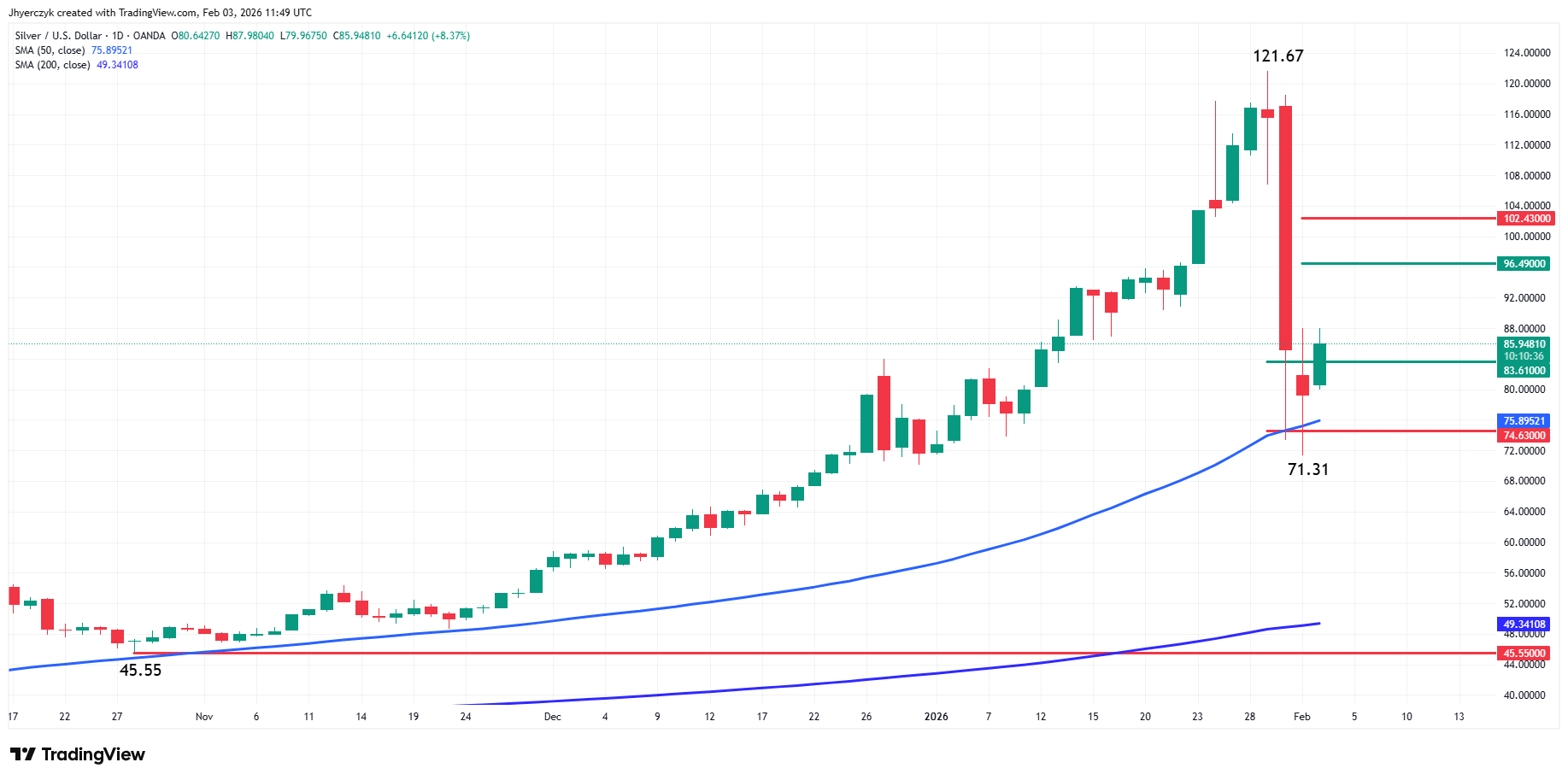
Technically, the market appears to be settling inside a key retracement zone and near the 50-day moving average. If you work backwards, you’ll see that traders loved the 50-day for its guidance throughout 2025 and now appear to be hoping for that same guidance at this time.
The range I believe the market is working with is the October 28 bottom at $45.55 and the January 29 top at $121.67. It formed the retracement zone at $83.61 to $74.63 that is currently being tested. The 50-day moving average at $75.91 is currently trading inside this area.
If this range holds and upside momentum builds, then we could see a surge into another retracement zone at $96.49 to $102.43. Trader reaction to this zone will determine whether we head to a new high or retreat lower to reestablish new support.
More Information in our Economic Calendar.