
Dollar Tests Key Retracement Zone for Third Day — Jobs Data Delay Adds Uncertainty
The U.S. Dollar Index is edging higher late Wednesday as it tests a key technical retracement zone for a third straight session. The index was under pressure early in the session as traders reacted to the news that a partial government shutdown this week is going to delay the release of key jobs data. This would add to the uncertainty over the timing of the Federal Reserve’s first interest rate cut in 2026.
At 21:08 GMT, DXY is trading 97.657, up 0.276 or +0.28%.

Weak ADP Report Surprises with Dollar Strength
The dollar recovered from early session weakness after payrolls processing firm ADP reported that private companies added just 22,000 positions in January, less than the Dow Jones consensus forecast for 45,000. The move came as a surprise because a weakening labor market usually supports a rate cut, which would be bearish for the dollar. However, the dollar rose, suggesting traders may be focusing on other factors.
The move in the dollar could be related to the movement in Treasury yields, which fell initially after the unexpectedly weaker ADP jobs report then moved back to unchanged.
Short-Term Strength, But When Does the Longer-Term Sell-Off Resume?
While our focus is on the short-term movement in the dollar index, the real story is when the greenback will resume its longer-term sell-off.
According to a Reuters survey of currency strategists, the consensus still calls for the Fed to make two rate cuts this year. However, that outlook is being clouded by uncertainty over Federal Reserve independence. With this in mind, my work suggests a rangebound trade until June, when Trump’s Fed Chair nominee Kevin Warsh is expected to take office.
EUR/USD Price Forecast
Every new EUR/USD analysis as it publishes, today's technical signal and key levels, live price — on one page.
See all EUR/USD forecastsAnalysts are likely to remain net short the dollar as they continue to follow Fed rate cut projections, even thoughinflation has been running above 2% for nearly five years.
Downtrend Intact — But 97.522 Holds the Key to Near-Term Direction
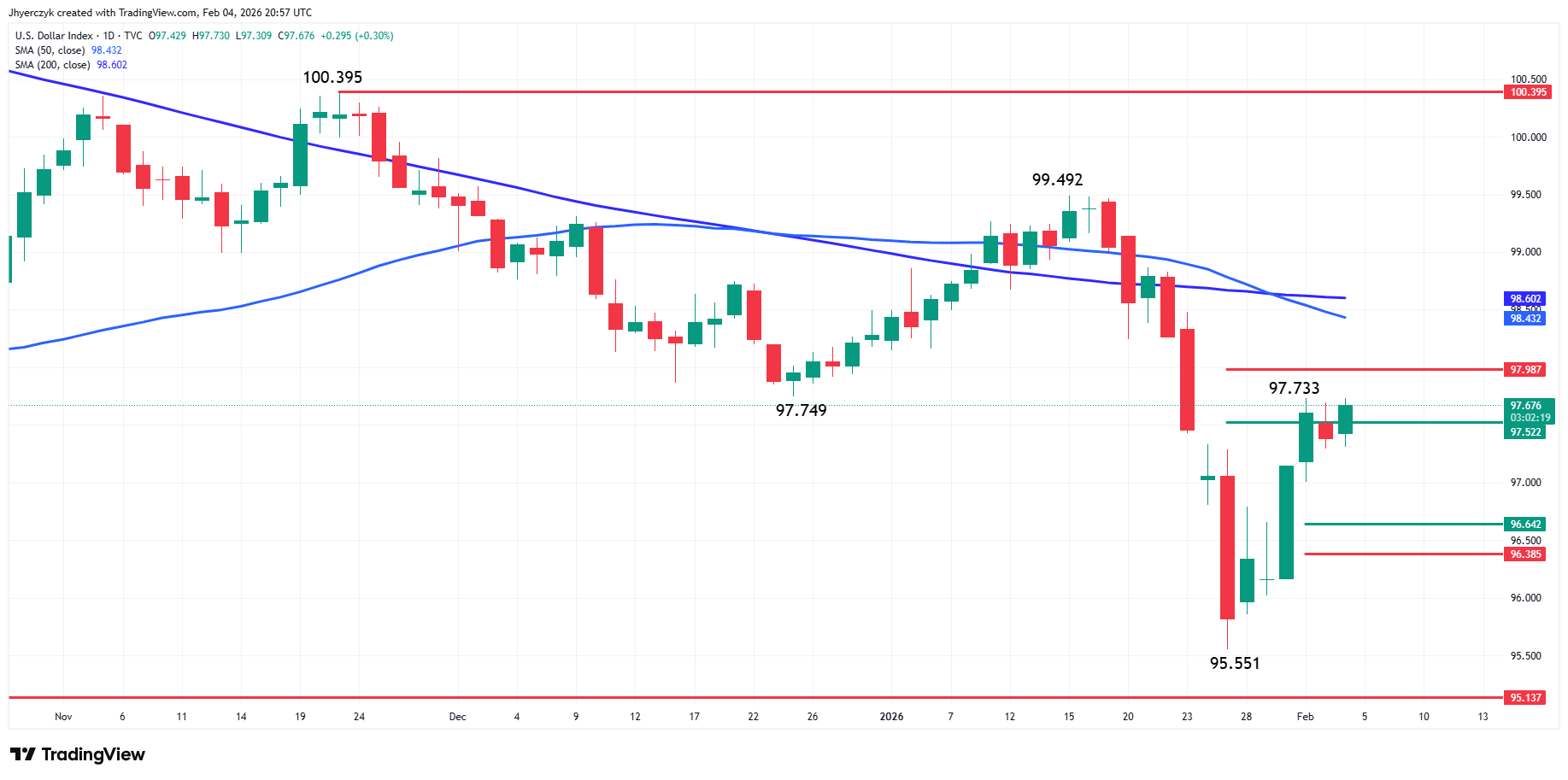
Technically, DXY is in a downtrend. A move through 95.551 will signal a resumption of the downtrend, while a trade through 99.492 will change the main trend to up.
The short-term range is 99.492 to 95.551. The DXY is currently testing its retracement zone at 97.522 to 97.987. Monday’s high at 97.733 fell inside this zone.
A new minor range could be forming between 95.551 and 97.733. If this brings in new sellers, the index could pull back to 96.642 to 96.385.
Looking ahead and based on the price action the last three sessions, the near-term direction of DXY is likely to be determined by trader reaction to the 50% level at 97.522.
A sustained move over 97.522 will create an upside bias, but the index will still face headwinds at 97.97, the 50-day moving average at 98.432, and the 200-day moving average at 98.601.
A sustained trade under 97.522 could trigger a plunge into 96.642 to 96.385.
More Information in our Economic Calendar.