
U.S. Dollar Flat After Retracement — Range May Be Forming
The U.S. Dollar is flat against a basket of major currencies early Wednesday after completing a little more than a 50% retracement on Monday. After last week’s volatile trade that saw the DXY plunge to a three-year low, the market has recovered enough to suggest it may be forming a range. Prices are consolidating as traders assess upbeat U.S. economic data and expectations of a less dovish Fed. Dollar sentiment is weakening on concerns about another government shutdown.
At 07:27 GMT, DXY is trading 97.383, up 0.002 or +0.00%.

De-Dollarization Fears Sparked the Selloff — Then Fed Doubts Fueled the Rally
Early last week, the dollar got hit with a wave of selling pressure as de-dollarization concerns came back after a monthlong reprieve. The selling came to a screeching halt on Tuesday, January 27, and the index started its comeback after the Federal Reserve failed to convince investors about the timing and number of rate cuts in 2026. The rally picked up steam Friday, posting a 1.02% gain. Two things fueled the move: a hotter-than-expected Producer Price Index (PPI) report and President Trump’s nomination of Kevin Warsh for Chairman of the Federal Reserve.
Hot PPI Raises Inflation Concerns — Could Keep the Fed on Hold
The PPI report showed U.S. producers increased prices by the most in five months in December. This was likely caused by the pass-through of import tariffs. The main concern is that producers could pass the increase along to consumers, which would push inflation higher in the next Consumer Price Index (CPI) report. A jump in CPI could push the Fed to hold rates steady longer.
Powell Signals Tariff Inflation May Peak Mid-Year
This jump in the PPI clarifies what Fed Chair Powell was suggesting last Wednesday after the Fed left its benchmark rate at 3.50% – 3.75%. In his press conference, Powell attributed lingering inflation to tariffs. He also added “but there’s an expectation that sometime in the middle quarters of the year we’ll see tariff inflation topping out.”
“This report validates the pivot of the Fed away from labor market risks back to price stability,” said Carl Weinberg, chief economist at High Frequency Economics.
EUR/USD Price Forecast
Every new EUR/USD analysis as it publishes, today's technical signal and key levels, live price — on one page.
See all EUR/USD forecastsWarsh Uncertainty Could Create Rangebound Trade
The reason we may see rangebound trade is uncertainty over the Warsh nomination. Traders had priced in two rate cuts by the Fed in 2026 so the dollar was pressured. Sellers paused last week when Warsh was nominated. With Powell’s term ending in May and Warsh not taking office until June, the market is starting to think the Fed won’t cut rates until June — the first meeting after Warsh takes over.
Warsh hasn’t made any comments about interest rates since his nomination, so it is possible that he could cut rates more aggressively than the market has priced in. Furthermore, there haven’t been any major shifts in Fed policy expectations. We could be entering a dead phase until dollar traders get more clarity.
That’s the short-term outlook. Longer term, traders betting on dollar devaluation are likely to keep the pressure on by capping rallies and selling into strength.
Retracement Zone at 97.52-97.99 Being Tested — Downtrend Still Intact
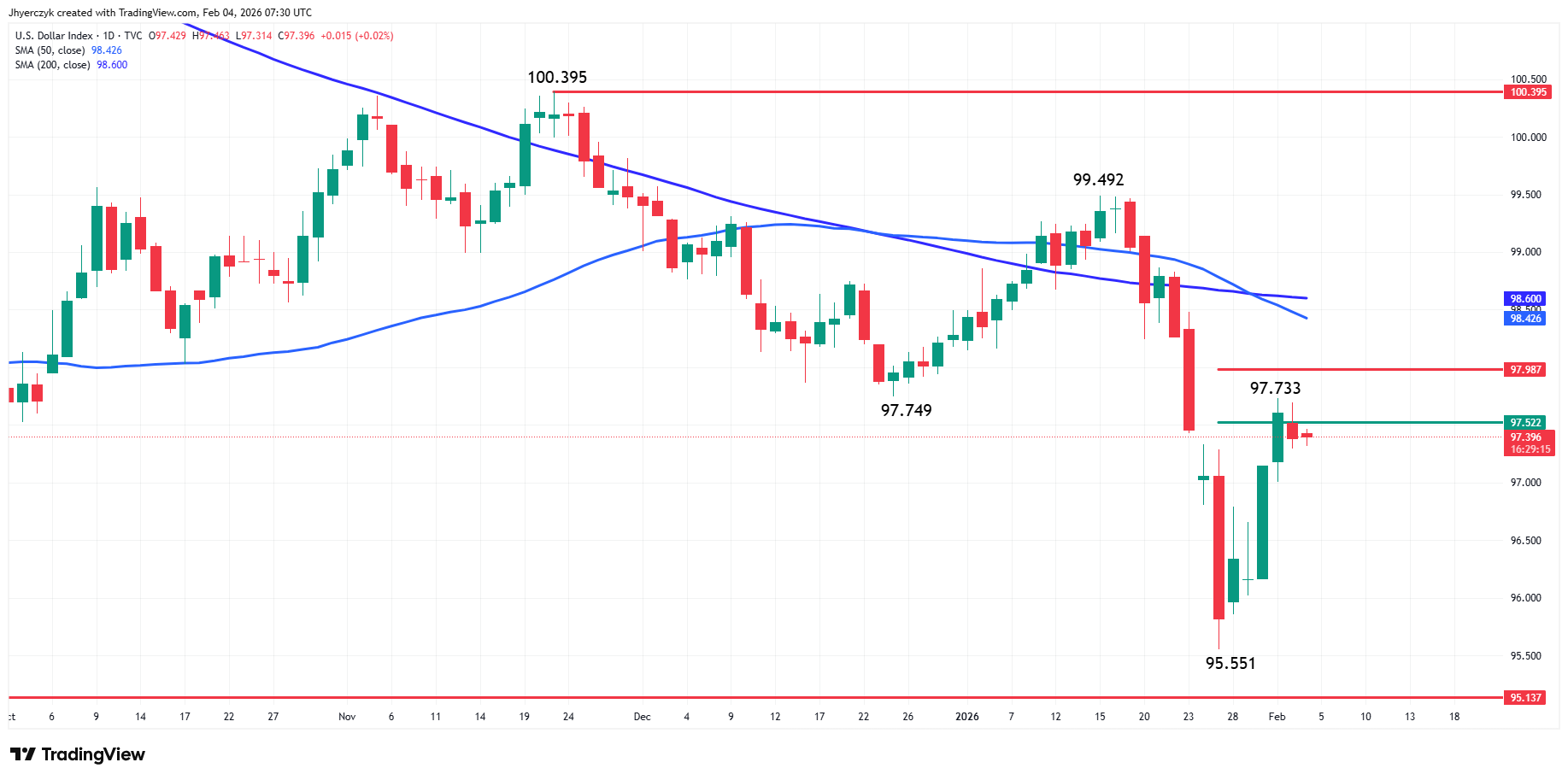
Technically, the main trend is down according to the daily swing chart and the moving averages. The nearest swing top and change in trend point is 99.492. This is above both the 50-day moving average at 98.426 and the 200-day moving average at 98.600. So the major resistance is pretty solid and the downtrend is clear.
The short-term range is 99.492 to 95.551. Its retracement zone at 97.522 to 97.987 stopped the rally on Monday at 97.733. Trader reaction to this zone is likely to determine the short-term direction.
More Information in our Economic Calendar.