
The market widely expects the ECB to hold rates unchanged, with the refinancing rate remaining at 2.40% and the deposit rate at 2.25%.
The real focus, however, is not the decision itself, but whether the updated monetary policy statement and Lagarde’s remarks signal readiness for a rate hike in September. Therefore, the real volatility will emerge during the press conference as traders will be searching for clues about the September decision as well as trying to gauge the general sentiment within the ECB.
EUR/USD Trend
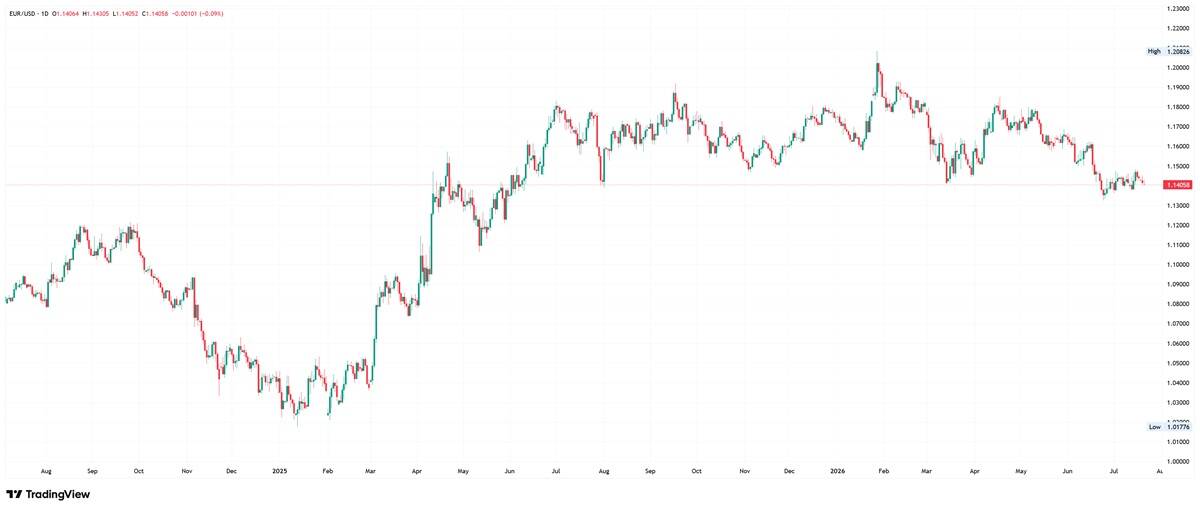
EURUSD has been in a clear downtrend since late April 2026. The pair has been primarily weakened by geopolitical developments as U.S.–Iran tensions over the Strait of Hormuz damaged risk sentiment and spurred safe-haven flows into the U.S. dollar. Widening monetary policy expectations between the ECB and the Federal Reserve (Fed) have also played a role. Specifically, EURUSD dropped 0.76% on 5 June after a strong U.S. jobs report cemented expectations for a Fed rate hike.
Additionally, the common currency depreciated by another 0.92% on 17 June (its largest one-day decline in almost six months) after the Fed meeting revealed that nine of the U.S. central bank’s 19 policymakers believed that there was a need to raise the Fed’s policy rate this year. Six of those nine, or nearly a third of the committee, felt that more than one 25-basis point (bps) rate hike would be needed in 2026. Overall, EURUSD is down just over 3.6% over the past three months and is currently trading near 1.14200, below all key daily moving averages and just 1% above its 14-month low.
Macro Factors
The current macro environment is complex with many competing factors at play. The most obvious is the ongoing U.S.–Iran conflict. Brent crude is currently trading at $90 per barrel. Higher oil prices mean higher Eurozone inflation and growing expectations of an ECB rate hike, which, in turn, should support the euro. However, geopolitical instability also results in stronger safe-haven demand for the U.S. dollar, putting downward pressure on the common currency.
Another complicating factor is that the recent heatwave in Europe and fertiliser shortages could put upward pressure on food prices. This is one reason traders and Reuters-polled economists expect a September hike even if oil prices stabilise.
EUR/USD Price Forecast
Every new EUR/USD analysis as it publishes, today's technical signal and key levels, live price — on one page.
See all EUR/USD forecastsAn additional, separate factor and one that could provide bullish support for EURUSD is the upcoming change in ECB reserve requirements. The ECB is considering doubling its minimum reserve requirement, a move that would effectively withdraw approximately 160–170 billion euros of excess liquidity.
Overall, the current macro environment is anything but stable. But what is the current market positioning? According to the latest interest rate swaps market data, traders are pricing in an 87% chance that the ECB will leave its benchmark interest rate unchanged at the upcoming meeting. They are also pricing in a 75% probability of a rate hike in September and a 34% probability of another rate hike in October. Thus, it seems reasonable to infer that even if Lagarde explicitly opens the door to a rate hike in September, the reaction in EURUSD may be only mildly bullish.
Key Scenarios for the EURUSD
I foresee only three scenarios. Indeed, Lagarde can only do one of three things: be hawkish, dovish, or neutral.
- Neutral Lagarde. This is what central bankers usually do. They strike a balanced tone, reiterate data dependence and say that all options are on the table. In this case, we should probably expect range-bound trading with a minor bearish tilt. Because the market is heavily positioned for a September rate hike, a failure by policymakers to either explicitly confirm or deny its possibility may push some traders to exit their EURUSD longs. However, a drop below 1.13600 is relatively unlikely. EURUSD will probably continue to drift within the 1.13800–1.15100 range.
- Hawkish Lagarde. If Lagarde calls for a rate hike in September and reveals that policymakers discussed one at their July meeting, EURUSD will likely rally past 1.15000 resistance. A break above 1.15000 will open the way towards 1.15400 and 1.16000–1.16100 area.
- Dovish Lagarde. In this scenario, Lagarde downplays the possibility of a rate hike in September. Indeed, she might highlight that wage growth is moderating and/or that June inflation figures were better than expected (which they were) and thus no further rate hike is currently warranted. While such a scenario is possible, I consider it the least likely of the three. Still, in this scenario, EURUSD will probably drop below 1.13500 and may even retest a previous swing low near 1.13200. Technically, bears will begin targeting 1.12800, but I believe the selloff will be kept in check by fears of energy-driven inflation.
Summary
Thursday’s ECB decision is unlikely to deliver a rate change, but Lagarde’s press conference (at 12:45 p.m. UTC) is the key event for the EURUSD. With a September hike fully priced and over 40 bps of further tightening expected by year-end, the bar for a hawkish surprise is high. It means that the risk asymmetry leans slightly towards the downside for EUR if Lagarde pushes back against aggressive tightening expectations, and is only modestly positive if she validates them.
Disclaimer: This article does not contain or constitute investment advice or recommendations and does not consider your investment objectives, financial situation, or needs. Any actions taken based on this content are at your sole discretion and risk—Elev8 does not accept any liability for any resulting losses or consequences.