China Economic Indicators Highlight Need for Consumption-Focused Stimulus
On Monday, December 16, China’s economic data drew interest as markets considered last week’s policy measures aimed at supporting the economy.
The data revealed mixed signals about the economy’s health:
- House Price Index fell 5.7% year-on-year in November after declining by 5.9% in October.
- Fixed asset investment rose 3.3% year-to-date in November, down from 3.4% in October.
- Industrial production increased by 5.4% year-on-year, up from 5.3% in October.
- Retail sales were up 3.0% year-on-year in November, down sharply from 4.8% in October.
- China’s unemployment remained steady at 5.0%.
While industrial production increased, fixed asset investment dipped, suggesting potential front-loading ahead of US tariffs on Chinese goods. However, the marked drop in retail sales was more concerning, reinforcing the need for stimulus measures to drive consumption and domestic demand.
The pullback in retail sales aligned with recent inflation figures, reflecting a pickup in deflationary pressures. Consumer prices declined by 0.6% month-on-month in November after falling 0.3% in October.

China Consumer Sentiment a Beijing Bugbear
Last week, markets showed disappointment toward China’s Central Economic Work Conference (CEWC) measures to bolster the economy. The CEWC announced plans to raise the budget deficit, loosen monetary policy, and issue more debt. Experts, however, remain skeptical about the effectiveness of these policies as consumer sentiment weakens.
The Kobeissi Letter remarked on China’s consumer sentiment, saying:
“Even as hundreds of billions of dollars of stimulus have begun, Chinese consumer sentiment is terrible. Over the last 3 years, consumer confidence in China is down ~ 50 points. Such a drop in consumer assessment of the Chinese economy has almost never been seen before.”
Today’s data could pressure Beijing to implement stimulus targeting domestic consumption, especially as US tariffs loom.
AUD/USD Price Forecast
Every new AUD/USD analysis as it publishes, today's technical signal and key levels, live price — on one page.
See all AUD/USD forecastsMarket Reactions: China’s Economic Data Pressures Hang Seng Index
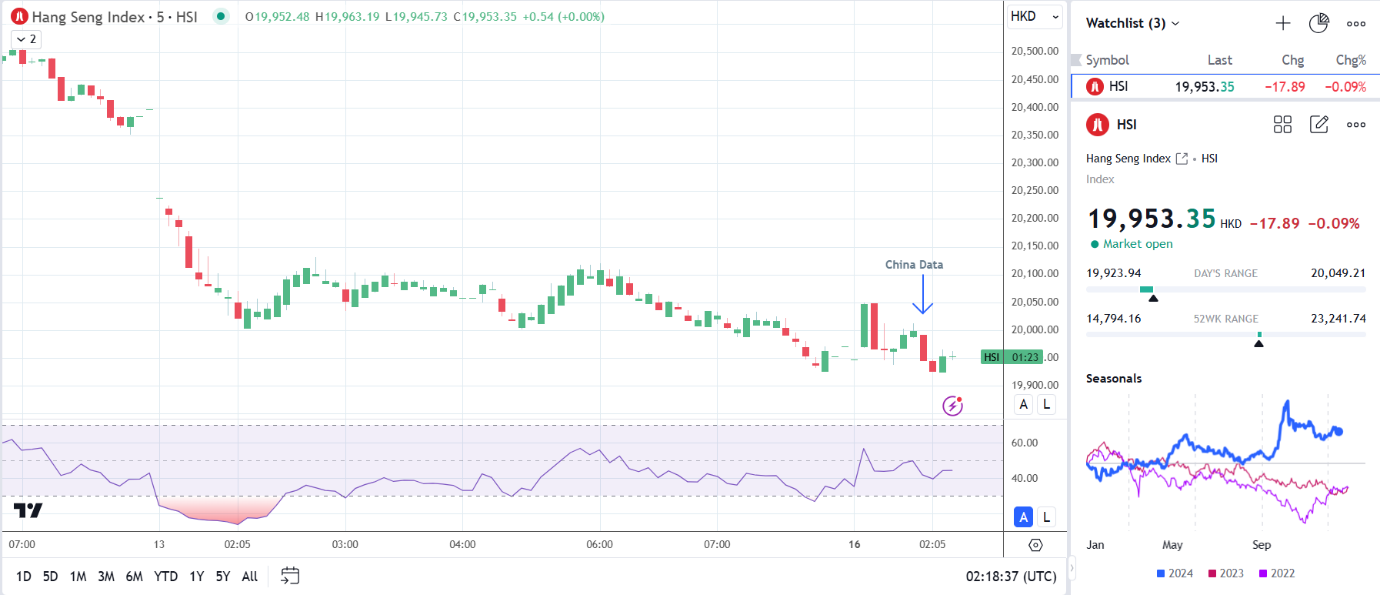
Before the economic indicators from China, the Hang Seng Index climbed to an early high of 20,049.
However, in response to the data from China, the Hang Seng Index fell to a post-data low of 19,924. The sub-indexes also trended lower. The Hang Seng Tech Index (HSTECH) and the Hang Seng Mainland Properties Index (HSMPI) reversed morning gains.
On Monday morning, December 16, the Hang Seng Index was down 0.09% to 19,953.
AUD/USD Reacts to Housing and Industrial Production Data
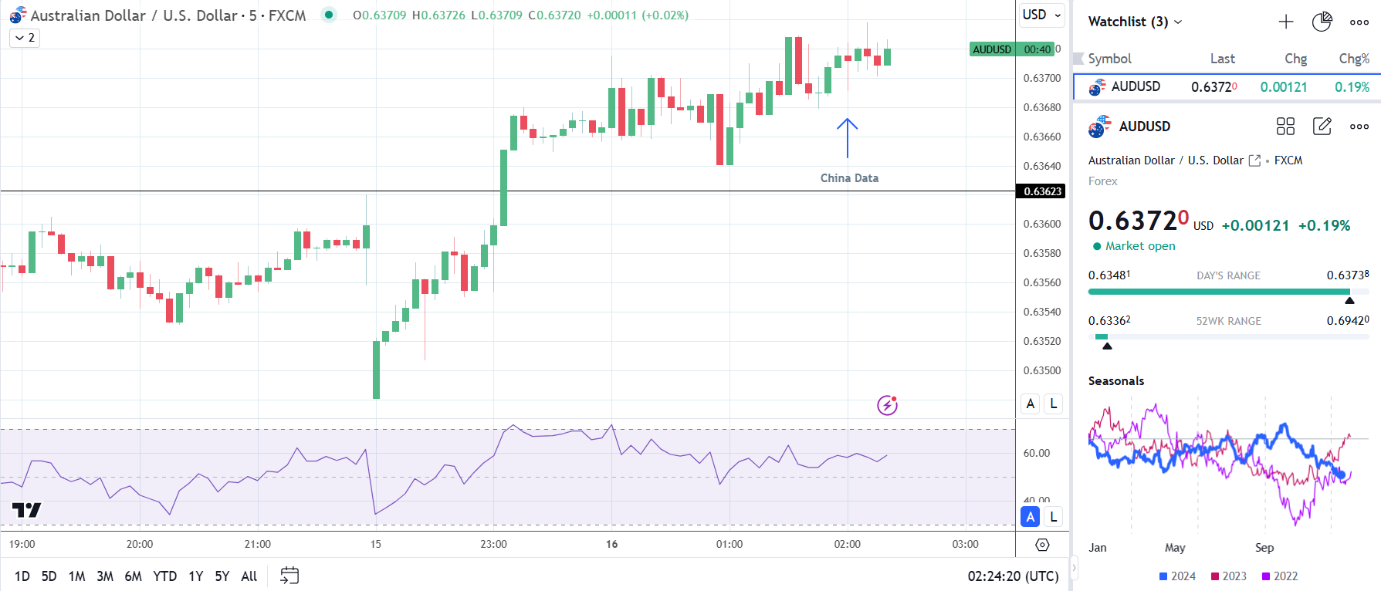
The AUD/USD reacted positively to the data. Improving housing market conditions and a pickup in industrial production boosted Aussie dollar demand. However, concerns surrounding weak domestic consumption limited gains.
On Monday, December 16, the AUD/USD was up 0.19% to $0.63720.