The Dow Jones Industrial Average dropped to 51,460 on Wednesday after the Federal Reserve raised interest rates by 25 basis points. Dow Jones recovered in early Thursday trading as oil prices eased after hitting significant resistance zones. But the bounce does not confirm a recovery. The 10-year Treasury yield remains close to 5% while several major Dow components face company-specific pressure. In my view, the index may remain volatile until Treasury yields start to correct below 5% and the rebound in index receives broader support.
Quoc Dat Tong, Senior Financial Markets Strategist at Exness commented:

The Dow is facing an unusual situation where good economic news can also create pressure. Strong consumer spending shows that the US economy is holding up well, but it also gives the Fed more reason to keep interest rates high if inflation remains stubborn. With bond yields already elevated, markets are likely to remain sensitive to inflation data, company earnings and any signals about another Fed rate hike.
Fed Rate Hike and 10-Year Treasury Yield Near 5% Weigh on Dow Jones
The Federal Reserve increased the target rate by 25 basis points to the range of 3.75%-4.00% in September. This was the first rate increase since 2023 and all policymakers supported this decision. The Fed said that the economy remained strong, but inflation was still too high. The latest rate forecasts also suggest that the tightening cycle may not be over yet. Sixteen of the 18 officials expect at least one more rate hike before the end of year.
The latest economic projections by Fed help explain the strong position. The officials raised their 2026 growth forecast to 2.3% and lowered the unemployment forecast to 4.1%. They also increased the forecast for the headline PCE inflation to 3.7% and the forecast for core to 3.4%. These figures suggest that the economic growth is steady but price pressure is still high. The strong growth may support the earnings in corporate sector. But it also gives the Fed more room to raise rates again. The 10-year Treasury yield traded near 5% on Thursday while the two-year yield remained close to 4.70%.
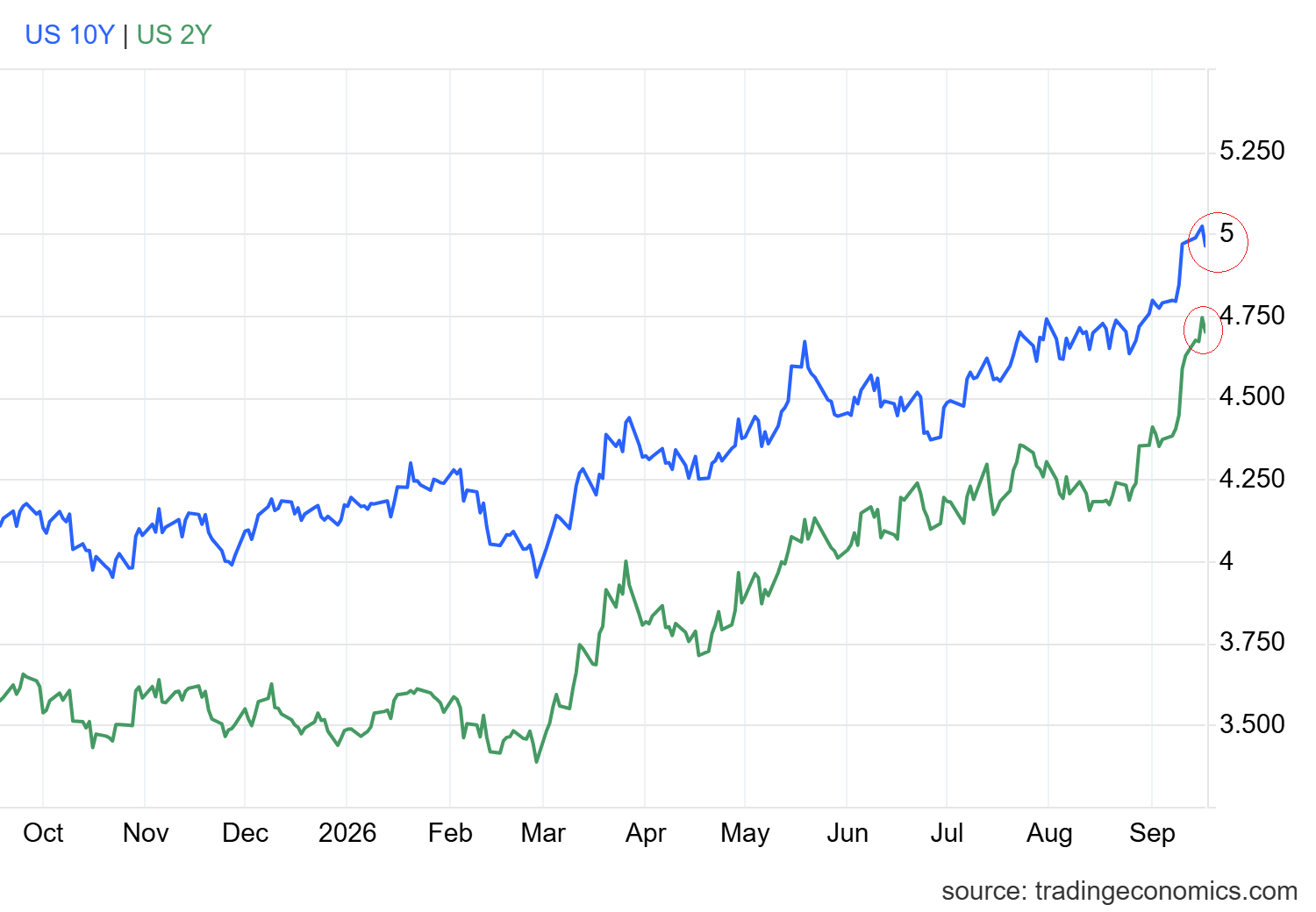
The latest data also show that the consumer spending is still high. The chart below shows that the US retail sales increased 1.2% in August after falling 0.5% in July.
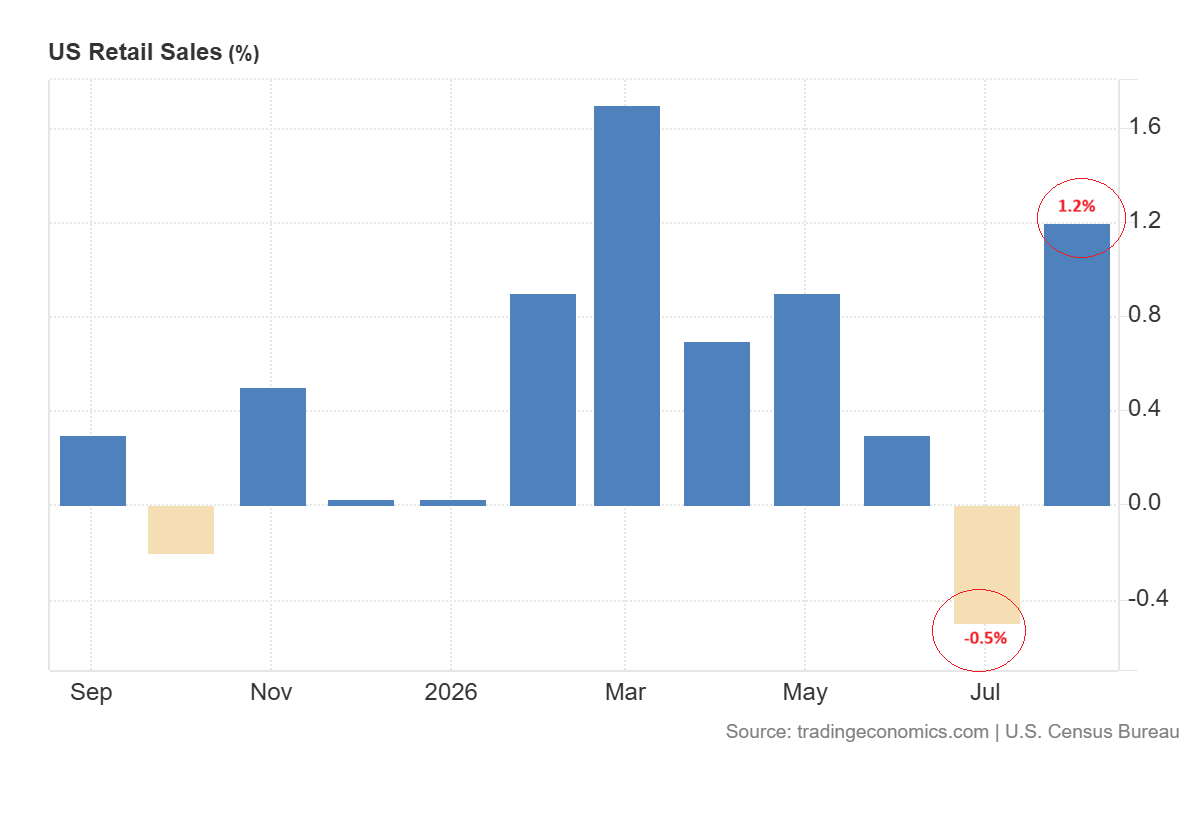
The core measure used in GDP calculations rose 1.4%.
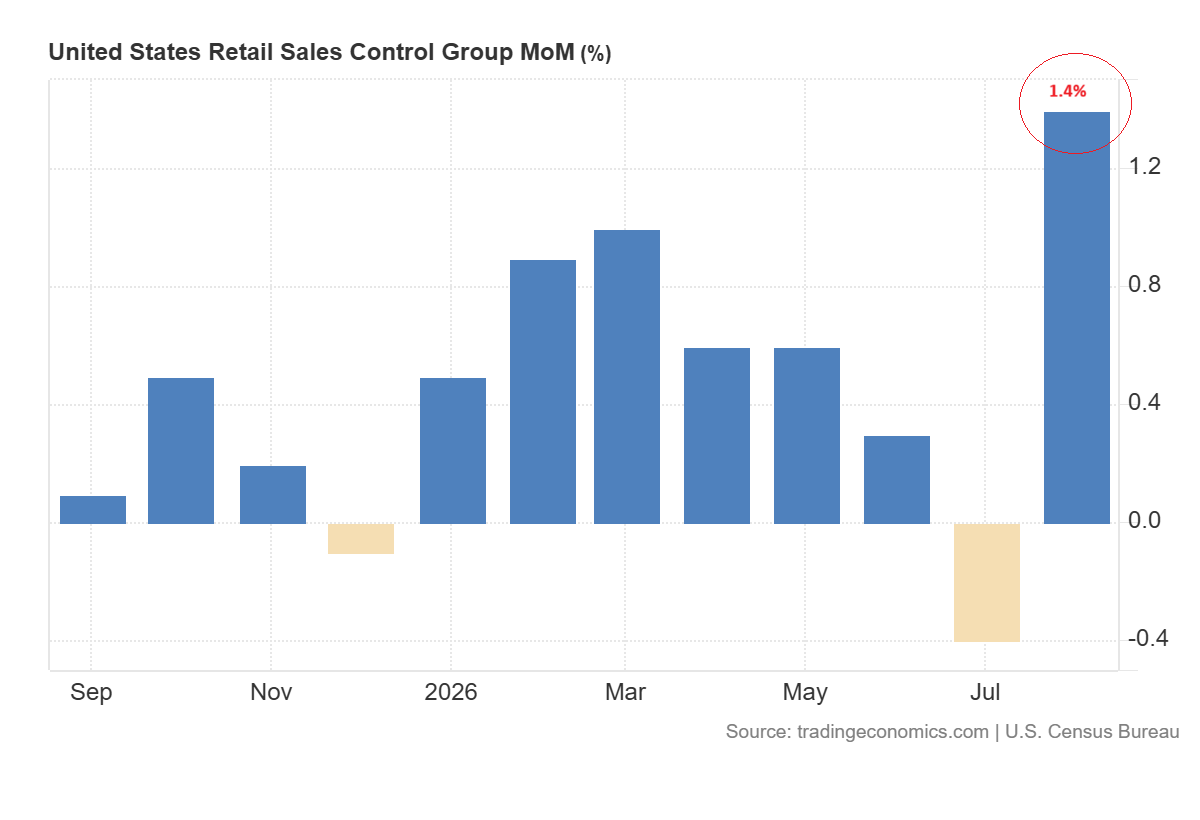
But inflation remains major concern. The headline CPI increased 3.4% from a year earlier while producer prices rose 5.4%. Import prices also increased 7.0% over the year. The high consumer spending may support sales at Dow companies but persistent inflation could keep interest rates and borrowing costs high.
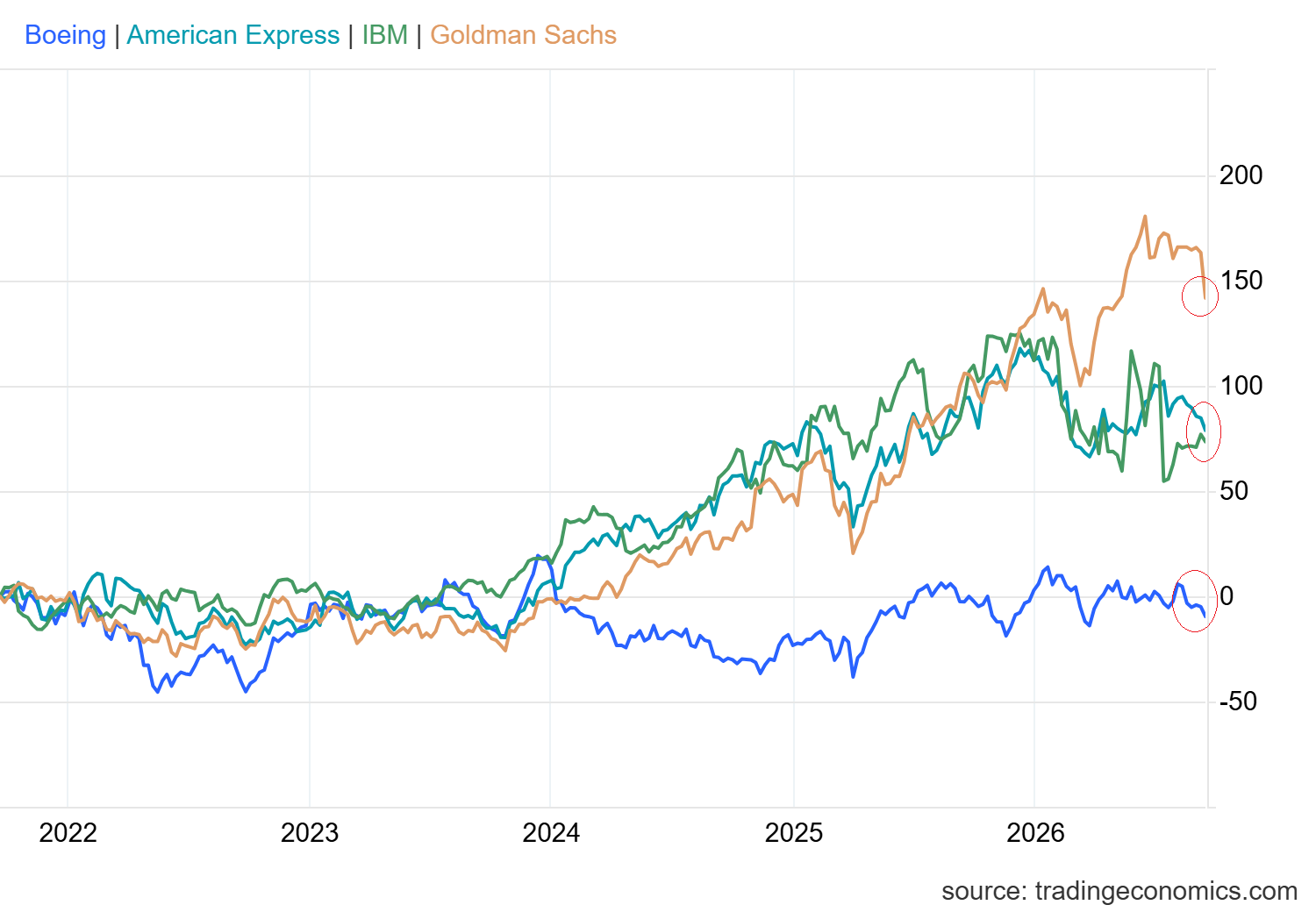
Dow Jones: Boeing, IBM and Goldman Sachs Lead Losses
US stocks showed weakness this week. The weakness was also broad as the Dow Jones Industrial Average, S&P 500 and Nasdaq Index dropped towards their key support zones. The declining stocks outnumbered the advancing stocks on the NYSE. The trading volume was also well above the 20-day average. This suggests that the fall in the US stock market is not driven by only one company.
Boeing Company (BA) fell over 4% after management said that the increase in aircraft production was taking longer than expected. The company has struggled to keep 737 MAX output stable at 47 jets per month as the wing production remains slow.
The shortages of engines and seats have also delayed higher 787 output. Boeing now expects free cash flow near $2 billion, midpoint of the guidance rather than the upper end of $3 billion. International Business Machines Corporation (IBM) also dropped over 4% as it announced a long term quantum foundry investment. The sharp declines in Boeing and IBM had a large effect on the index.
Goldman Sachs Group Inc. added further pressure on the index. The stock price dropped nearly 4% after management warned of softer fixed-income trading, weaker gains in investment and higher costs.
American Express Company (AXP) also declined as investors assessed the effect of higher rates on credit demand. Chevron Corporation (CVX) dropped 2.9% as oil prices pulled back after strong rally last week. The correction in oil prices hurt energy shares in the short term but they may also reduce inflation pressure and support the wider market. This mixed effect makes oil an important driver for the Dow.
Alphabet Inc. may receive some support after the judge stopped short of ordering a breakup of Google’s advertising technology. But the rebound in the stocks looks like a relief bounce for now.
Dow Jones Technical Analysis: 50,000 Support Holds the Key
The Dow Jones has started a correction after hitting the target of 55,000 as seen in the chart below. This correction was expected as discussed in the previous analysis.
Now, the index is moving towards the primary support at the 50,000 level. If the index holds the 50,000 level, it will likely introduce a rebound back towards the 55,000 area. But a break below the 50,000 level will likely push the index towards 48,000.
A break above 55,000 will likely open the way for strong rally towards the 60,000 area. The target of 60,000 in the Dow Jones is defined by the ascending broadening wedge pattern that stretches from the January 2024 lows.
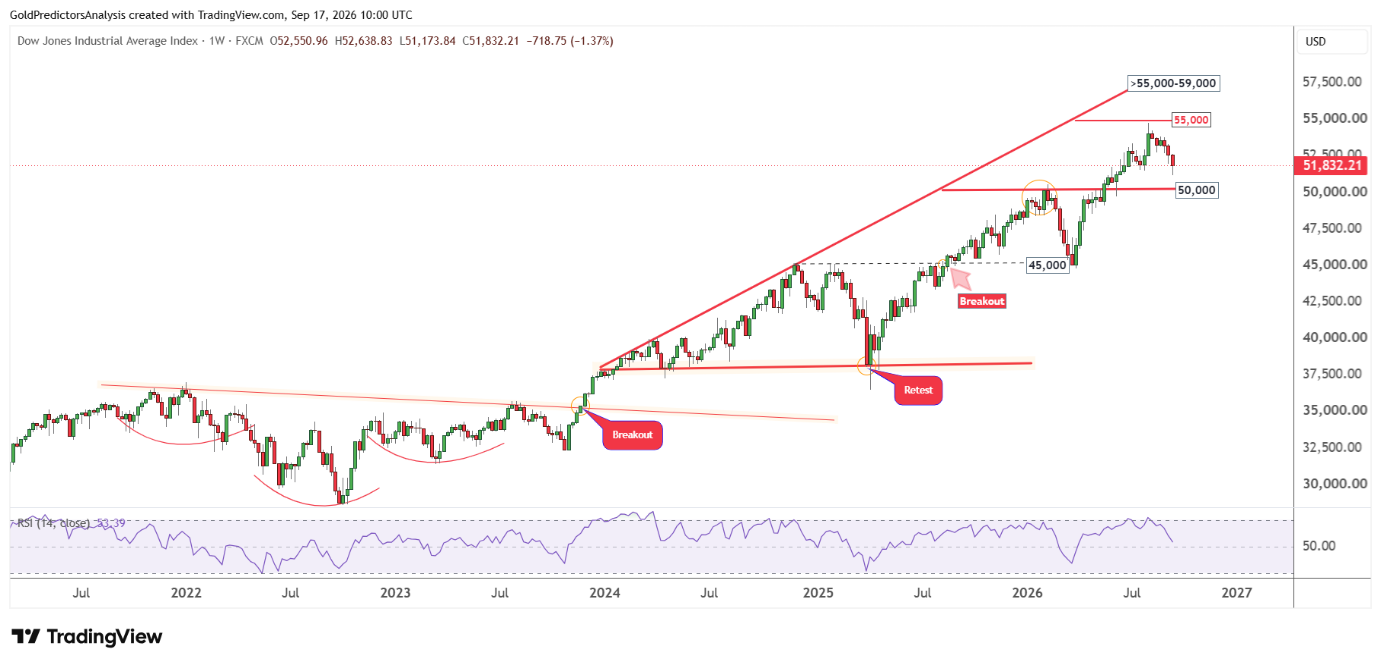
Moreover, the formation of an inverted head and shoulders pattern from September 2021 to July 2023 suggests a strong bullish outlook in the long term.
Therefore, any correction within the 48,000 to 50,000 zone will likely offer a pivotal point for long-term investors and introduce strong rally to higher levels.
Moreover, the RSI is approaching the mid-level as the index approaches support at 50,000, which increases the likelihood of a rebound from 50,000.
What to Watch Next
The Dow Jones remains under pressure after the rate hike by the Fed and the increase in Treasury yields. Strong consumer spending supports economic growth. But it also keeps the inflation outlook positive and suggests further rate hikes are in focus. The weakness in Boeing, IBM and Goldman Sachs adds more pressure. The correction in oil prices and bond yields may support rebound in the short term. But the market needs broader buying before the recovery becomes convincing.
In my view, the level of 50,000 remains the key for Dow Jones. A rebound from this support could push the index back to 55,000. But a break below 50,000 may expose the 48,000 area. A move above 55,000 would strengthen the bullish outlook and open the way to 60,000. The structure remains positive in the long term but buyers must defend the support zone of 48,000-50,000.