Commodity gains in 2026 suggest traders and investors are beginning to recognize what scarcity could be worth. The question is whether this is only the beginning.
The 2026 Scoreboard Is Becoming Impossible to Ignore
Measured from their 2026 lows, the scale of the move is striking.
European Natural Gas has surged 204%. Heating Oil has climbed 149% and Diesel 136%. Gasoline has more than doubled, Jet Fuel has gained 98%, while WTI and Brent Crude Oil have advanced 85% and 82%.
Agriculture is being repriced just as aggressively. Cocoa has roughly doubled from its 2026 low. Rice has gained 66%, Wheat 45%, Cotton 41%, Sugar 35% and Corn 32%.
Soybeans are up more than 20%, while Arabica Coffee has surged 71% this year. Copper, Tin and Aluminium have also posted substantial gains.
Moves of this magnitude signal tightening physical markets and show capital is already being rewarded for owning scarcity.
“What makes 2026 so important is the breadth of the move,” says Lars Hansen, Head of Research at The Gold & Silver Club. “Scarcity premiums are appearing simultaneously across Energy, Agriculture, Metals and critical materials. That is the hallmark of a broader regime change.”
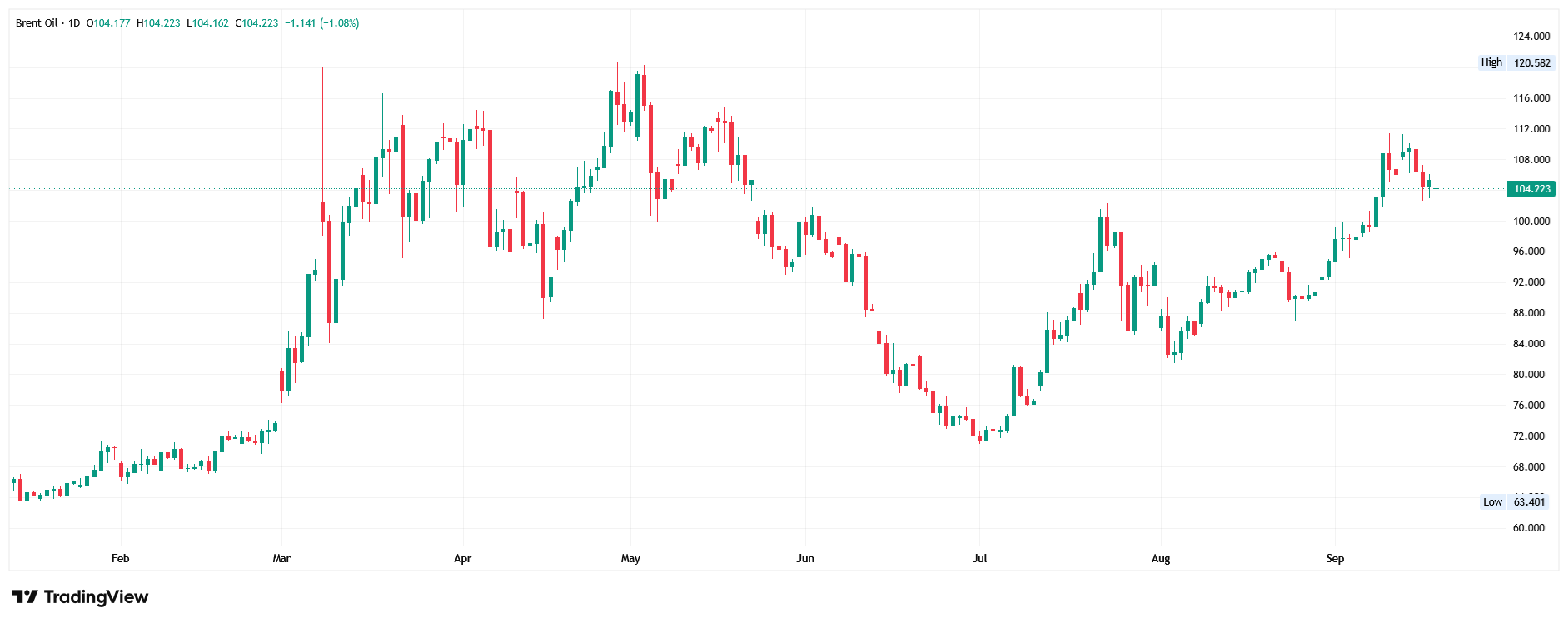
Brent Oil Price Forecast
Every new Brent Oil analysis as it publishes, today's technical signal and key levels, live price — on one page.
See all Brent Oil forecastsDiesel Is Turning Scarcity Into a Real-Economy Problem
Brent Crude remains above $100 after prolonged Middle East disruption, while damage to Russian refining capacity has tightened fuel markets.
Diesel is a clear warning signal. U.S prices have surged above $6 a gallon, while distillate inventories sit around 13% below their five-year seasonal average.
More striking are signs of localized physical tightness. Diesel pumps in California are displaying $9.999 – the maximum figure dispensers show when fuel has temporarily run dry.
“Scarcity stops being abstract when the physical product becomes difficult to source,” Hansen says. “Diesel powers trucks, farms, mines and supply chains. When Diesel reprices, the cost of moving almost everything reprices with it.”
Scarcity Has Reached the Ships
The squeeze is spreading beyond the barrel.
VLCC tanker rates have surged to record highs as disruption forces vessels onto longer routes and reduces effective capacity. The market is paying more not only for Oil, but for the ability to move it.
The Breakwave Tanker Shipping ETF has risen more than 6,200% over roughly 15 months, demonstrating how violently markets can reprice when supposedly abundant infrastructure becomes scarce.
Saudi Aramco has also been seeking Diesel in the Mediterranean and Gasoline in Europe amid disruption to Saudi energy infrastructure. One of the world’s largest Oil exporters is itself competing for refined fuel.
“The world is being forced to pay more for the assets it cannot function without,” Hansen says. “Energy, Power, Metals, Food, Transportation and Strategic Materials are increasingly being priced around availability.”
Scarcity Is Becoming Structural
The world’s largest Iron Ore producers are depleting reserves faster than they replace them. The six largest depleted 11.1 billion tonnes of saleable reserves between 2016 and 2025.
Replacement is becoming harder and more expensive. Ore grades are declining, discoveries are more difficult and new mines, refineries and pipelines can take years to develop.
The world can create money almost instantly. It cannot create physical supply instantly.
“This is what makes the current Hard Asset cycle potentially so powerful,” Hansen says. “Demand can accelerate quickly. New supply cannot.”
Costco has imposed purchase limits on its Kirkland Motor Oil as markets tighten, while G7 governments have committed to increasing domestic critical-mineral stockpiling capacity.
This is how scarcity spreads: from physical markets into freight, refining margins and inventories, then onto retail shelves.
For decades, globalization rewarded efficiency. Now security of supply is becoming more important than price.
The Opportunity Everyone May Still Be Underestimating
After 2026’s extraordinary gains, traders and investors could be tempted to believe the opportunity has already passed.
But what if the opposite is true?
Energy supply is being disrupted. Tanker capacity commands record prices. Governments are stockpiling. Retailers are rationing. Major Oil exporters are buying refined fuel abroad. Miners are struggling to replace depleted reserves.
This is a global repricing of scarcity.
If Natural Gas can rise more than 200%, refined fuels more than 100%, Agriculture between 30% and 100% and freight-linked exposure thousands of percent while these pressures are still developing, what happens if competition for supply intensifies?
AI requires power. Electrification requires Metals. Defence consumes strategic materials. Growing populations require food and Energy.
Demand is not disappearing.
But the ability to satisfy it cheaply is.
The Hard Asset Decade and the Era of Scarcity
At the beginning of 2026, analysts at The Gold & Silver Club coined “The Year of Hard Assets.”
As 2027 approaches, that thesis is evolving into something potentially far bigger.
What began as a cyclical rotation increasingly resembles a structural regime change driven by Energy security, deglobalization, stockpiling, infrastructure constraints and rising replacement costs.
The Year of Hard Assets may have been the opening chapter.
The Hard Asset Decade and the Era of Scarcity may be what comes next.
The Time to Position Is Now
Governments are stockpiling. Corporations are scrambling for supply. Tanker rates are breaking records. Exporters are competing for refined fuel. Retailers are imposing purchase limits. Miners are struggling to replace what they extract.
“In a scarcity cycle, markets do not wait for everyone to become comfortable,” Hansen says. “They reprice first.”
Across Precious and Industrial Metals, Energy and Agriculture, volatility will create pullbacks. Those periods may provide compelling opportunities before the next stage unfolds.
What appears expensive after 2026’s gains could ultimately be remembered as attractive pricing before scarcity was fully recognized.
The world needs more Energy, Power, Metals, Agriculture, Transportation and Strategic Materials. Yet producing, refining and replacing them is becoming slower, harder and more expensive.
Demand can accelerate quickly. Supply cannot respond at the same speed.
When the wider investment community recognizes that imbalance, capital may not rotate gradually.
It could move fast.
2026 was The Year of Hard Assets.
2027 could mark the beginning of the Hard Asset Decade and the Era of Scarcity.
But amid all the Commodities becoming more valuable, there is one that can never be replaced: Time.
Time is the most valuable Commodity we have. In fast-moving markets, every second, minute, hour and day matters.
Prices will move. Opportunities will disappear. Markets will not wait for perfect certainty.
Neither will the Age of Scarcity.
The opportunity will not wait. The time to position is now.
Where are prices heading next? Watch The Commodity Report now, for my latest price forecasts and predictions: