

Trading costs, regulatory structure, account type, margin requirements, execution conditions, overnight financing, withdrawal procedures and platform compatibility can all affect the trading experience. The importance of each factor also changes according to trading style.
An active trader, for example, may focus heavily on spreads, commissions and execution conditions. Someone holding CFD positions for several days may place greater emphasis on overnight financing. Traders who rely on technical analysis may prioritise MT4, MT5 or TradingView compatibility.
This guide explains the main factors traders can consider when evaluating a CFD trading platform, with current Vantage account and platform data used as practical examples where relevant.
Unless otherwise stated, Vantage pricing, account and platform information referenced below was checked as of 21 September 2026. Conditions may change and can vary by product, account, entity and jurisdiction.

1. Start With Regulation and the Account Entity
Regulation is one of the first areas to examine when assessing a CFD provider, but the name of the broker alone does not tell the whole story.
International CFD providers can operate through multiple legal entities. The entity under which an account is opened determines the applicable regulatory framework, legal documentation and potentially some of the trading conditions available to the client.
Traders should therefore ask:
- Which legal entity will provide the account?
- Which authority regulates that entity?
- Which client protections apply?
- What risk disclosures and dispute procedures are provided?
- Are the relevant CFD products available in the trader’s jurisdiction?
Vantage operates through multiple independently operated entities across different jurisdictions, each subject to its respective regulatory framework. The applicable entity, regulatory framework and client protections may vary depending on factors including the client’s country or region of residence and account eligibility.
This is why traders should verify the specific entity applicable to their account rather than assuming that every client of a global trading brand receives identical regulatory protections or trading conditions.
For Thailand-based users in particular, regional availability and whether accessing the relevant products is permitted under applicable local laws and regulations should be checked independently before opening an account.
Reference:
Vantage TradingView and regulatory disclosures
2. Compare Spreads With Actual Pricing Structure
Spread is one of the most visible CFD trading costs, but the minimum advertised spread should not be evaluated in isolation.
Spreads can change according to the instrument, liquidity, account structure, trading session and market conditions.
Account type also matters.
As of 21 September 2026, Vantage publishes Forex spreads starting from 0.0 pips on eligible RAW ECN pricing. Its Standard STP pricing starts from 1.0 pip, although actual spreads vary with the instrument and market conditions.
The difference is connected to how the two account structures charge for trading.
On a Standard STP account, there is generally no separate Forex trading commission, with the applicable cost incorporated into the spread. RAW ECN pricing instead combines the applicable raw spread with a separate commission.
For traders comparing CFD accounts, useful spread questions therefore include:
- Is the quoted number a minimum or typical spread?
- Which instruments does it apply to?
- Does the account charge a separate commission?
- How does the spread change during lower-liquidity periods?
- What is the resulting all-in transaction cost?
A “0.0 pip” headline alone does not establish the total cost of a trade.
Reference:
Vantage Spreads
3. Calculate Total Trading Cost, Not Just Spread
For a more complete comparison, trading cost can be considered as:
Total Trading Cost = Spread + Commission + Overnight Financing + Currency Conversion + Other Applicable Fees
Different components matter for different trading styles.
For active traders, spreads and commissions may account for a larger share of overall cost because positions are opened and closed more frequently. For traders holding positions for longer periods, overnight financing can become increasingly relevant.
Vantage’s RAW ECN account provides a useful example of how the calculation works.
As of 21 September 2026, the published commission for a USD-denominated RAW ECN account is:
USD3 per standard lot per side
This equals:
USD6 per standard lot for a round-turn transaction.
Vantage defines one standard Forex lot for this commission schedule as 100,000 units of base currency.
The RAW ECN account currently also lists a USD50 recommended minimum amount for opening the account, with spreads from 0.0 pips on major Forex pairs, subject to market conditions.
By contrast, the Standard STP structure does not apply a separate Forex trading commission in the same way; its applicable trading cost is primarily incorporated into the spread.
Neither structure should automatically be considered cheaper for every trader. Position size, instrument, spread, trading frequency and holding period all influence the final cost.
Reference:
Vantage RAW ECN Account
Vantage Commission Schedule
4. Understand What “No Overnight Fees” Actually Means
CFD positions held beyond the daily rollover point may incur an overnight financing adjustment, often called swap.
This cost can vary according to:
- Instrument
- Position direction
- Position size
- Interest-rate environment
- Holding period
- Account structure
Some platforms also provide swap-free accounts, but “swap-free” should not automatically be interpreted as “free to hold indefinitely.”
Vantage, for example, offers a Swap-Free Account that removes the conventional swap or interest charge normally associated with eligible overnight positions. Instead, an administration fee may apply to positions held overnight.
The account currently provides access to 1,000+ instruments across product categories including Forex, shares, commodities, ETFs and bonds, with trade sizes starting from 0.01 lot.
This distinction matters when evaluating a platform advertised as having “no overnight fees.”
The more useful questions are:
- Is conventional swap removed?
- Is an administration fee charged instead?
- Which instruments qualify?
- When does the administration fee begin?
- Does the charge vary by instrument?
- Are there regional or eligibility restrictions?
For positions held for multiple days, the cumulative overnight cost can be more important than a small difference in the opening spread.
Reference:
Vantage Swap-Free Account
5. Evaluate Leverage Together With Margin
For the same notional market exposure, higher leverage reduces the margin required to open a position. However, it does not reduce the underlying market exposure, and gains or losses from a given market move can therefore be larger relative to the margin committed.
For this reason, maximum leverage should be considered alongside the associated margin structure and risk controls.
Vantage’s Premium Unlimited Account provides an example of a dynamic leverage model.
As of 21 September 2026, its published default leverage is:
Unlimited — represented in the Terms and Conditions as 1:2,000,000,000
However, this does not mean that every account continuously receives this leverage level.
Vantage currently applies the following equity-based structure:
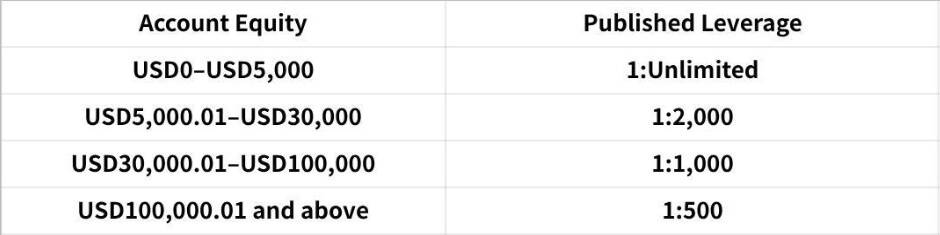
Click the image to view the sheet.
The terms also state that leverage can be dynamically adjusted around major economic announcements and under applicable trading conditions. Regional availability is restricted to jurisdictions approved by Vantage and remains subject to applicable local laws and regulatory requirements.
This illustrates why comparing CFD platforms purely on a headline maximum leverage number can be misleading.
Traders should also examine:
- Equity-based leverage tiers
- Margin requirements
- Margin-call levels
- Stop-out levels
- Product-specific leverage
- News-period restrictions
- Account eligibility
- Regional availability
On Vantage’s Standard STP and RAW ECN account structures, the currently published margin-call level is 50% and the stop-out level is 20%.
Higher leverage increases risk as well as potential market exposure.
6. Look Beyond an Advertised Execution-Speed Number
Execution quality is particularly relevant for active, short-term and automated trading strategies.
However, execution should not be assessed using a single speed claim alone.
A more complete assessment includes:
- Execution model
- Liquidity
- Slippage
- Order types
- Requotes or rejected orders
- Platform stability
- Performance during volatile conditions
- Trading infrastructure
Vantage states that its RAW ECN environment connects to multiple liquidity providers and uses price aggregation to source available quotes. It also describes the use of a fibre-optic network and low-latency infrastructure for order execution.
The important distinction is that infrastructure designed for low latency does not guarantee that every trade will execute at a specific speed or price.
Market liquidity can change rapidly, particularly around economic announcements and periods of high volatility. Slippage can therefore occur even when a platform uses low-latency infrastructure.
For this reason, traders should evaluate the broker’s execution model and disclosures rather than treating a single advertised millisecond figure as a guaranteed outcome.
Reference:
Vantage RAW ECN Account and Execution Information
7. Separate Withdrawal Processing From Total Arrival Time
Withdrawal speed is another area where headline claims can oversimplify the actual process.
There are usually at least two stages:
Broker processing → Payment provider / bank processing
Even after a broker approves and processes a withdrawal request, additional time may be required by the receiving bank, card network, e-wallet or other payment provider.
Traders should therefore check:
- Available withdrawal methods
- Broker processing procedures
- Payment-provider processing times
- Minimum withdrawal amounts
- Currency conversion
- Verification requirements
- Potential fees
- Source-of-funds requirements
Vantage allows withdrawal requests to be submitted through its secure client portal. The minimum withdrawal amount can depend on the selected withdrawal method.
For traders in Thailand, available funding and withdrawal methods should be checked directly with the applicable provider before depositing, as availability can vary according to account entity, location and payment provider.
Rather than asking only “Which platform has the fastest withdrawals?”, it can therefore be more useful to ask how transparent the complete withdrawal process is and which part of the process the broker actually controls.
8. Check MT4 and MT5 Functionality
MetaTrader remains an important part of the CFD platform landscape.
Vantage currently supports both MetaTrader 4 (MT4) and MetaTrader 5 (MT5).
MT4 may be relevant for traders who rely on established Expert Advisors, custom indicators and Forex-oriented workflows.
Vantage’s current MT4 information lists:
- 3 execution modes
- 2 market-order types
- 4 pending-order types
- 2 stop-order types
- 30 built-in technical indicators
- Access to 2,000+ free custom indicators
- 9 timeframes, from one minute to monthly
- Expert Advisor development through MQL4
MT5 extends the MetaTrader environment toward broader multi-asset workflows and more advanced analytical functionality.
The decision between MT4 and MT5 therefore depends less on which platform is universally better and more on existing trading tools, automated strategies, preferred markets and workflow.
Reference:
Vantage Trading Platforms
9. Check Whether TradingView Supports Actual Trading, Not Just Charts
TradingView compatibility can mean different things.
Some traders simply use TradingView for analysis and then execute trades elsewhere. A deeper integration allows a brokerage account to be connected so that orders can be placed directly through TradingView.
Vantage supports direct account connection with TradingView, allowing eligible clients to trade CFDs through TradingView charts and the order interface.
The current Vantage integration provides access to CFD markets including:
- Forex
- Indices
- Shares
- Commodities
TradingView itself currently provides 100+ pre-built indicators,50+ drawing tools, 15+ customisable chart types and 12 alert conditions referenced on Vantage’s integration page.
Availability of the integration, supported products, and features may vary by account and jurisdiction and may not be available to all clients.
Vantage also states that its TradingView integration is available without an additional integration fee from Vantage, although normal account trading fees and commissions still apply and optional paid TradingView plans can carry separate costs.
Deposits and withdrawals remain handled through Vantage rather than TradingView.
When evaluating a TradingView-compatible CFD platform, traders should therefore check:
- Whether direct order execution is supported
- Which CFD instruments are available through the integration
- Which order types are supported
- Whether account management remains external
- Whether additional integration costs apply
- Whether functionality differs by region or account type
Reference:
Vantage TradingView Integration
10. Evaluate Copy Trading Through Risk Data, Not Popularity Alone
Copy trading allows users to replicate the activity of another trader or strategy provider, but the number of available strategies should not be the only selection criterion.
Useful data can include:
- Historical return
- Maximum drawdown
- Length of track record
- Trading frequency
- Instruments traded
- Position concentration
- Risk level
- Profit-sharing structure
- Ability to stop copying
- Personal risk controls
Vantage currently provides integrated copy trading functionality and allows users to link MT4 and MT5 accounts to its copy trading ecosystem.
For Signal Providers, Vantage currently allows the creation of up to 10 strategies. Its published Profit Sharing model also allows eligible Signal Providers to adjust their profit-sharing ratio, subject to applicable terms.
These numbers describe platform functionality, not expected performance.
A strategy with a high historical return can also carry substantial drawdown or concentration risk. Past performance does not guarantee future results.
For this reason, copy trading should be assessed through both platform functionality and strategy-level risk data.
Reference:
Vantage Copy Trading
11. Consider Product Range and Minimum Trade Size
The number of available CFDs matters most when it matches the markets a trader actually wants to trade.
A broad product range can be useful for traders who want to access multiple asset classes from one account, but instrument specifications can vary considerably.
For example, Vantage’s Swap-Free account page currently references access to 1,000+ instruments across categories including Forex, shares, commodities, ETFs and bonds. It also states that trade sizes start from 0.01 lot.
TradingView integration, meanwhile, supports eligible CFDs across Forex, indices, shares and commodities.
Before choosing a platform based on the total instrument count, traders should check:
- Whether the specific instruments they want are available
- Contract size
- Minimum trade size
- Trading hours
- Margin requirements
- Spread and commission
- Overnight financing
- Platform availability
A headline product count alone does not describe the trading conditions attached to each instrument.
12. What Should CFD Traders in Thailand Check?
Thailand-based traders should add regional considerations to the general platform checklist.
The fact that an international platform can be accessed online does not by itself establish which products, entity, leverage conditions or protections apply to a particular user.
Before opening an account, traders can check:
Account entity:
Which entity would actually hold the account?
Regional availability:
Are the relevant CFD products and account types available in Thailand under applicable laws and regulations?
Trading conditions:
Do leverage, margin and account rules differ for the applicable entity?
Language and support:
Is Thai-language assistance available when account, funding or trading questions arise?
Funding:
Which deposit and withdrawal methods are currently available to users in Thailand?
Platforms:
Are MT4, MT5, TradingView, web and mobile trading interfaces available for the relevant account?
Costs:
Are the published spreads, commissions and swap conditions applicable to the selected account and instruments?
Vantage publishes account and product information on its international website, but product, account and regional availability should be independently checked against the applicable requirements in Thailand before account opening.
Regional availability should therefore be treated as a separate part of CFD platform research rather than assumed from a global product page.
How to Match a CFD Platform to Your Trading Needs
There is no single CFD platform feature that is equally important for every trader.
For a cost-focused trader, useful numbers include minimum and typical spreads, commission per lot and expected overnight financing.
For example, Vantage currently publishes RAW ECN Forex spreads from 0.0 pips on major pairs, subject to market conditions, and a USD RAW ECN commission of USD3 per standard lot per side for USD-denominated RAW ECN accounts. These numbers still need to be considered together rather than independently.
For an active or short-term trader, execution model, liquidity, slippage, platform stability, spreads and commissions may deserve greater weight.
For a longer-term CFD trader, overnight financing can become increasingly important. A swap-free account may remove conventional swap but can replace it with an administration fee.
For a trader seeking higher leverage, the headline maximum should be considered together with equity tiers, margin rules and stop-out conditions. Vantage’s Premium Unlimited structure, for example, ranging from 1:Unlimited for eligible accounts with equity of up to USD5,000 to 1:500 for accounts with equity of USD100,000.01 and above, with intermediate leverage tiers also applying.
For MetaTrader users, Vantage supports both MT4 and MT5, while traders using chart-driven workflows can connect eligible Vantage accounts directly to TradingView.
For copy traders, platform integration should be considered alongside drawdown, historical performance and strategy-level risk.
For traders in Thailand, the applicable account entity, regional availability, funding options and support arrangements should be independently verified before account opening.
Final Thoughts
Choosing a CFD trading platform in Thailand is best approached as a multi-factor decision rather than a search for the lowest spread, highest leverage or largest number of trading tools.
The key areas to examine include:
Regulation and account entity → Spread → Commission → Total trading cost → Overnight financing → Leverage and margin → Execution → Withdrawals → MT4/MT5 → TradingView → Copy trading → Regional availability
The data can also tell different stories depending on how it is interpreted.
A 0.0-pip minimum spread does not mean a trade has zero cost if a commission applies.
A swap-free account does not necessarily mean that holding a position overnight has no cost if an administration fee applies.
An advertised 1:Unlimited leverage level does not mean that every account receives the same leverage regardless of equity, market conditions or jurisdiction.
And access to MT4, MT5 or TradingView does not by itself establish whether the platform fits a trader’s instruments, account structure and trading workflow.
The most useful comparison is therefore not a single headline number but the complete set of conditions that applies to the account, instrument and trading strategy.
CFDs are leveraged products and carry significant risk. Trading conditions, pricing, leverage, product availability and account eligibility can change and may vary by jurisdiction. The applicable regulatory framework and client protections depend on the entity providing the services. Traders should independently confirm that accessing and trading the relevant products is permitted under the laws and regulations applicable to them, and review the current legal documents, product specifications and account terms applicable to their account before trading.