On Friday, August 9, crucial inflation data from Germany drew investor interest, as inflation rose from 2.2% in June to 2.3% in July.
According to Destatis:

- Energy prices fell by 1.7% year-on-year in July, slightly improving from a 2.1% decline in June.
- Food prices increased by 1.3% year-on-year, up from 1.1% in June.
- Excluding food and energy, the annual inflation rate stood at 2.9%.
- Goods prices rose by 0.9% year-on-year, while consumer goods prices increased 1.1%.
- Services prices were up 3.9% year-on-year, with net rents rising by 2.2%.
Implications for the German Economy and ECB Rate Decisions
The inflation numbers for July will challenge investor expectations of multiple 2024 ECB rate cuts. Services sector inflation sits significantly above the ECB’s 2% target. Conversely, German goods prices emphasized the weak demand environment affecting Germany’s manufacturing sector.
The rising risk of a German economic recession is unlikely to pressure the ECB into cutting interest rates. Services prices may need to soften sharply to raise investor bets on multiple 2024 ECB rate cuts.
Expert Opinions on German Inflation
Federal Statistical Office (Destatis) President Ruth Brand commented on the inflation report, saying,
“The price declines for energy in particular are dampening the inflation rate. In contrast, we continue to observe above-average price increases for services.”
Pictet Wealth Management Head of Macroeconomic Research Frederik Ducrozet commented on the June National Central Bank macro projections, stating,
EUR/USD Price Forecast
Every new EUR/USD analysis as it publishes, today's technical signal and key levels, live price — on one page.
See all EUR/USD forecasts“We just got the macro projections from euro National Central Banks. In June and in December, ECB projections are produced jointly by NCBs and ECB staff. The upward revision to 2025 inflation projections has been almost entirely driven by Germany, the Netherlands, and Belgium.”
EUR/USD Reaction to German Inflation
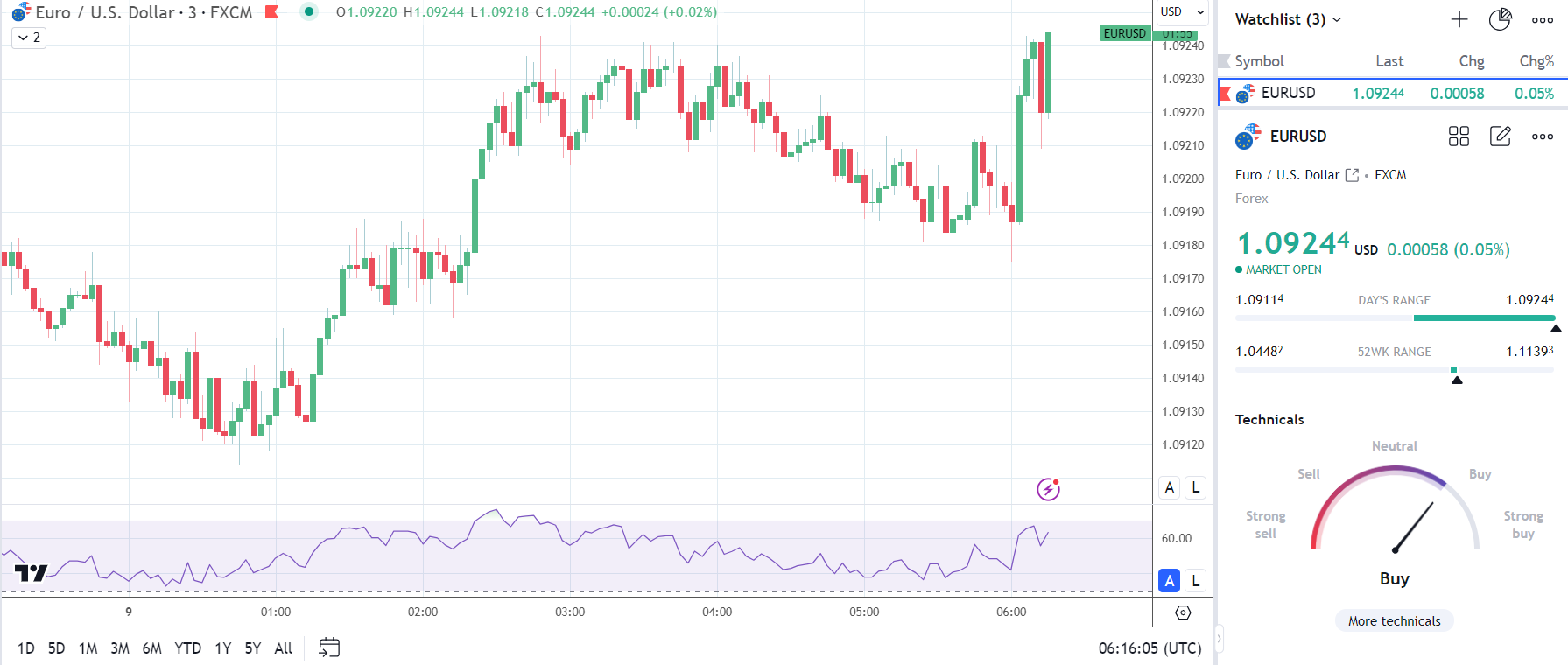
Before Germany’s inflation data, the EUR/USD dipped to a Friday low of $1.09114 before climbing to a high of $1.09243.
However, in response to the inflation numbers, the EUR/USD fell to a low of $1.09175 before rising to a high of $1.09244.
On Friday, August 9, the EUR/USD was up 0.05% to $1.09244.