


I Completed Capital.com KYC in 15 Minutes — Here’s Exactly What Happened
Here's an insight into how we make money. While we strive to be comprehensive, the compensation we receive can influence the products, companies, or services we showcase and review. Not all available options may be featured on this page.
Intro
For this guide, I cover everything – from the documents you will need to why the broker may ask you what the source of your funds is.
I created this guide using FXEmpire’s independent research and hands-on account testing, supplemented by information provided by Capital.com. It’s the first in a series of in-depth Capital.com guides where we will go deeper than our review format allows. When we research a broker, lots of the data we collect does not make the final cut of the review. That is why we decided to introduce this series to share with you these smaller details, the finer print in a broker’s offering. All editorial conclusions, including criticism, are FXEmpire’s own.
Before you sign up with a broker, you do your due diligence and identify its strengths and weaknesses. That is how you know who you are doing business with. Likewise, a broker’s KYC policy is just its way of getting to know a trader. Brokers are required by their regulators to collect essential data about you, such as your trading experience and financial status, to make sure you are given all the right tools to succeed.
For this article, I created an account with Capital.com’s European entity, which is regulated by CySEC, and went through its full verification process.
What is Verification For?
Brokers have to verify who you are to make sure that their products and services match your goals and means. For example, if you don’t have enough trading experience or capital but you aim to deal with ‘short-term price speculation’, the broker may decide that trading high-risk leveraged products may not be the best option for you.
The verification process is not entirely determined by a broker. Most brokers are licensed in multiple jurisdictions by different regulators (like CySEC, ASIC, FCA UK, SCB Bahamas), meaning they must meet the specific requirements of each regulator.
Check out our guide to the Best regulated forex and CFD brokers.
For example, under CySEC, which operates within the European Securities and Markets Authority (ESMA) framework, Capital.com is required to collect comprehensive data about your trading experience (for how long you have been an active trader, what your average monthly traded volume is, whether you have traded other instruments besides CFDs, and so on). In contrast, offshore regulators, like the SCB of the Bahamas, are typically less strict, allowing you to complete the process in fewer steps.
Step-by-Step KYC Walkthrough
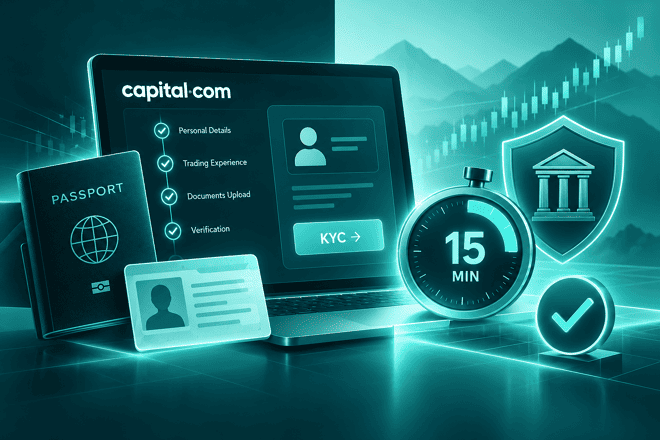
I have identified 5 major stages in Capital.com’s onboarding process and outlined each minor step below. The entire process took me less than 15 minutes. Here is what I did:
Stage 1: Getting Started
- Click ‘Open Account’ at the top-right corner of the main page.
- Enter your email address and choose an account password.
- Choose your country of residence, nationality, and place of birth.
- Tick the box below to confirm that you will deposit and withdraw funds using accounts held in your country of residence.
- Confirm that you are not a citizen, green card holder, or tax resident of the US. (Capital.com does not accept clients from the United States.)

Stage 2: Trading Experience and Financial Background
- State your age group (18–21; 22–50; 51–79; or 80+).
- Confirm your highest level of education (PhD, Master’s, Bachelor’s, or High school).
- Choose your employment status (employed, self-employed, retired, unemployed, or student).
- Provide the name of the company you currently work for or your own company.
- Explain the nature of the industry you work in (e.g., business, IT services, finance and law, or others).
- State your occupation.
- Choose what your trading experience includes (trading apps and online platforms, professional advice, or portfolio-management services).
- State for how long you have traded (less than 6 months, 6-12 months, 1-2 years, over 2 years).
- Explain why you want to trade with Capital.com (to diversify your trading strategies, speculative trading on market movements, or for some other reason).
- State the number of CFD trades you typically open per month (1–9, 10–49, 50+).
- List the CFD instruments you typically trade (FX, Commodities, Equities, Indices, Cryptos).
- Choose the total value of your CFD trades in the last year (over €10,000, €5,000 – €10,000, or under €5,000).
- Elaborate on your experience in CFD products or financial trading (Do you have a relevant professional certificate, have worked in banking/financial services, or something else?).
- Elaborate also on your annual income (anywhere in the €0 – €1 million range).
- State the amount of your income that is available to save (more than 50%, 25%-50%, 10%-25%, or less than 10%).
- Choose your main sources of income (salary, inheritance, investment and/or rental income, or something else).
- Specify the current value of your wealth, including savings, investments, and assets (anywhere from €0 to more than €1 million).
- State the amount you plan to invest in trading over the next year (from less than €1,000 to more than €100,000).
- Confirm whether you are a Politically Exposed Person (PEP) or closely related to one.

Answer these questions truthfully and do not try to impress Capital.com. If you do not have any trading experience or cannot afford much capital to start trading, do not be afraid to point that out.
Stage 3: Trading Questionnaire
This is the most critical stage during which the broker assesses your general knowledge and readiness to trade leveraged products. I got questions about the consequences of trading on margin, the impact of market volatility on your balance, and how to calculate the bid/ask spread.

I was also asked to complete a basic math problem, such as “If you buy Asset A at one price level and sell it at another, how much will your profit be?” And finally, I had to state my risk tolerance by explaining how I would feel if I were to lose my entire investment.
Compared to other brokers, I found Capital.com’s questionnaire more straightforward and precise. It only has several questions, meaning that it should not take you more than 2-3 minutes to complete. On the other hand, if you fail to answer any of them, this would be a clear indication that you are not ready to start trading.
Note that if you fail even one question, Capital.com may stop the registration process. However, you can try again later.
Stage 4: Personal Info
In this stage, you will be asked to provide additional personal info. You must:
- Enter your name using Latin letters.
- Enter your date of birth. You have to be 18 or older to trade.
- Provide your address.
- State your personal ID number.
- Verify your email address.
- Enter and verify your phone number.
- Choose whether you would like to receive a call from your account manager.
- Declare you have read and understood Capital.com’s terms and conditions, and that you agree to them.

Make sure you really do understand the broker’s terms and conditions, and do not just check the box automatically. And if you have any questions or if something is unclear to you, you can then discuss it with your account manager.
Stage 5: Account Verification
In this final stage, you will be asked to:
- Choose an account currency.
Capital.com offers a choice of EUR, USD, GBP, CZK, DKK, HUF, NOK, SEK, or PLN.
If you trade assets denominated in a currency other than your account’s base currency (e.g., Apple shares from an EUR-denominated account), you will incur conversion fees. Generally, it’s best to choose the same currency as the one of your personal bank account.
- Select a national identity document to upload.
You can choose between your passport, driving license, identity card, or a card of a subsidiary protection beneficiary.
- Upload a scan of your document.
Scan the document on both sides (front and back). Make sure you scan it in a well-lit room and with no reflections on the document. Do not edit the images. Also, I’d recommend taking a new photo for this purpose. If you use an old image from your library, the system might flag and reject it. The accepted formats include JPG, PNG, HEIC, WEBP, or PDF. Make sure that the image does not exceed 10 MB.
- Take a selfie for the liveness check.
Take a photo of yourself to match the photo in your document. Make sure your face is clearly visible and fills the circle. Use a well-lit room and do not wear any clothing or accessories that cover your face, like sunglasses.
- Upload proof of address.
You can upload a utility bill, bank statement, or any other document with your address clearly visible. Make sure that the document is issued in the last 6 months. The temporary or permanent address must match the address on your personal document.
Timelines: How Much Time I Spent Signing Up with Capital.com
It took me about 15 minutes to complete Capital.com’s registration and verification, including entering my details, completing the questionnaire, uploading the documents, and getting the green light from the broker’s compliance department.
While your application is pending, you will still be able to access the platform, use the charts, and browse Capital.com’s available instruments. You will also be able to set up a demo account and trade in a simulated environment. However, you won’t be able to deposit any real funds or trade live.
Capital.com displays a progress bar at the top of the screen, so you can see how many steps remain. I also found out that the process is automatically saved, so even if you are interrupted, you can still pick up from wherever you left off.
I personally started my account registration process on a Friday and completed it the next Monday. All I had to do was refresh the page. This is a major leg up on other brokers, most of which would lose your data in similar cases and require you to start from scratch.
While everyone goes at their own pace, I think you won’t spend more than 20 minutes signing up with Capital.com. I had no difficulties throughout the entire process.
What Can Delay Your Verification
However, consider that some delays may occur if:
- you submit your application over the weekend or during peak hours;
- there is an issue with your scanned documents (e.g., the image is blurry or cropped);
- there is a discrepancy between your stated details and the info on your documents;
- you submit expired documents.
Any of these may trigger a manual review of your application, which may take more than 1 business day to finalize. You may also be asked to provide additional documents to confirm your status.
Verification for Different Account Types
So far, I have covered the steps necessary to open a retail account with Capital.com. However, the broker also provides Islamic accounts (with its global entities) and professional accounts for wholesale and corporate clients. Here is what you need to know:
Swap-Free (Islamic) Account
Capital.com provides Islamic accounts aimed at clients who require swap-free trading conditions due to their religious beliefs. When you request your standard account to be converted into an Islamic one, which is done by contacting the broker at support@capital.com, you will no longer incur overnight charges.
However, you will have to pay an additional maintenance fee, subject to discussions with your account manager. The fee rate may depend on your account balance, trading activity, and so on. The broker does not display additional information about that on the website.
The service is available to clients from the United Arab Emirates, Kuwait, Qatar, Bahrain, Oman, Jordan, Saudi Arabia, Egypt, Lebanon, Tunisia, Algeria, and Morocco.
Since Islamic accounts are only available to residents of the listed countries, I was not eligible to open one.
Professional/Wholesale Account
Capital.com also provides professional accounts for high-volume and experienced traders. The main perk of the professional account is the higher maximum leverage. Where Capital.com’s standard account features a maximum retail leverage on FX pairs of 1:30, the professional account’s multiplier is set at 1:200. This will allow you to generate comparatively higher profits whenever the market moves in your favor, but it will also amplify your running losses.
On the downside, to receive professional status, you will have to agree to forfeit some of the protections available to retail clients. Most importantly, you will no longer be entitled to negative balance protection. It means that your losses may exceed your account balance.
To qualify for professional status, you must meet two of the following three criteria:
- Have averaged at least 10 trades in significant size per quarter over the last year;
- Have a liquid investment portfolio exceeding €500,000; or
- Have at least one year of professional experience in the financial industry trading leveraged products.
I also learned that you can request a professional account with Capital.com from the Client Area. Once you have set up a standard account with the broker, just download Capital.com’s app or log in to the web platform; go to ‘Account’ or click ‘Live’ from the top-right corner; select ‘Upgrade to Pro’ and complete the application.
I myself could not complete the process because I did not meet the qualification criteria.
Regional Nuances: The Entity You Sign Up With Matters More Than You Think
Capital.com operates several entities. Each is licensed and supervised by a different regulator, which means different trading conditions, client protections, and account registration experience. Here are the most meaningful differences:
Trading Conditions & Client Protection Discrepancies
| Entity Protections | Capital Com SV Investments Limited | Capital Com (UK) Limited | Capital Com Australia Pty Ltd | CAPITAL COM MENA SECURITIES TRADING L.L.C | Capital Com Online Investments Ltd |
| Country/Region | Cyprus/Europe | UK | Australia | UAE | Bahamas/Global |
| Regulator | CySEC | FCA | ASIC | CMA | SCB |
| Tier | 1 | 1 | 1 | 2 | 3 |
| License Number | 319/17 | 793714 | 513393 | 20200000176 | SIA-F245 |
| Segregated Funds (your funds are kept separate from the corporate capital) |
✅ Yes | ✅ Yes | ✅ Yes | ✅ Yes | ✅ Yes |
| Negative Balance Protection (your losses cannot exceed your account balance) |
✅ Yes | ✅ Yes | ✅ Yes | ✅ Yes | ✅ Yes |
| Compensation Scheme (In the event of insolvency, you may be entitled to compensation) |
Up to EUR 20,000 under the ICF | Up to GBP 85,000 under the FSCS | ❌ No | ❌ No | ❌ No |
| Maximum Leverage | 1:30 | 1:30 | 1:30 | 1:100 | 1:200 |
| Islamic Accounts | ❌ No | ❌ No | ❌ No | ✅ Yes | ✅ Yes |
| Professional Accounts | ✅ Yes | ✅ Yes | ✅ Yes | ✅ Yes | ✅ Yes |
The good news is that all Capital.com entities guarantee the segregation of client funds, as well as negative balance protection. This means that you are not exposed to the risk of funds mishandling by the broker, and that your trading losses cannot exceed your account balance.
Also on the client protections front, the leg up of the two entities authorized by CySEC and FCA over the other Capital.com entities is the participation in the Investor Compensation Fund (ICF) and Financial Services Compensation Scheme (FSCS). I confirmed that in the unlikely event of broker insolvency, you will be compensated for your losses. However, the major drawback to working with a Tier-1 regulator is the capped leverage. Under CySEC, FCA, and ASIC, the maximum retail leverage is set at 1:30.
If you need higher leverage, you can apply for professional status, which raises the maximum leverage to 1:200. To qualify, though, you must meet specific criteria, and you’ll receive weaker protections than retail clients do.
From my experience with financial regulators, I consider the SCB of the Bahamas the most trustworthy offshore regulator. They have among the most stringent policy mandates, including high capital requirements for brokers (at least $300,000 for Class 1 Broker-Dealers, according to national regulation). So, transparency is not an issue, and I can recommend Capital Com Online Investments Ltd to international traders. However, if you lack experience and are highly risk-averse, then you had better avoid the entity’s rather high leverage of 1:200.
After Verification: Key Things to Keep in Mind
I have listed several additional things for you to consider after you have completed your account verification:
- Account Dormancy: In case you stay inactive (you haven’t executed a single trade or made any deposits or withdrawals) for a period longer than 1 calendar year, Capital.com will impose a €10 account inactivity fee. The fee is charged monthly until you resume your activity or your account balance drops to zero.
- Two-factor Authentication: Capital.com’s app features two-factor authentication. You can use a personalized pin as well as biometric login to access your account, which adds an extra layer of security.
- GDPR/Privacy Policy: I worked through Capital.com’s Privacy Policy to learn how the broker handles its clients’ personal data. It claims that it takes all “reasonable and appropriate technical and organizational measures to protect all personal data collected by us from loss, theft, misuse and unauthorized access, disclosure, alteration and destruction”. It means that Capital.com promises to keep your personal data safe and handle it with caution. I also discovered that your personal data will be generally stored for the period required by the Prevention and Suppression of Money Laundering and Terrorist Financing Laws (2007-2024), namely, not less than 5 years after the end of the business relationship with Capital Com.
- Info Expiration: In case the document you used to verify your account with Capital.com expires mid-relationship, it is your responsibility to notify Capital.com and send them a copy of your renewed ID document. The same applies to your address – in case you move house, you are required to provide a new utility bill or bank statement to confirm your new address.
The Bottom Line
Opening an account with Capital.com was speedy and generally hassle-free for me. I experienced the same during the KYC and account verification, with no major delays or hurdles. I have completed the same procedure with dozens of other brokers, and I can say that Capital.com’s path was generally easier to follow and more streamlined.
About the Author
Finance writer, analyst, and author of a book for beginner traders "Bulls, Bears and Sharks" with an experience of over 8 years in retail trading and more than 3 years in the finance area.


