U.S. Dollar Weakness and Fiscal Concerns
The U.S. Dollar Index (DXY) has lost approximately 9% in value from its cycle peak of 110.176 reached in January 2025. So far in 2026, the greenback has been trading mostly sideways with a minor bullish tilt, but it still remains below all key daily moving averages. Fundamentally, the same bearish factors that helped bring it down are still at play today.
Trade wars, geopolitical tensions and doubts about the Federal Reserve’s (Fed) inflation-fighting credibility have all weighed on the currency. Most importantly, however, the dollar’s decline since late 2024 reflects a structural erosion of confidence in US fiscal sustainability.
Two days ago, U.S. public debt passed $40 trillion. It doubled from $19.95 trillion in January 2017 and grew by $11.6 trillion under Donald Trump and by $8.4 trillion under Joe Biden. Interest payments are now the second-largest federal budget expense after Social Security. Foreign investor demand for Treasuries has declined over the past year, reinforcing a ‘sell America’ narrative and encouraging diversification away from the greenback. Unsurprisingly, bond yields have risen. In fact, the rise in yields alarmed the U.S. Treasury, forcing it to double its long-end buybacks to $4 billion per operation, a move widely interpreted as an attempt to cap yields approaching 19-year highs.
Predictably, as the dollar declined, other currencies appreciated. The chart below compares the performance of 12 selected currencies against the U.S. dollar since 31 December 2024. As you can see, apart from the greenback, only the Japanese yen is still below the level reached at the end of 2024. All the other currencies have moved up. Each currency gained in value for its own specific reasons, but the primary driver was the U.S. dollar’s weakness.
In this article, I would like to focus on the Australian Dollar (AUD). I will provide a brief overview of the current situation, describe the impact of the upcoming Australia Consumer Price Index (CPI) report, which is due next Wednesday and conclude with a list of the main themes that traders should monitor in the present environment.
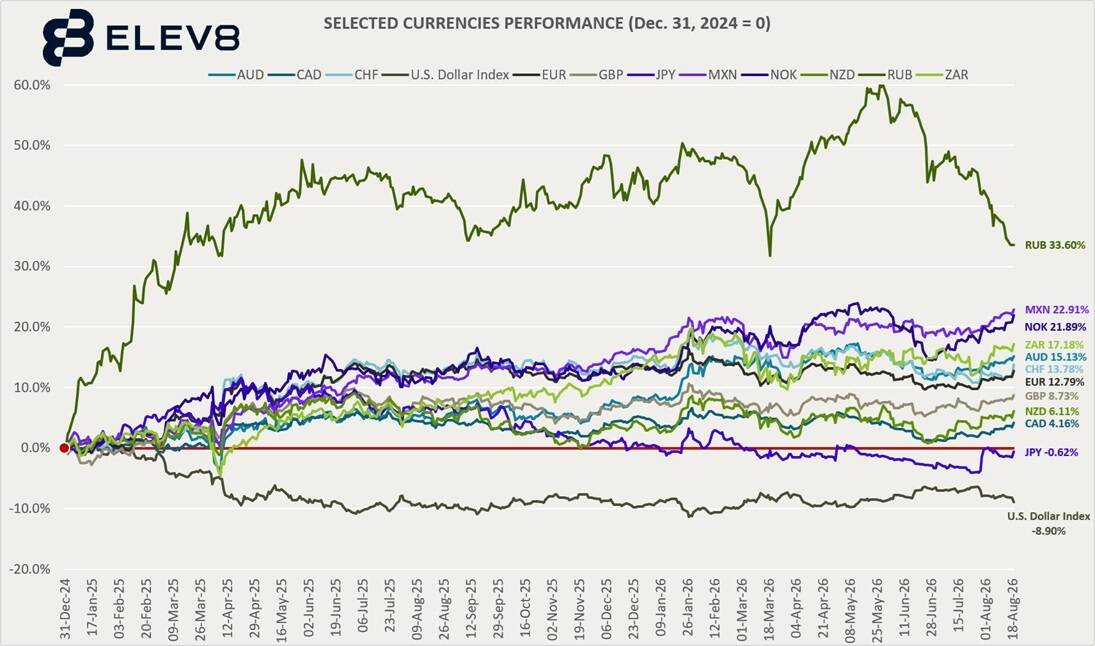
Selected currencies performance since Dec. 31, 2024 shows the Australian dollar among the strongest currencies against the U.S. dollar through Aug. 19, 2026. Source: Elev8 broker calculations.

Australian dollar overview
At the time of writing, AUDUSD was trading at around 0.7150, near a multi-week high, having rallied from a late-June low of 0.6865. Indeed, since the end of 2024, AUDUSD has been the best-performing currency among eight majors (see the chart above).
Right now, the pair faces competing pressures. A weak U.S. dollar supports the pair, while a slowing Australian economy limits gains. Yesterday’s data showed that Australian monthly employment fell by 15,800 in July, while the unemployment rate rose to 4.5%, a near five-year high. The data prompted the market to lower its rate-hike expectations from the Reserve Bank of Australia (RBA). According to the latest interest rates swaps market data, traders are pricing in only a ~16% probability of a 25-basis point (bps) rate hike in September and ~38% probability of a similar move in November. Australia currently has one of the highest rates of interest among developed countries—4.35%.
AUD/USD Price Forecast
Every new AUD/USD analysis as it publishes, today's technical signal and key levels, live price — on one page.
See all AUD/USD forecastsUpcoming Australia CPI and its Impact
A higher-than-expected CPI print would reinforce the RBA’s hawkish bias and could push AUDUSD through the 0.7160–0.7190 resistance zone, as it would strengthen expectations for a further hike to 4.60%. Conversely, a softer reading, one which is consistent with yesterday’s weak jobs report and moderating wage growth, would likely cap the pair and confirm that the RBA can remain on hold, potentially dragging AUDUSD back towards the 0.7070–0.7050 support area.
Key themes for investors
- Inflation vs labour-market softening: The RBA faces a difficult task: a cooling labour market (4.5% unemployment, falling participation) and sticky inflation that could be pushed higher by unstable geopolitics and commodity prices.
- Middle East and oil prices: The U.S.-Iran conflict has driven Brent crude price above $93 per barrel, amplifying inflation concerns globally and particularly for Australia, which is a net energy importer.
- U.S. fiscal credibility: The $40 trillion debt milestone and the Treasury buyback intervention have dented confidence in the dollar, encouraging investors to shift capital into alternative currencies, including the ‘Aussie’.
- El Niño weather risk: Analysts warn that an El Niño event could affect Australia’s wheat harvest, creating an inflation shock that could complicate the RBA’s monetary policy decisions.
- Relative monetary policy: In the U.S., the July FOMC meeting minutes showed that several officials remain open to further hikes. Last week, the RBA held the cash rate at 4.35%, but Deputy Governor Andrew Hauser warned the central bank ‘will have to raise interest rates again’ if upside risks to inflation materialise. The latest swaps points data shows that the implied annualised rate differential* between the RBA and the Fed narrows from approximately 63 bps at the front end to roughly 51 bps at the 2-year point. This probably means that markets expect the RBA-Fed policy gap to compress over the medium term and most likely through further Fed tightening rather than RBA cuts.
AUD/USD Bullish Trend Holds Above 0.7100
Overall, the general trend in AUDUSD remains bullish so one should not be looking for selling opportunities, unless, of course, a technical reversal signal comes up. Technically, only a drop below 0.7100 would invalidate the underlying bullish trend. As far as fundamentals are concerned, AUDUSD is certainly at risk of a short-term correction as markets do not generally expect positive rate differential between RBA and Fed to hold in the long term. Furthermore, stronger AUD is helping to keep inflation at bay, which may potentially lead to lower-than-expected CPI print. On the contrary, weaker USD is stroking even more inflation fears in the U.S. and may eventually prompt the Fed to tighten the policy more aggressively.
Note: *Implied annualised rate differential = (swap points / spot) × (12 / months to maturity) × 10,000, expressed in basis points.
Disclaimer: This article does not contain or constitute investment advice or recommendations and does not consider your investment objectives, financial situation, or needs. Any actions taken based on this content are at your sole discretion and risk—Elev8 does not accept any liability for any resulting losses or consequences.
Elev8 is a global broker that takes trading to a new level. Elev8 provides traders with an ecosystem designed to meet their needs, featuring a wide range of instruments, analytical and educational tools, integrated AI solutions, and responsive customer support. As a socially responsible broker, Elev8 funds various charitable projects and humanitarian efforts worldwide.