
US Jobs Data Comes in Weaker Than Expected
It would be remiss of me not to kick off this morning’s report with a rundown of last Friday’s US jobs report, which was a belter. Headline payrolls fell by 23,000, versus expectations of an 80,000 gain. The BLS noted that May was revised down by 66,000 (from 129,000) and June by 37,000 (from 57,000), resulting in combined May-June revisions of 103,000 lower than previous reports. This also takes the three-month rolling average to just 20,000, which is below the expected breakeven rate of around 50,000. Under normal conditions, that shortfall would push the unemployment rate up. Instead, it fell to 4.1%, because the labour force itself shrank by 264,000.
Adding to this weak vibe, average wage growth came in below expectations at 3.2% YY (from 3.5% in June) and 0.1% MM (from 0.3%). The unemployment rate ticked lower to 4.1% from 4.2%, but this was not the positive signal it might appear. Net employment actually fell by 87,000, and the labour force participation rate dropped to its lowest level since early 2021 at 61.4%. In other words, the improvement in the headline rate was a participation story, not a jobs story – echoing the same dynamic seen in June’s report.
Following a strong batch of jobs numbers earlier this year, July’s report is the second consecutive weak print. The OIS curve observed a dovish repricing, bringing year-end Fed rate pricing from 22 bps of tightening to 17 bps, and September’s meeting pricing down from around 7 bps of tightening to 5 bps. If jobs data continues to soften and inflation to weaken, I do not envisage the Fed hiking rates. Although some may disagree, inflation is more important to the Fed than jobs right now.
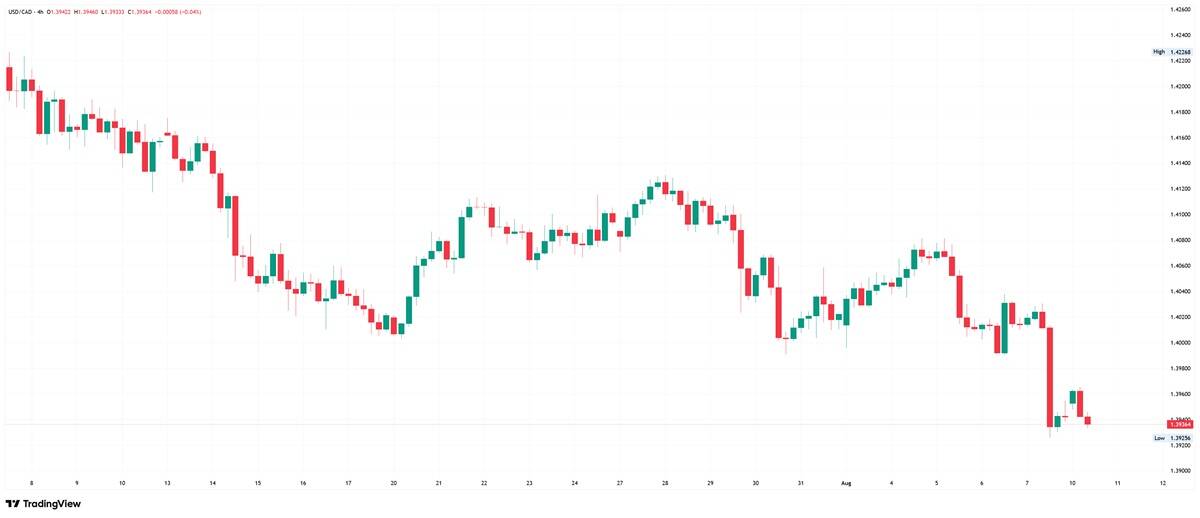
As you would expect, US Treasury yields bull-steepened in the immediate aftermath of the report, and the USD took a hit across the board – notable downside moves were seen in USD/JPY and USD/CAD, with the latter opening the door to short scalps, aided by strong Canadian jobs data released at the same time.

Thin Data Slate Today; RBA Decision in Focus Early AM Tomorrow
The macro calendar is thin today, with focus shifting to the RBA decision tomorrow, the all-important US July CPI inflation report on Wednesday, as well as UK June GDP numbers and US July PPI inflation out on Thursday.
For the RBA meeting – scheduled for 4:30 am GMT tomorrow – market consensus expects the bank to hold the cash rate at 4.35% for a second consecutive meeting. You will recall that the central bank has increased the cash rate by 75 bps this year.
Since June’s meeting, YY CPI inflation eased at the headline level from 4% to 3.8%, while the RBA’s preferred measure – YY trimmed-mean – edged higher in Q2 26 to 3.6%, from 3.5% – but was still below the market’s median estimate of 3.7%. This is above both the RBA’s 2-3% target band and the central bank’s May forecasts for year-end.
On the jobs front, unemployment fell to historic lows near 3.5% in 2022, and the labour market has gradually normalised since – drifting up to a 4.1-4.5% range over the past two-plus years, with June’s 4.4% near the top of that recent band. Employment also rose strongly in June, adding just shy of 80,000 new jobs, up from May’s reading of about 44,000.
With inflation cooling – albeit sticky – and the jobs market loosening, and with central bank rhetoric remaining two-sided, the RBA is unlikely to change policy, thereby shifting attention to communication and the SoMP. While language on inflation will be vital to monitor, for me the latter is more important.
As you may recall from the May SoMP, the RBA projected the cash rate to be at 4.7% by year-end, though the RBA’s YY trimmed-mean projection was 3.8% for June this year and 3.5% by the end of the year. However, as we now know, June’s trimmed-mean came in at 3.6%, which is below June’s projection and almost in line with the year-end estimate.
Therefore, I will be closely watching for a downward revision in both the trimmed-mean and the cash rate forecasts, which, of course, would be negative for the AUD. While this could be considered an ideal dovish scenario, another possibility is that the RBA will maintain a hawkish stance – likely leaving trimmed-mean and cash rate projections unchanged – amid still elevated underlying inflation; this would be AUD positive.
AUD/USD Price Forecast
Every new AUD/USD analysis as it publishes, today's technical signal and key levels, live price — on one page.
See all AUD/USD forecastsWritten by FP Markets Chief Market Analyst, Aaron Hill