
FTSE Frontier Status Takes Effect as NGX Tests Record Territory
The NGX All-Share Index, a comprehensive value-weighted Nigerian Exchange Group barometer that tracks the general market movement of all listed equities, reached a high of 250,156.80 points on Monday, September 21, a 3.35% move from the 242,226 low it hit a few days earlier. On that same day, Nigeria received an FTSE Russell status update, from Unclassified to Frontier Market status. The NGX’s market cap jumped to ₦162.39 trillion in the days leading up to the news, while year-to-date returns sit at 60.76%.
The index’s bullish climb was no surprise, as investors had been pumping money into it since Thursday, August 27, when FTSE Russell confirmed that Nigeria’s reclassification would take effect on September 21 after reviewing Nigeria’s transition to a T+1 settlement cycle. According to FinanceTracked, about ₦60 trillion in shareholder wealth has been created year-to-date, with market cap sitting below ₦100 trillion when 2026 opened, growing by more than 60% to where it is now. The real question for investors now is whether this massive growth signals that the FTSE Russell reclassification has already been priced in.

Passive Inflows Provide a Structural Bid, but Breadth Remains Narrow
The Nigerian Stock Exchange’s status upgrade by FTSE Russell comes with significant bullish advantages. For instance, more money will flow into the exchange from Global passive funds and frontier market ETFs that track FTSE indices through compulsory stock allocations. 31 Nigerian companies are deemed fit for FTSE Russell’s Frontier Index Series. These companies include large-caps like GTCO, Zenith Bank, MTN Nigeria, Dangote Cement, Seplat Energy, and First HoldCo, amongst others.
Investors are already moving. On Friday, September 4, at the end of the trading week, about 4.36 billion shares worth ₦210.33 billion changed hands on the exchange, marking a 74% increase from the previous week, according to the NGX weekly report. Notably, 82% of those transactions involved financial services stocks.
Concentration Risk Leaves the Rally Top-Heavy
One risk worth noting is the investment concentration of the exchange. About 87% of the NGX’s turnover in the first five months of 2026 was from local investors, while only 13% came from foreign investors. Also, a significant portion of funds that come into the NGX through the FTSE Russell’s Frontier Index Series are most likely going to be concentrated in the top 10 biggest names, instead of being spread evenly across the market. This means the index’s growth will be largely driven by the heavy weights while the smaller stocks lose momentum and may give back their gains. This concentration narrows the NGX’s growth potential to just a few names, meaning that a hit to those equities can send the index crashing.
CBN MPC Decision Adds a Second Catalyst
The Central Bank of Nigeria’s Monetary Policy Committee went against the majority expectations of the market on September 21 and 22, when it aggressively lowered the interest rate to 23% from 26.5%, a basis point cut of 350. This dovish decision was informed by the steady cooling of the price of consumer goods, as headline inflation in the country dropped for the third straight month to 15.39% year-on-year in August. Meanwhile, core inflation moderated to 13.29%.
Lower Rates Push Capital Out of Fixed Income
The CBN’s aggressive rate cuts are advantageous to equities, as the naira already strengthened to about ₦1,317 per dollar in September from its January high of about ₦1,450. Meaning that lower interest rates will squeeze the returns that fixed-income assets give and increase investor appetite for risk assets like stocks, as the opportunity cost of holding such assets becomes reduced.
When you take this development together with the FTSE reclassification, it points to a potential increase in the demand for Nigerian equities, as significant funds will rotate out of bonds into stocks and drive the NGX upwards.
Ascending Triangle Meets Record Resistance
A look at the NGX All Share Index on the daily timeframe reveals an ascending triangle pattern that traces as far back as April 2026, with price currently pressing the upper limit of the triangle near 251,237 points. There’s also a resistance band, sitting right next to the triangle’s upper limit, from 249,888 – 254,246. The ASI tested that band in May, reaching about 253,862 before falling back down to 224,314 in July. Price has since been compressed inside the triangle, failing to break out in either direction, as we approach the narrower end of the pattern.
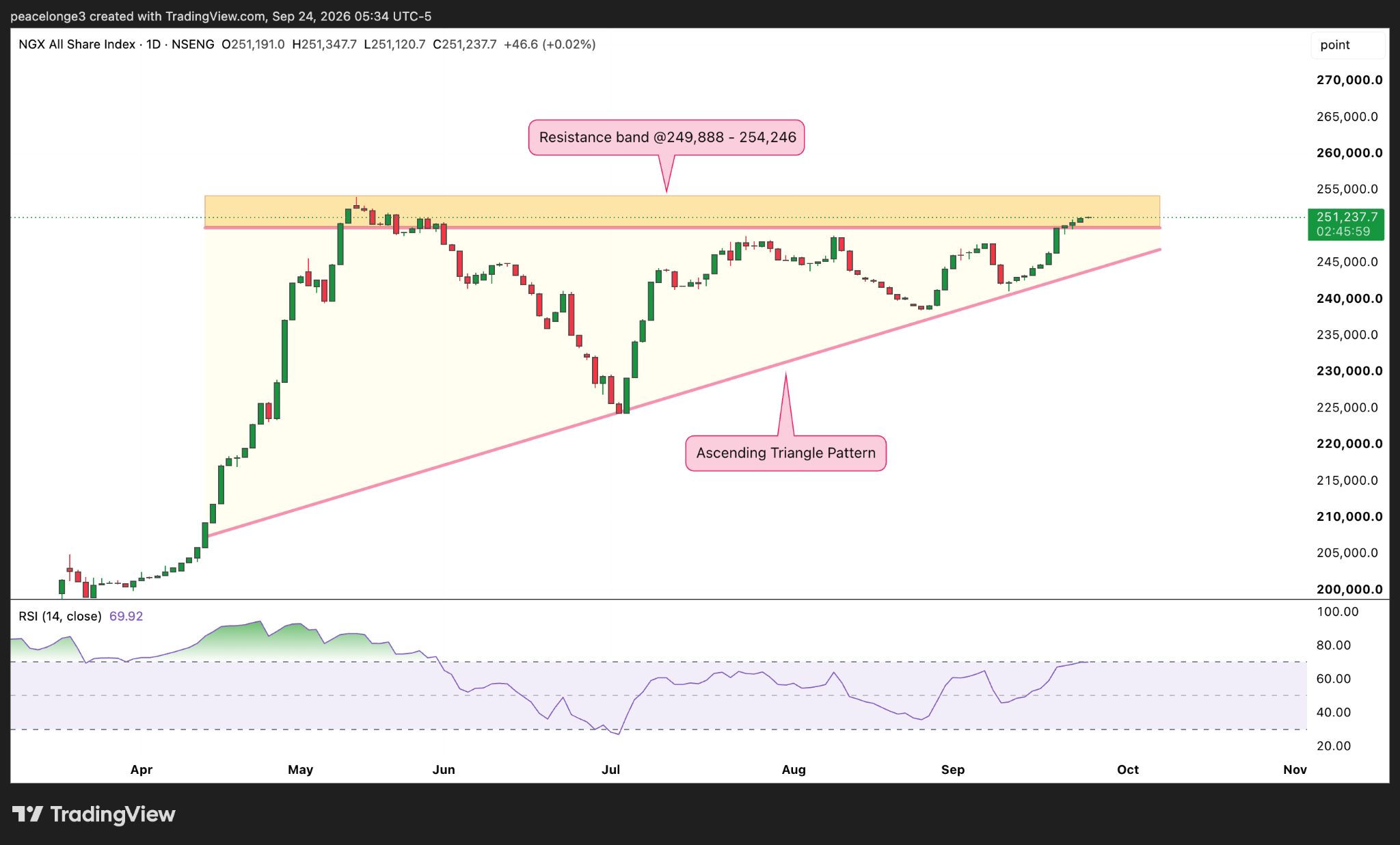
The RSI currently reads 69.92, which is significantly above the 50 average and about to enter the overbought zone past 70. Typically, this means we’re running out of room for bullish momentum. However, the recent FTSE reclassification and dovish CBN decision might be enough to push the NGX ASI higher into price discovery.
Breakout Levels and Downside Triggers
For the bullish thesis to be confirmed, we need to see a daily candle close above the 249,888 – 254,246 resistance band. A rejection of the band can send price back down to the lower trendline of the triangle near 244,060. A daily close below that level reinforces the bearish thesis and opens the pathway to the next significant support near 244,314 points.
The major risk for the NGX bulls is that foreign investments that come in as a result of the FTSE reclassification are smaller than what local investors have priced in, weakening the near-term impact of Nigerian stock listings on the Frontier Index Series. It is also worth noting that the ongoing Dangote IPO could pull significant funding out of the broader NGX listings in the near term, at least until the Dangote shares make it into the NGX later in November 2026.
For the bears, the main risk is the long-term impact of sustained foreign capital inflow into the NGX through mandatory allocations from funds that track the FTSE Frontier Index. These funds are required to build positions in the 31 Nigerian companies that are eligible for listing on the index. Hence, even if foreign inflows are smaller than what the market expects in the near term, the constant inflows over the long run will build into a significant inflow that favors the bulls.