Compression at Resistance Signals Decision Point
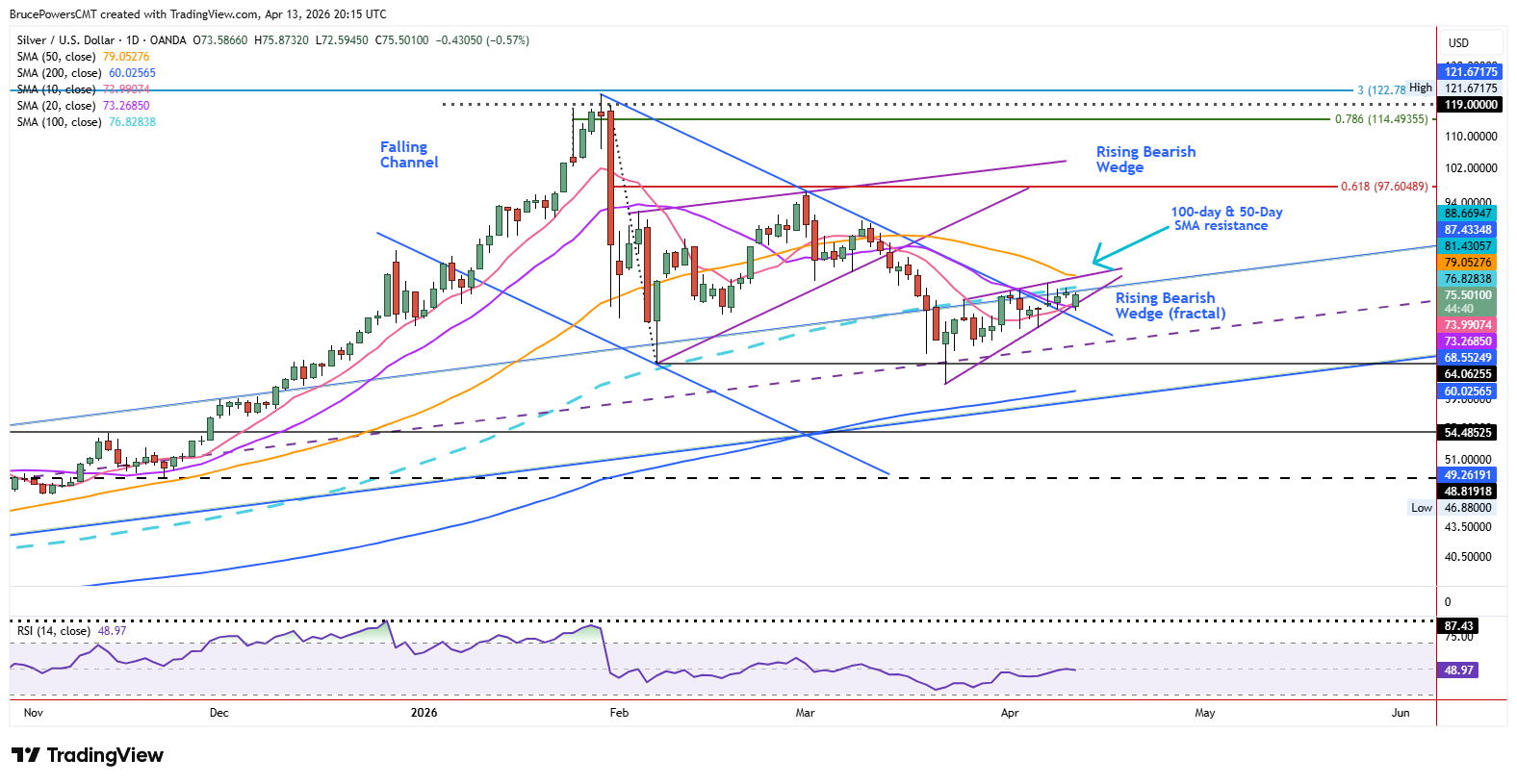
A small rising bearish wedge pattern has formed on the chart for silver, positioned near resistance at the 100-day and 50-day moving averages. This is a bearish trend continuation pattern, but it needs a decisive trigger to confirm. A failed breakdown was triggered earlier in Monday’s session with a drop below the lower rising boundary line and 10-day moving average, now at $73.98.
However, that move was quickly met by strong buying interest at the day’s low of $72.52, which was a four-day low. The bullish intraday recovery puts price in a position to close the session back above the breakdown levels and within the top third of the day’s range, reinforcing the ongoing consolidation within the wedge introduced at the start.

Trigger Levels Define Downside Risk
The low of the day provides a new short-term price level to trigger a bearish continuation of the rising wedge. That would precede a decline to the interim higher swing low of $69.81, which partly defines the lower boundary of the pattern. Key lower support is defined by the 200-day moving average at $60.02, which is rising. It will likely trend higher and approach the recent higher swing low at $61.01, which is a key structural support level.
Resistance Tests Hold Key to Invalidating Breakdown
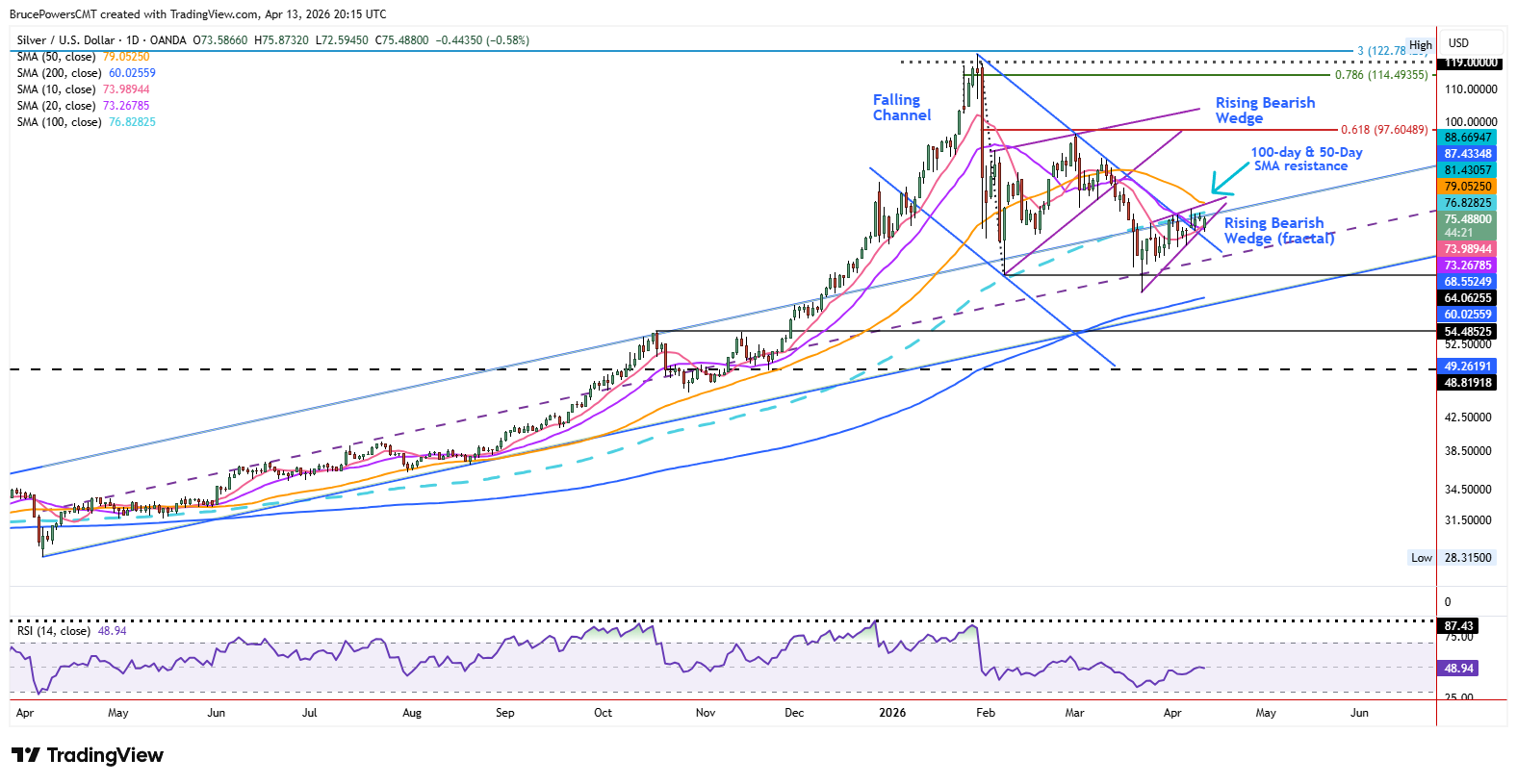
If a breakdown does not occur, then further consolidation within the parameters of the wedge can be expected. A sustained recovery of the 50-day moving average would be needed to indicate that the bearish wedge may not confirm with a breakdown. It is now around $79.05 and is testing the top boundary line of the wedge. Initial resistance of note remains near the 100-day moving average around $76.83. Although the 100-day line was reclaimed briefly after it failed as support on March 20, there has not yet been a daily close above it. If that occurs, it will provide a new sign of short-term strength.
Channel Confluence and Momentum Shift Ahead
There is also the potential for a recovery of resistance represented near the top boundary line of a rising channel. It takes on added significance since the 100-day average recently aligned with it. Once the 50-day average converges with the 100-day average, momentum should shift, either to the upside with a breakout or to the downside with a wedge breakdown.
If you’d like to know more about how to trade gold and silver, please visit our educational area.