Household Spending, Inflation, and the Bank of Japan
On Friday (June 7), household spending figures from Japan influenced buyer demand for the USD/JPY.
Household spending unexpectedly declined by 1.2% in April after rising by 1.2% in March. Economists forecast household spending to advance by 0.2%.
Furthermore, household spending was up 0.5% year-on-year after a decline of 1.2% year-on-year in March. Economists expected household spending to advance by 0.6%.
Downward trends in household spending could dampen demand-driven inflation and reduce investor expectations of a 2024 BoJ rate cut.
However, the BoJ will likely want to see longer-term trends in household spending to raise interest rates. Wage growth figures for April may increase disposable income. But, the Bank of Japan continues to send mixed signals vis-à-vis a second interest rate hike.
Bank of Japan board member Nakamura spoke on Thursday (June 6), predicting that inflation may not hit 2% until 2025. The BoJ needs the services sector and household spending to fuel demand-driven inflation to begin discussing rate hikes.
After the spring wage negotiations, household spending has remained lackluster, with the BoJ concerned about the effects of a weaker Yen on the economy.
Subdued private consumption could leave the Yen at current levels. Further weakening may force the BoJ to raise interest rates if economic indicators begin to reflect the impact of a weak Yen.
This week, Bank of Japan Deputy Governor Ryozo Himino raised concerns about the Yen, saying,
“Exchange-rate fluctuations affect economic activity in various ways. It also affects inflation in a broad-based and sustained way, beyond the direct impact on import prices.”
Comments from Deputy Governor Himino and board member Nakamura highlighted diverging focal points within the BoJ.

US Economic Calendar: The US Jobs Report in Focus
Later in the Friday session, the all-important US Jobs Report will warrant investor attention.
Economists forecast average hourly earnings to rise 3.9% year-on-year in May after an increase of 3.9% in April. Additionally, economists predict nonfarm payrolls to increase by 185k after rising by 175k in April. With economists expecting the unemployment rate to remain steady at 3.9%, weaker-than-expected numbers could fuel investor bets on a September Fed rate hike.
A deterioration in labor market conditions may affect wage growth and reduce disposable income. A fall in disposable income could force consumers to curb spending on non-essential items. Downward trends in consumer spending may dampen demand-driven inflation and enable the Fed to cut interest rates.
USD/JPY Price Forecast
Every new USD/JPY analysis as it publishes, today's technical signal and key levels, live price — on one page.
See all USD/JPY forecastsShort-term Forecast
Near-term trends for the USD/JPY will hinge on the US Jobs Report. A deterioration in US labor market conditions could raise investor bets on multiple 2024 Fed rate cuts and impact buyer demand for the USD/JPY. Investor expectations of multiple 2024 Fed rate cuts could bring sub-150 into play.
USD/JPY Price Action
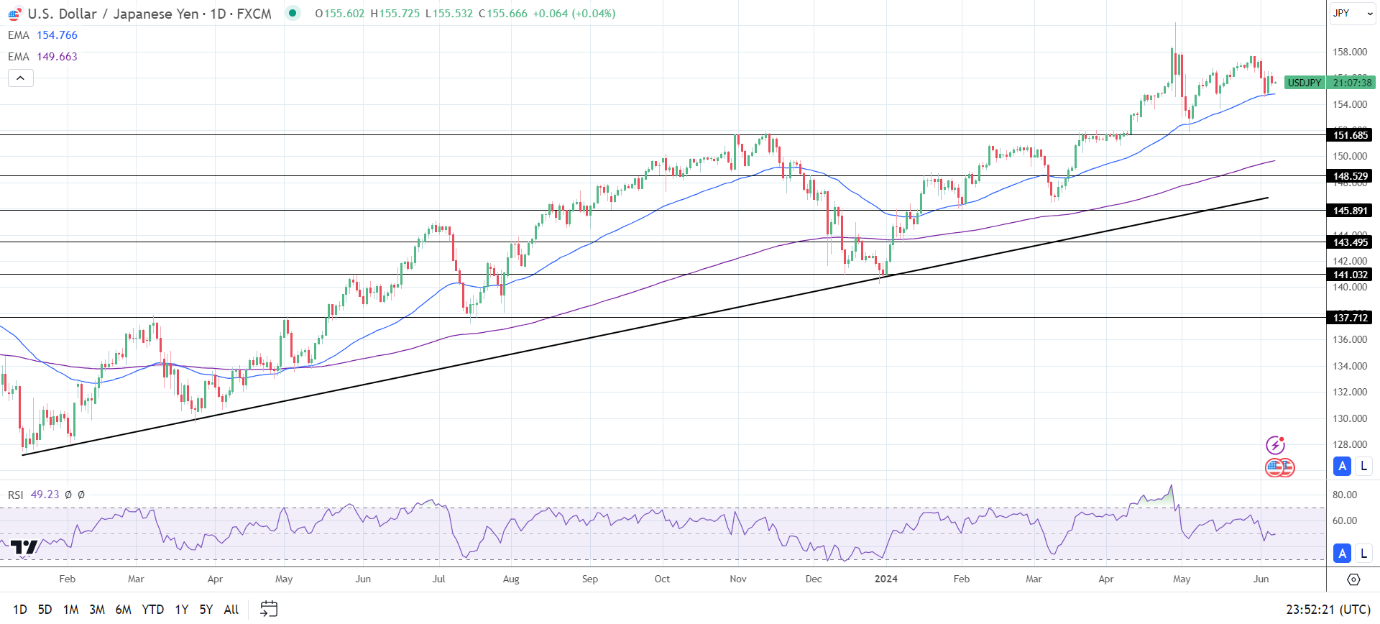
Daily Chart
The USD/JPY remained well above the 50-day and 200-day EMAs, confirming the bullish price trends.
A USD/JPY breakout from the 156.500 level would support a move toward the 158 level. Furthermore, a USD/JPY break above the 158 level could give the bulls a run at the April 29 high of 160.209.
Investors should monitor Bank of Japan commentary and consider the US Jobs Report.
Conversely, a USD/JPY break below the 50-day EMA into play could signal a fall toward the 151.685 support level.
The 14-day RSI at 49.23 indicates a USD/JPY fall to the 151.685 support level before entering oversold territory.