Cocoa fell year-over-year from its December 2024 high of about $12,602 per metric tonne to a low of about $2,888 in February 2026, a decline of more than 75%. By March, Cocoa’s price was sitting at a historic support zone, stretching as far back as 2020, between 2,981 and 2,753. Upon testing this zone, price bounced back upwards into the 6,185 – 6,418 area, where it met resistance and has kept rejecting since early June till now.
The Cocoa US daily chart shows price at 5,938 at the time of writing, down 2.21% for the day with a loss of about $134 per metric tonne.
The persistent price rejection at the 6,185 – 6,418 resistance zone is a problem for the bulls, as textbook price action signals that price usually falls after multiple failed attempts to break through a resistance band.
The RSI (14) reads 57.02 on the daily timeframe, which is fairly above average and down from early July’s overbought level of about 84. This drop in the RSI over the last month fits the narrative that Cocoa’s price is losing bullish momentum after encountering significant resistance.

The Bearish Flag Points Price Back Toward the Base
Another key pattern on the Cocoa US daily chart is a bearish flag that price has mostly filled. The flag stretches from the 2,981 – 2,753 support zone to the 6,185 – 6,418 resistance band. Price rejected the upper trendline of the flag in July in a simultaneous test of the resistance band’s upper line at 6,185. The current inability of price to break above that zone favors a bearish move to the downside.
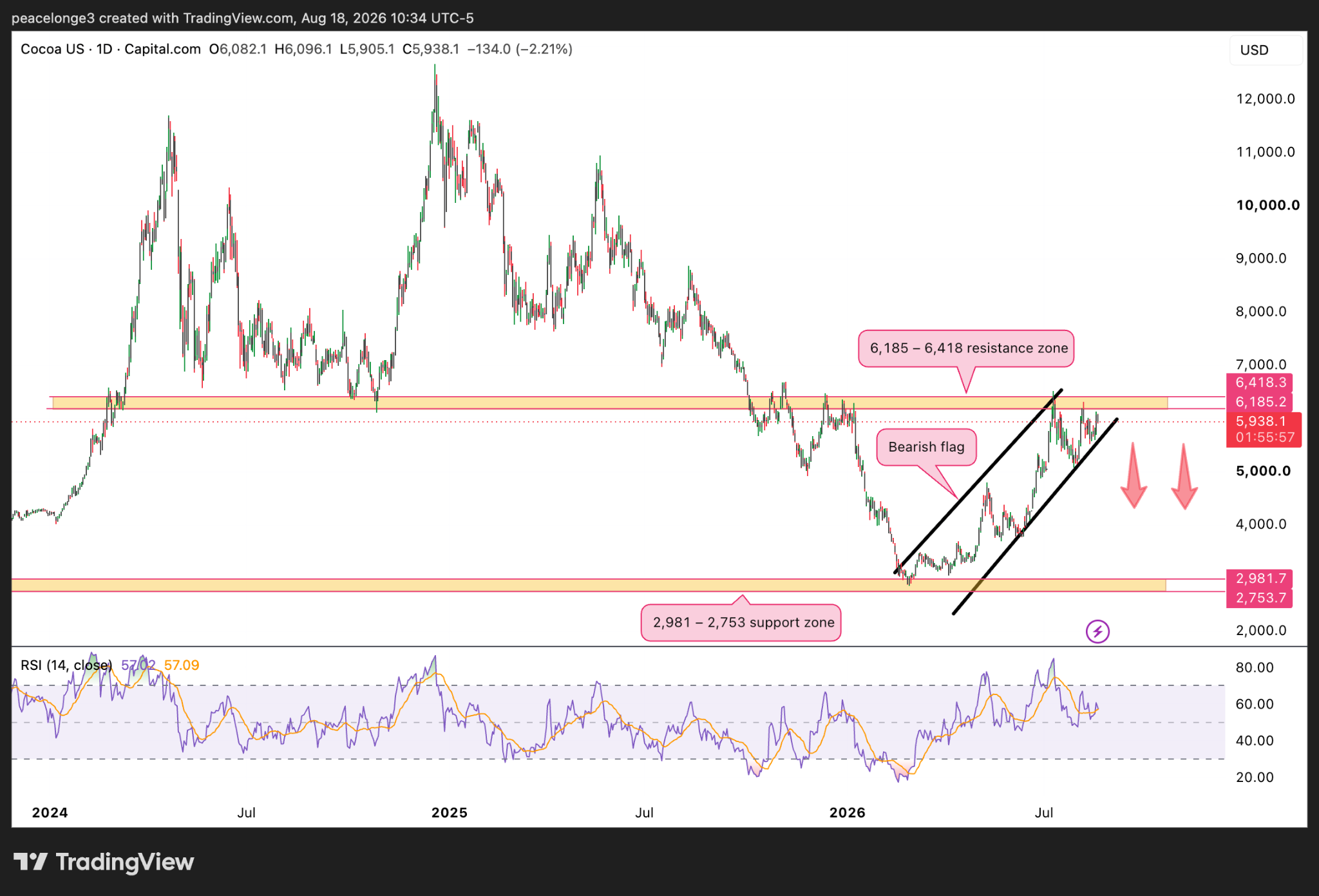
The bearish flag remains capped below the 6,185.2-6,418.3 resistance zone, with a break below the channel exposing the 2,981.7-2,753.7 support area. Source: TradingView.
If price breaks and closes below the bottom trendline of the flag at about 5,355 on the daily timeframe, there is a clear downward path to 2,981.
For the bulls to win this current price tussle, there needs to be a decisive daily close above 6,418 that invalidates the bearish flag, clearing the supply band, and reopening the upward path to the 7,000 psychological level.
The Supply Squeeze Risk That Could Flip the Setup
The major risk to the bearish thesis is a fundamental one. Reports show that there is a possible upcoming global deficit in the supply of cocoa, and any slight threat to the harvest output of the crop’s major producers (like Ghana and Côte d’Ivoire) would result in increased seller greed and buyer desperation; causing buyers to push cocoa price higher in an attempt to outbid themselves.
A sudden, aggressive price pump can easily create a short squeeze that sends price even higher, as short-sellers are forced to buy back cocoa contracts to mitigate their losses.
What Drives Cocoa Next: A Tight Supply Floor Against a Heavy Chart
The fundamental analysis of cocoa reveals a further struggle for the crop’s price.
The current supply condition of cocoa is good, as farmers from Ivory Coast shipped over 2 million tonnes of the crop for export over the last 10 months, from October 1, 2025, to August 2, 2026. This export volume is an uptick of 20% from the same period a year earlier. And more cocoa arriving at the ports pressures price lower, which is consistent with the current price action seen on the daily chart.
Cocoa investories back up the current supply story as well. Stockpiles monitored by the Intercontinental Exchange (ICE) climbed to a two-year high of 3,384,965 bags as of August 5 before settling back down to around 3,332,604 bags. This current amount of cocoa reserves helps keep supply flowing and prices lower.
Why the 2026/27 Crop Outlook Keeps a Floor Under Price
However, while the present supply of cocoa is good and steady, the future outlook for the next harvest is shaky. Ghana’s regulator, COCOBOD, expects a decline of at least 16% in the nation’s output during the 2026/27 season. This projected decline is as a result of El Niño risk, heavy rainfall in May and June, swollen shoot crop disease, illegal mining activities, and ageing farms with cocoa trees that have exceeded their peak production years.
According to COCOBOD’s July 30 guidance, 2026/27 harvest is estimated to be as low as 450,000 to 550,000 tonnes, which is significantly lower than the projected 2025,26 output of 750,000 tonnes.
This output decline is not unique to Ghana alone. According to a report on CNBC Africa, Ivory Coast, which is the world’s largest cocoa producer, is expected to have a decline of more than 10% in its next season’s output.
Trading firms have been responding to these harvest expectations. On July 29, StoneX cut its 2026/27 global surplus estimate from 149,000 tonnes to just 25,000 tonnes, while Transgraph trimmed its own to 80,000 tonnes from 415,000 tonnes. It is worth noting that a shrinking harvest creates a fundamental safety net to stop prices from crashing too deeply, as buyers will naturally step in to buy the crop for cheap if prices get low.
Final Takeaway
In the near-term, the dollar is best positioned to swing the cocoa trade in an upward direction. If the dollar index drops to a multi-month low, it increases demand for cocoa and sends its price up, as dollar-priced commodities become cheaper for buyers trading in other currencies when the dollar weakens.
The takeaway is straightforward: the current cocoa season’s strong supply and heavy inventory keep prices lower, creating a bearish pathway that supports a move to the 2,981 – 2,753 band. The forward outlook, however, which predicts an incoming 2026/27 decline in cocoa output and reserves, can favor the bullish thesis. A weaker dollar also encourages more buying action, which can send cocoa prices higher.
If you’re interested in adding cocoa contracts to your investment portfolio, keep your eyes on the next port-arrival reports and weather updates to know the performance of upcoming cocoa harvests.